Intestinal Blockage in Cats: Symptoms and When To Call Your Vet



dardespot/E+ via Getty Images
Is your cat vomiting and not keeping anything down?
They may be suffering from an intestinal blockage. An intestinal blockage in cats occurs when something they eat gets stuck in their intestines and won’t pass.
Let’s take a closer look at what causes intestinal blockages, what to look for, and when to get your cat to the vet.
Key Takeaways
- An intestinal blockage in cats occurs when a foreign object, such as string, a hair tie, or a small toy, becomes stuck in the intestines.
- Common signs of an intestinal blockage in cats include vomiting, loss of appetite, lethargy, and difficulty passing stool. Most intestinal blockages require surgery.
- Intestinal blockages in cats are medical emergencies. If your cat is vomiting, not eating, or acting lethargic, take them to a veterinarian immediately.
What Is an Intestinal Blockage in Cats?
An intestinal blockage in cats occurs when your cat eats something that gets stuck and can cause distress.
It could be a piece of a toy or even random objects, like a hair tie. Cats are very drawn to string-like objects, such as ribbon, dental floss, or string, but these can become dangerous quickly.
When the foreign object is swallowed, it travels down the esophagus to the stomach. From there, it moves into the small intestines. This is a common location for things to lodge as the diameter is much smaller than the stomach. Once the object becomes stuck, cats start to feel sick.
Intestinal blockages in cats are considered a medical emergency. If your cat is vomiting acutely (several times a day) and is not keeping food or water down, they should be seen immediately by a vet.
Symptoms of an Intestinal Blockage in Cats
Common symptoms of intestinal blockage in cats include:
- Vomiting
- Lack of appetite
- Lethargy
- Tense, painful belly (their stomach will be tight to the touch)
- Behavior changes (hiding, growling)
- Straining to defecate or absent bowel movements
Causes of an Intestinal Blockage in Cats
Intestinal blockages in cats are caused by a cat eating something that is too large to pass through their GI tract, or a string-like object that gets caught and tangled in their intestines.
Normal food passes through the intestines by a rhythmic contraction of the smooth muscle layer called peristalsis. When something is lodged and won’t move, the ingesta and gas back up causing the bowel wall to stretch.
Linear—or string-foreign bodies—are very dangerous. When a cat eats a string (or ribbon, tinsel, dental floss, etc.) part of it will move forward in the intestines, while the other part may remain behind.
The end of the string can get tangled under the tongue, in the stomach, or even in another loop of bowel. With the string ends trapped in different parts of the gastrointestinal tract, the intestines are pulled together and will bunch or accordion on themselves. This can rapidly lead to compromised blood supply and death of tissue.
Young cats tend to be more playful and likely to eat nonfood items, so they carry a higher risk of intestinal foreign bodies.
Rarely, cats can develop an intestinal blockage from a large intestinal mass. Gastrointestinal lymphoma is one of the more common GI cancers seen in cats and is more prevalent in senior cats.
Complete bowel obstructions from bowel cancer are not common, and most affected cats are more likely to develop chronic GI problems (like diarrhea or vomiting).
How Veterinarians Diagnose an Intestinal Blockage in Cats
If an intestinal blockage in cats is suspected, your vet will start with a thorough physical exam. They may recommend blood work, urine, and feces testing to rule out other common causes of GI symptoms.
X-rays are often the most helpful in determining what is going on with the gastrointestinal tract.
When a cat has an intestinal blockage, the intestines will distend with gas behind the blockage as the gas accumulates with nowhere to go. This can lead to hairpin turns as bowel loops twist and float upward in the gut.
While X-rays are helpful, determining whether a cat needs surgery can be tricky.
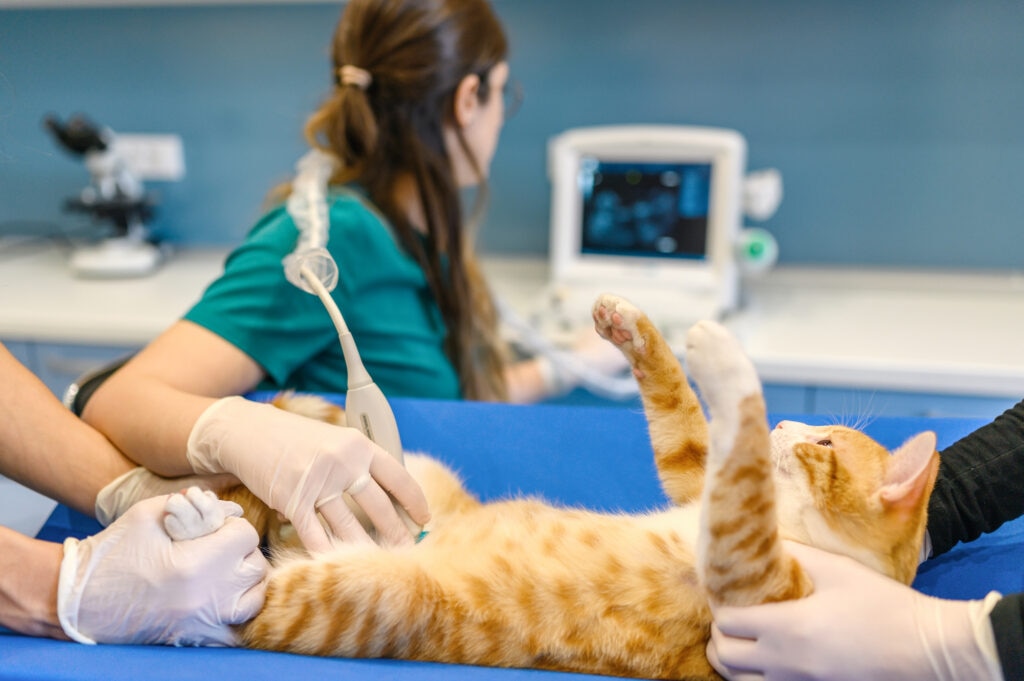
Your vet may recommend other tests, like advanced imaging. An abdominal ultrasound or a GI scope procedure may be discussed.
Sometimes exploratory surgery is recommended if an intestinal blockage is suspected. Even if there is not an object stuck in the intestines, it can still yield answers. Gastric or intestinal biopsies can be taken while in surgery to determine the cause of repeat vomiting and/or diarrhea.
Your vet will want to know how long your cat has had GI distress and if they’re still eating or not.
If you have a multi-cat household, separating the sick pet will allow you to be more knowledgeable about when and how much they’re eating and what their output looks like.
Treatment of an Intestinal Blockage in Cats
Intestinal blockages in cats are treated surgically.
To relieve the blockage, your cat’s vet will open their abdomen and look at every part of the stomach and intestines. The object blocking the intestines will be removed and the GI tract will then be sutured and flushed.
Sometimes foreign material, especially linear/string foreign bodies, may require a portion of the intestines to be removed. This is more common when they have been sick for a while and the blockage has impaired blood flow to the intestines long enough to result in death of tissue. This can occur in as little as one to two days.
Following surgery, your cat may be prescribed pain medications, like Onsior or gabapentin.
Sometimes antibiotics, like Clavamox or marbofloxacin, may be prescribed post-op.
Some cats may require anti-nausea medication. Meds like maropitant or metoclopramide may be prescribed.
Recovery and Management of an Intestinal Blockage in Cats
Recovery time can vary depending on what part of the intestines were involved and how extensive the surgery was. Usually, the healing time after an intestinal blockage in cats is about 10 to 14 days.
Small obstructions that were caught quickly and only required a smaller incision are quicker to heal. Affected cats may feel better after just a day or two and immediately act like themselves again when they go home.
Make sure to restrict your cat’s activity while they’re healing. Unfortunately, there’s a language barrier, so we can’t simply say to the cat, “You just had major surgery so you need to rest.”
As the pet parent, you will be responsible for preventing your cat from running, jumping, and playing. Consider talking to your vet about a mild sedative, like gabapentin, if this is a struggle.
Gabapentin helps with both pain and sedation in cats.
More extensive surgery, like when a portion of the intestines is removed or if the GI tract needs to be opened in multiple places, may require longer hospital stays and slower healing.
These kitties may be prescribed a bland diet that is gentle on the GI tract during recovery.
Probiotics may also be recommended to support gut health.
Be sure to keep your cat from licking or chewing at their incision site until the sutures or staples have been removed. Consider a recovery collar or recovery suit for two weeks after surgery.
Prevention of an Intestinal Blockage in Cats
Avoid leaving strings or small cat toys out for your cat to play with unsupervised. If it fits in their mouth, it should not be left out when you are not watching them.
Keep all hair ties, ribbon, tinsel, and other tempting items out of reach from your cat.
If your cat is vomiting, not eating, or acting lethargic, get them to a veterinarian right away.
It’s a much easier surgery and safer recovery for the vet to remove a foreign object from the stomach than the intestines.
Intestinal Blockage in Cats FAQs
How long can a cat survive with intestinal blockage?
Intestinal blockages can become life-threatening quickly. Without surgery, affected cats can die in a matter of days.
Can a cat still poop if it has a blockage?
A cat can still pass feces that is past the blockage. After that bowel movement, they are less likely to have any more stools until the blockage is resolved. Scant diarrhea and posturing to poop may still occur.
Is an intestinal blockage in cats an emergency?
Yes, an intestinal blockage in cats is absolutely an emergency.
What are the signs of an intestinal blockage in a cat?
The most common signs of an intestinal blockage in cats are vomiting, not eating, and lethargy.
Will a cat eat if they have an intestinal blockage?
Cats may eat initially but will often go off food when they have an intestinal blockage.
How do veterinarians check a cat for an intestinal blockage?
Vets will palpate the abdomen and take X-rays if an intestinal blockage is suspected. They will also likely run blood work and may recommend other tests.
Can an intestinal blockage in a cat clear on its own?
Intestinal blockages usually require surgery to resolve.
How is an intestinal blockage in cats treated?
Intestinal blockages are treated surgically with the vet going into the affected cat's abdomen to physically remove the blockage.
How long does it take a cat to recover from an intestinal blockage?
After surgery, recovery time is usually 10–14 days.
What commonly causes intestinal blockages in cats?
Intestinal blockages in cats are commonly caused by ingesting nonfood items, like strings, hair ties, ribbons, pom-pom balls, or small toys.
Can intestinal blockages in cats be prevented?
Keeping all small nonfood items up and tucked away from your cat’s reach can reduce their risk of getting an intestinal blockage.


