Inguinal Hernia in Dogs: Symptoms and Treatment

Wirestock/iStock / Getty Images Plus via Getty Images
An inguinal hernia in a dog occurs when abdominal contents protrude through the inguinal ring, an opening in the muscle wall in the groin area. This can cause a visible or palpable bulge or swelling in the groin.
Many inguinal hernias are uncomplicated, but a hernia can become a surgical emergency if organs become trapped and their blood supply is compromised.
Key Takeaways
- An inguinal hernia in a dog can appear as a bulge or swelling on one or both sides of the groin.
- Inguinal hernias can be uncomplicated or complicated. Complicated hernias can become life-threatening.
- Hernias can be congenital or acquired, with risk factors including trauma, obesity, and pregnancy.
- Complicated inguinal hernias require surgical repair, while some small or uncomplicated hernias may only require monitoring.
What Is an Inguinal Hernia in Dogs?
An inguinal hernia in a dog occurs when internal organs, such as the intestines, bladder, or uterus, protrude through the inguinal ring—an opening in the muscle wall in the groin area—and through the abdominal wall and muscle layer.
This protrusion can appear as a bulge or swelling just below the skin.
In most dogs, the hernia can be seen or felt on one or both sides of the groin area. The contents may be able to be pushed back into the opening by a veterinarian.
Inguinal hernias can occur in both dogs and cats. Inguinal hernias in puppies can also occur as congenital defects, meaning they are born with them.
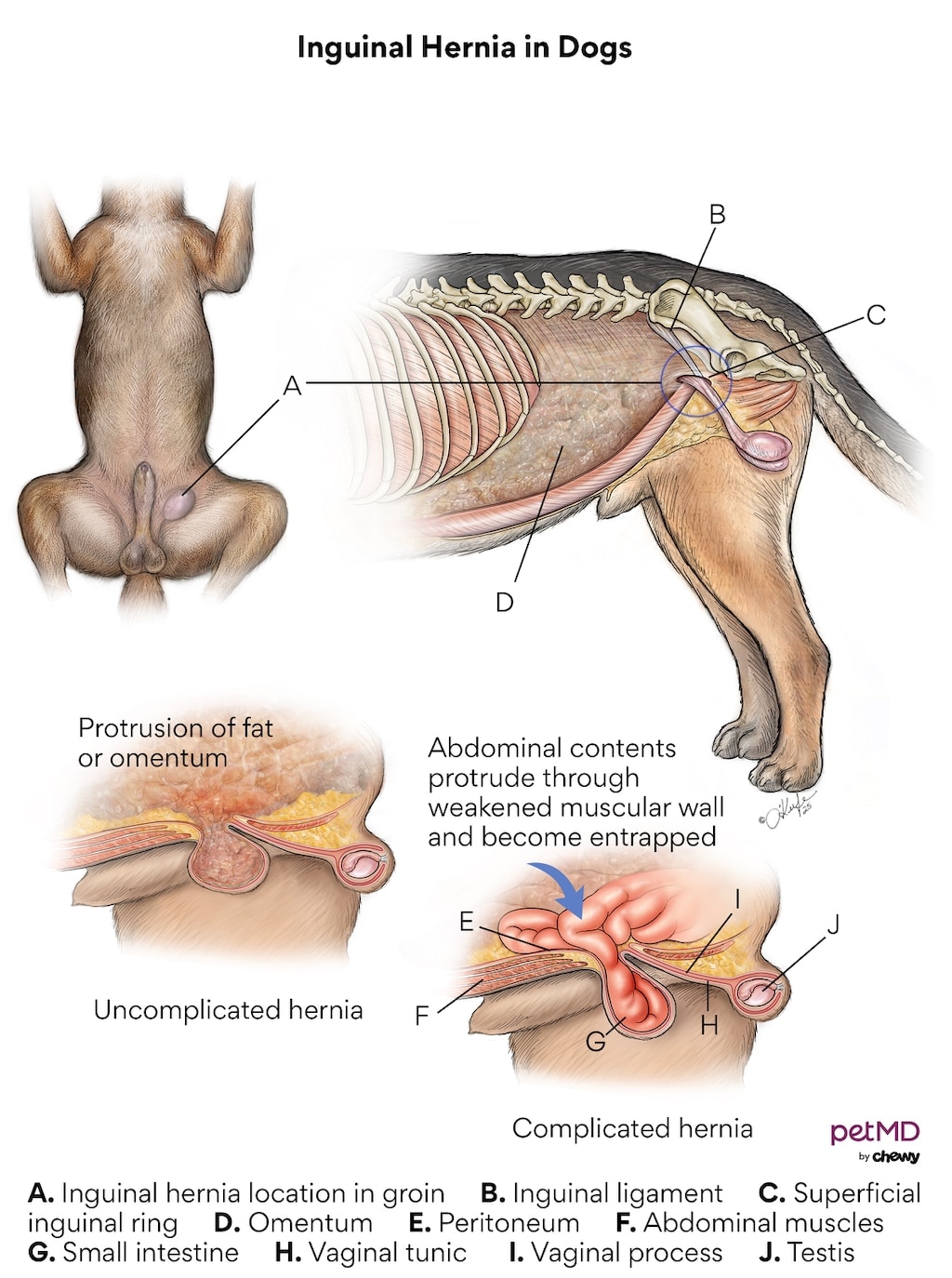
Download the medical illustration of inguinal hernias in dogs.
Inguinal hernias in dogs are common and may not always be a cause for immediate alarm.
However, if organs become trapped in the opening, their blood supply can become compromised or cut off, leading to strangulation and death of the organ and potentially life-threatening complications.
This can be painful for the dog and is considered a surgical emergency.
Types of Inguinal Hernias in Dogs
There are two types of inguinal hernias in dogs: uncomplicated and complicated.
Uncomplicated Inguinal Hernias
An uncomplicated inguinal hernia may involve a smaller defect with little to no protrusion of abdominal contents or protrusion of only fat or omentum (a membrane of tissue that covers the abdominal organs).
Most inguinal hernias are uncomplicated and cause no symptoms other than swelling in the groin area.
Complicated Inguinal Hernias
A complicated inguinal hernia occurs when contents of the abdominal cavity pass through the opening and become entrapped.
If abdominal contents such as the bladder, a loop of intestine, or the uterus become entrapped, the situation can become life-threatening.
What Are the Symptoms of an Inguinal Hernia in Dogs?
The most noticeable symptom of an inguinal hernia in a dog is swelling in the groin area. Signs vary depending on whether the hernia is uncomplicated or complicated.
Uncomplicated Inguinal Hernia Symptoms
Symptoms of an uncomplicated inguinal hernia in dogs may include:
- A soft, non-painful swelling in the groin area, which may occur on one or both sides of the body
Complicated Inguinal Hernia Symptoms
Symptoms of a complicated inguinal hernia in dogs may include:
- Swelling in the groin area, which may become painful and warm to the touch
- Vomiting
- Frequent attempts to urinate
- Bloody urine
- Lack of appetite
- Depression
- Abdominal pain
- Retching or attempting to vomit
- Straining to defecate
- Painful urination or defecation
- Fever
- Lethargy
- Localized bruising
What Causes Inguinal Hernias in Dogs?
Inguinal hernias in dogs may be acquired (not present at birth but developing later in life) or congenital (present at birth). Factors that may predispose a dog to an inguinal hernia include trauma, obesity, pregnancy, and certain medical conditions.
Acquired Inguinal Hernias
Factors that may predispose a dog to an acquired inguinal hernia include trauma, such as blunt force trauma, getting hit by a car, or bite wounds; obesity; and pregnancy due to increased abdominal pressure.
Older, intact (not spayed) female dogs are more at risk for acquired hernias due to anatomical and hormonal factors. Estrogen can weaken the tissue.
Congenital Inguinal Hernias
Young male dogs are more at risk for congenital inguinal hernias, especially breeds such as:
- Pekingese
- Cairn Terriers
- West Highland White Terriers
- Retrievers, including Labrador Retrievers and Golden Retrievers
- Cocker Spaniels
- Dachshunds
Other Risk Factors for Inguinal Hernias
Nutritional and endocrine conditions can also predispose dogs to inguinal hernias, including Cushing's disease, diabetes, and certain rectal diseases.
How Are Inguinal Hernias in Dogs Diagnosed?
Inguinal hernias in dogs can usually be diagnosed during a physical examination by identifying the swelling caused by the hernia. Additional testing, such as fine needle aspiration (FNA), X-rays, or an abdominal ultrasound, may be used when needed.
Physical Examination and Medical History
Your veterinarian will examine the swelling caused by the hernia. It's important to tell your veterinarian if your dog is pregnant or has been pregnant and whether she is currently being treated for other comorbidities, such as diabetes or Cushing's disease.
Fine Needle Aspiration
Fine needle aspiration of the hernia contents may be performed for confirmation, but the procedure carries a risk.
X-Rays and Ultrasound
Contrast radiographs (X-rays) or an abdominal ultrasound may be needed to determine which abdominal contents, if any, are entrapped.
How Are Inguinal Hernias in Dogs Treated?
Treatment for an inguinal hernia in a dog depends on the size and severity of the hernia. Complicated inguinal hernias require surgical repair, while a small or uncomplicated hernia may not require treatment and may instead be monitored by your veterinarian.
Inguinal Hernia Surgery
Treatment of inguinal hernias in dogs may involve surgical correction of the opening and replacement of abdominal contents back into the abdomen if necessary. The edges of the opening are often surgically debrided and closed with a permanent type of suture.
Surgical mesh may be necessary if the defect is exceptionally large.
Complicated inguinal hernias require surgical repair. Dogs can often be spayed or neutered at the same time to help prevent recurrence.
Depending on the severity, portions of the intestines may need to be surgically removed.
Monitoring an Uncomplicated Inguinal Hernia
If the defect is small or uncomplicated, treatment may not be needed. Your veterinarian may recommend monitoring your dog's hernia for:
- Swelling
- Changes in size
- Changes in appearance
- Development of acute symptoms
Pain Medication After Surgery
Your veterinarian may send home pain medications such as gabapentin or tramadol, as well as an anti-inflammatory medication such as carprofen, deracoxib, or meloxicam.
Give all medications as directed by your veterinarian. Do not give your dog any human or over-the-counter pain medications.
Dogs often rebound quickly after this procedure. Giving pain medication helps the healing process and improves recovery time.
Most dogs undergoing this type of surgery rarely require antibiotics.
Protecting the Incision
A recovery cone can help protect your dog's incision and allow it to heal without complications.
When properly fitted, the cone should allow you to fit a couple of fingers through the base, and the collar should extend past your dog's nose.
Alternatively, a recovery suit or similar clothing can be used to protect the incision and provide comfort, but it should be kept clean and routinely laundered.
Do not remove the recovery cone or surgical suit unless your dog is supervised or as directed by your veterinarian.
How Much Does Inguinal Hernia Surgery Cost for Dogs?
Inguinal hernia surgery (herniorrhaphy) for dogs may cost anywhere from $400 to $8,000 or more, depending on the type of hernia present. A complicated herniorrhaphy can be more expensive.
Some pet insurance companies may cover some or all of the cost unless specifically stated otherwise in their terms and conditions.
Alternative payment options may include applying for CareCredit® or setting up a payment plan, if available.
Find a CarePlus insurance plan to match your pet’s needs
Learn about CarePlus, insurance plans with exclusive Chewy benefits


Recovery and Management for Inguinal Hernias in Dogs
Recovery after inguinal hernia surgery in dogs usually includes a two-week confinement period with restricted activity and careful monitoring of the surgical incision.
Activity Restrictions After Surgery
Follow your veterinarian's postoperative (aftercare) instructions, which usually include a two-week confinement period with:
- Limited exercise
- No jumping
- No running
- No rough play with others
If your dog is active during this confinement period, it could lead to dehiscence, or breakdown of the surgical repair. This may require additional treatment or surgery.
A suitable place for your dog to rest and recover is their crate with padded, comfortable bedding or a small room closed off with a gate.
Caring for the Incision
Don't bathe your dog during recovery or allow the incision site to become wet. Do not leave your dog unattended for at least the first 24 hours after surgery.
Keep the incision clean and dry and inspect it at least once daily. Watch for any changes in its appearance that could be a sign of infection.
When To Seek Veterinary Attention
Seek veterinary attention immediately if you notice:
- Redness or changes in color
- Any type of discharge, including clear, red (bloody), white (pus), or a mixture
- Odor
- Swelling
- Heat coming from the incision
- Tenderness when touched
- Excessive bruising (mild bruising may be noted at first but should improve daily)
- Loose or missing stitches or staples
- Puckering or gaping of the incision
How To Prevent Inguinal Hernias in Dogs
Ways to help prevent inguinal hernias in dogs include not breeding dogs with hereditary hernias, having puppies checked for hernias during early veterinary visits, minimizing trauma, and keeping your dog at a healthy body weight.
- Avoid breeding dogs with hernias: Because inguinal hernias in dogs can be hereditary, dogs with hernias should not be bred.
- Have puppies checked early: Have your puppy checked during their first few veterinary appointments to see if a hernia can be felt. If detected early, hernias can be corrected sooner and prevent future health issues.
- Minimize trauma: Puppy-proof your home and monitor play behavior. Keep your dog on a leash when outside to minimize trauma and inguinal herniation as a complication.
- Maintain a healthy body weight: Because obesity is a risk factor, keep your dog at a healthy body weight with proper nutrition and exercise.
- Spay female dogs: For female dogs, it's best that they are spayed—not only as a preventive measure against hernias, but for other life-threatening conditions as well.
Inguinal Hernia in Dogs FAQs
What does an inguinal hernia look like on a dog?
An inguinal hernia in a dog typically looks or feels like a bulge or swelling in the groin area. It may occur on one or both sides of the body. An uncomplicated hernia may be soft and non-painful, while a complicated hernia may become painful and warm to the touch.
Is an inguinal hernia in a dog an emergency?
An uncomplicated inguinal hernia may not require immediate treatment.
However, if abdominal organs become trapped in the opening, their blood supply can become compromised or cut off. This can lead to life-threatening complications and is considered a surgical emergency.
Do inguinal hernias in dogs require surgery?
Complicated inguinal hernias require surgical repair. If the hernia is small or uncomplicated, treatment may not be needed, but your veterinarian may recommend monitoring it for swelling, changes in size or appearance, or the development of acute symptoms.
Can puppies be born with inguinal hernias?
Yes. Inguinal hernias in puppies can be congenital, meaning they are present at birth. Young male dogs are more at risk for congenital inguinal hernias, particularly certain breeds.


