Cushing’s Disease in Dogs: What It Is and How Vets Treat It


FatCamera/E+ via Getty Images
Cushing’s disease in dogs is a hormonal disorder caused by too much cortisol in the body. Common symptoms include increased thirst and urination, increased appetite, excessive panting, hair loss, muscle loss, and a pot-bellied appearance.
Cushing’s disease—also called hyperadrenocorticism or Cushing’s syndrome—most often affects middle-aged and senior dogs. While most cases require lifelong management, treatment can help control symptoms and maintain a good quality of life.
Key Takeaways
- Cushing’s disease in dogs develops when there is too much cortisol in the body, usually because of a tumor affecting the pituitary or adrenal glands.
- Common symptoms include increased thirst, urination, and appetite; excessive panting; a pot-bellied appearance; muscle loss; hair loss; and recurring skin problems.
- Veterinarians diagnose Cushing’s disease based on a dog’s symptoms, medical history, physical exam, routine lab work, imaging, and specialized hormone testing.
- Treatment depends on the cause and may include medication, surgery, or radiation therapy.
What Is Cushing’s Disease in Dogs?
Cushing’s disease in dogs occurs when the body is exposed to excessive amounts of cortisol over time.
Cortisol is a steroid hormone that plays an important role in metabolism, the stress response, immune function, and other normal body processes. Problems develop when cortisol levels remain too high for too long.
Two glands are particularly important in Cushing’s disease:
- Pituitary gland: Located at the base of the brain, the pituitary gland produces adrenocorticotropic hormone (ACTH), which tells the adrenal glands to produce cortisol.
- Adrenal glands: Located near the kidneys, the adrenal glands produce cortisol in response to signals from the pituitary gland.
Normally, the body carefully regulates how much cortisol is produced. With Cushing’s disease, this feedback system is disrupted, resulting in excessive cortisol exposure.
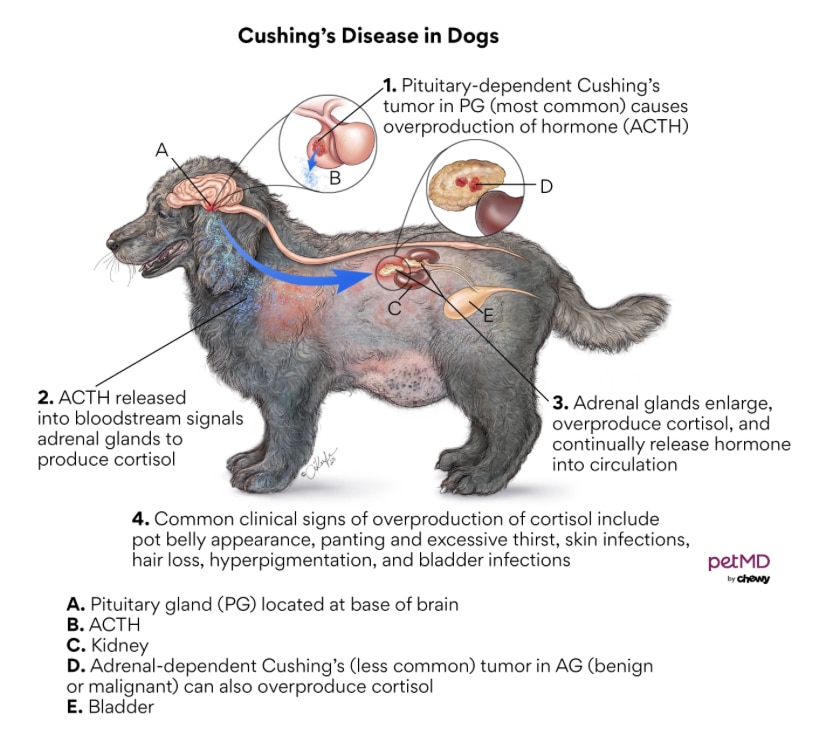
Click here to download this medical illustration.
Types of Cushing’s Disease in Dogs
There are two main forms of naturally occurring Cushing’s disease in dogs: pituitary-dependent and adrenal-dependent hyperadrenocorticism.
A third form, called iatrogenic Cushing’s disease, can develop after prolonged exposure to corticosteroid medications, like prednisone or dexamethasone.
Pituitary-Dependent Cushing's Disease
Pituitary-dependent hyperadrenocorticism is the most common form of Cushing’s disease in dogs, comprising around 80–85% of cases.
It develops when a tumor in the pituitary gland produces too much ACTH. The excess ACTH continually signals the adrenal glands to produce cortisol.
Advanced imaging such as a CT scan or MRI may be used when veterinarians need to evaluate the pituitary gland, particularly when a larger pituitary tumor is suspected or advanced treatment is being considered.
Adrenal-Dependent Cushing's Disease
Adrenal-dependent hyperadrenocorticism occurs when a tumor develops in an adrenal gland and produces excessive cortisol.
Around half of adrenal tumors are benign (non-cancerous), while the other half are malignant (cancerous).
Malignant adrenal tumors may invade into nearby tissues or spread to other parts of the body (metastasize).
Abdominal ultrasound or CT imaging may be used to evaluate the adrenal glands and help determine whether surgery is an appropriate treatment option.
Symptoms of Cushing’s Disease in Dogs
The most common symptoms of Cushing’s disease in dogs include increased thirst, increased urination, increased appetite, and excessive panting.
These changes often develop gradually, which means they can initially be mistaken for normal signs of aging.
Early signs of Cushing’s disease can include:
- Increased thirst
- Increased urination or urinary accidents
- Increased appetite
- Excessive panting
Other symptoms can include:
- Pot-bellied appearance
- Muscle weakness or muscle loss
- Lethargy
- Thinning skin, particularly on the belly and sides
- Hair loss, usually symmetrically on the trunk of the body
- Recurring skin infections
- Calcified or hardened areas of skin, often on the neck, back, armpits, and/or groin
A dog with Cushing’s disease may appear to gain fat around the abdomen while simultaneously losing muscle elsewhere in the body.

When Should You Call Your Veterinarian?
Schedule a veterinary appointment if your dog begins drinking or urinating significantly more than usual, develops a noticeably increased appetite, pants excessively without an obvious reason, or develops a combination of skin, coat, muscle, or abdominal changes.
Measuring your dog’s food and water intake can help you recognize changes and give your veterinarian useful information.
Vomiting, diarrhea, loss of appetite, marked weakness, collapse, or new neurologic symptoms should not simply be assumed to be Cushing’s disease.
Contact your veterinarian promptly if your dog develops these signs, particularly if they are already receiving treatment for Cushing’s disease.
Causes of Cushing’s Disease in Dogs
Cushing’s disease in dogs is most often associated with a pituitary tumor, but adrenal tumors and prolonged exposure to corticosteroid medications can also cause Cushing’s syndrome.
The main causes include:
- Pituitary gland tumor: A pituitary tumor produces excessive ACTH, causing the adrenal glands to produce too much cortisol.
- Adrenal gland tumor: A tumor of an adrenal gland directly produces excessive cortisol.
- Iatrogenic Cushing’s disease: Long-term or excessive exposure to corticosteroid medications can cause Cushing’s-like symptoms.
Dogs receiving corticosteroids such as prednisone should never have these medications suddenly stopped unless specifically instructed by their veterinarian.
When medication is responsible for Cushing’s syndrome, your veterinarian will determine whether and how the corticosteroid can be gradually reduced.
Cushing’s disease is most often diagnosed in middle-aged and senior dogs.
Some breeds may also have an increased risk, including:
How Veterinarians Diagnose Cushing’s Disease
There is no single test that diagnoses every case of Cushing’s disease in dogs.
Instead, veterinarians consider the dog’s:
- Symptoms
- Medical and medication history
- Physical examination findings
- Routine blood and urine tests
- Specialized hormone testing
- Imaging, like X-rays
Dogs with Cushing’s disease may have abnormalities such as elevated liver enzymes or cholesterol, changes in blood cell count, or dilute urine.
If the overall clinical picture suggests Cushing’s disease, specialized testing may include:
| Test | Purpose |
|---|---|
| Low-dose dexamethasone suppression test (LDDST) | This blood test evaluates how the body’s cortisol production responds to dexamethasone and is commonly used as an initial diagnostic test |
| High-dose dexamethasone suppression test (HDDST) | May be used to differentiate between pituitary-dependent and adrenal-dependent forms of Cushing’s |
| ACTH stimulation test | Evaluates how the adrenal glands respond to ACTH and can be useful in certain diagnostic situations |
| Additional testing and imaging | Helps determine whether confirmed disease is pituitary- or adrenal-dependent and guides treatment decisions |
The LDDST is the preferred screening diagnostic for Cushing’s and can sometimes differentiate between pituitary-dependent and adrenal-dependent cases.
Because stress and other illnesses can affect testing, abnormal results must be interpreted along with the dog’s clinical signs and overall health.
Low-Dose Dexamethasone Suppression Test
The low-dose dexamethasone suppression test (LDDST) is commonly used to diagnose Cushing’s disease in dogs.
A baseline blood sample is taken to measure cortisol. Dexamethasone is then administered, and additional blood samples are collected over several hours.
In healthy dogs, dexamethasone normally causes cortisol production to decrease. Dogs with Cushing’s disease may not suppress cortisol normally.
However, no diagnostic test for Cushing’s disease is perfect. Other illnesses and stress can affect results, so veterinarians interpret the LDDST in the context of the dog’s symptoms and other laboratory findings.
ACTH Stimulation Test
The ACTH stimulation test evaluates how the adrenal glands respond to ACTH.
A baseline cortisol sample is collected, ACTH is administered, and another cortisol measurement is taken afterward.
The ACTH stimulation test may be useful when Cushing’s disease is suspected in certain situations, including suspected iatrogenic disease. It is also used in some monitoring protocols for dogs receiving treatment.
A normal or abnormal result alone does not always provide the complete answer, so additional testing may be necessary when clinical suspicion remains high.
This, along with its inability to differentiate pituitary- and adrenal-dependent hyperadrenocorticism, mean the ACTH stimulation test isn’t usually the preferred screening test.
Additional Diagnostic Tests
Once Cushing’s disease is confirmed, your veterinarian may recommend additional testing to determine its underlying cause and help guide treatment.
Tests can include:
- Abdominal ultrasound
- CT scan
- MRI
- Additional hormone testing
- Blood work and urinalysis
Not every dog needs every test.
Your veterinarian will recommend diagnostics based on your dog’s symptoms, health, test results, and potential treatment options.
Treatment for Cushing’s Disease in Dogs
Treatment for Cushing’s disease in dogs depends on whether the condition is pituitary-dependent, adrenal-dependent, or caused by corticosteroid medication.
Many dogs require lifelong treatment and monitoring. The goals are to control the effects of excess cortisol, improve symptoms, and maintain a good quality of life.
Medications
Medication is commonly used to manage naturally occurring Cushing’s disease in dogs.
- Trilostane reduces cortisol production by blocking an enzyme involved in steroid hormone production. It is commonly used to treat dogs with pituitary- or adrenal-dependent Cushing’s disease.
- Mitotane is another medication that can reduce cortisol production by affecting adrenal tissue and may be used in selected cases.
Both medications require veterinary supervision and ongoing monitoring because cortisol levels can become too low. This can result in Addison’s disease.
Never change the dose or frequency of your dog’s Cushing’s medication without speaking with your veterinarian.
Surgery and Radiation
Treatment options depend on the type of Cushing’s disease and the individual dog.
Dogs with adrenal-dependent Cushing’s disease may be candidates for surgery to remove the affected adrenal gland.
Whether surgery is appropriate depends on factors such as the nature of the tumor (benign versus malignant), whether it has spread or invaded nearby structures, and the dog’s overall health.
Dogs with pituitary-dependent disease may sometimes be candidates for advanced treatments such as pituitary surgery or radiation therapy.
These treatments are generally performed at specialty veterinary hospitals.
Dietary Management
There is no single diet that cures Cushing’s disease in dogs.
Dogs should receive a complete and balanced diet appropriate for their age, health, body condition, and any other medical conditions.
Because some dogs with Cushing’s disease develop elevated cholesterol or triglycerides, a veterinarian may recommend a diet with controlled fat levels.
Veterinary diets may be appropriate for certain dogs.
Don’t make major dietary changes or add supplements intended to treat Cushing’s disease without discussing them with your veterinarian.
Managing Cushing’s Disease in Dogs
Managing Cushing’s disease in dogs requires regular veterinary follow-up and close observation at home.
Naturally occurring Cushing’s disease generally cannot be prevented because it is associated with pituitary or adrenal disease.
However, careful veterinary management of long-term corticosteroid therapy can help reduce the risk of medication-induced Cushing’s syndrome.
Your veterinarian may recommend regular examinations, blood work, hormone testing, and medication adjustments.
At home, monitor changes in your dog’s:
- Thirst
- Urination
- Appetite
- Energy
- Panting
- Skin and coat
- Muscle strength
- Body shape
If symptoms return or worsen, contact your veterinarian rather than adjusting medication yourself.
Dogs receiving treatment should also be monitored for signs that cortisol may have become too low. Contact your veterinarian promptly if your dog develops loss of appetite, vomiting, diarrhea, unusual weakness, or lethargy.
Life Expectancy for Dogs With Cushing's Disease
Many dogs with Cushing’s disease can maintain a good quality of life for months or years with appropriate treatment and monitoring.
Life expectancy varies significantly from dog to dog and depends on factors including the underlying cause, the dog’s age and overall health, concurrent medical conditions, treatment, and response to therapy.
Rather than focusing on a single survival estimate, work with your veterinarian to monitor your dog’s comfort, symptoms, treatment response, and overall quality of life.
Cushing's Disease in Dogs FAQs
What are the first signs of Cushing’s disease in dogs?
The first signs of Cushing’s disease in dogs are often increased thirst, urination, and appetite.
What does a dog with Cushing’s disease look like?
Dogs with Cushing’s may have thinning hair and fur along their sides and a pot-bellied appearance. They may have thickened skin plaques on their neck, back, armpits, and groin.
How do veterinarians test for Cushing’s disease in dogs?
The preferred diagnostic for Cushing’s disease is a low-dose dexamethasone suppression test. This test involves drawing a blood sample, administering dexamethasone, and then drawing more samples throughout the day.
Can a blood test alone diagnose Cushing’s disease in dogs?
While there is a blood test that can diagnose Cushing’s disease quite reliably, the veterinarian is unlikely to run this test without physical exam findings or changes to routine blood and urine testing that suggest Cushing’s.
Is Cushing’s disease curable in dogs?
Cushing’s disease generally requires lifelong medical management. Rarely, surgical removal of adrenal glands can be performed to “cure” Cushing’s. Cushing’s caused by prolonged steroid use may be cured by decreasing steroid doses, though this should only be done with veterinary guidance.
What is the recommended diet for a dog with Cushing’s disease?
Most cases of Cushing’s don’t require a specific diet. Food should be balanced and appropriate for your dog’s life stage. In some cases, the veterinarian may recommend a low-fat diet.
How do dogs get Cushing’s disease?
The most common cause of Cushing’s is the development of a tumor (usually benign) on the pituitary gland. Around 15–20% of cases develop because of a tumor on the adrenal gland, half of which are benign. Occasionally, Cushing’s can be caused by prolonged steroid use.
Should I treat my senior dog for Cushing’s disease?
Yes, treatment is recommended for senior dogs with Cushing’s disease. Treatment improves quality of life and can prevent secondary medical conditions, like diabetes or recurrent urinary tract infections.
How long can a dog live with Cushing’s disease?
Dogs with managed Cushing’s disease can live for months to years. Most dogs with Cushing’s will not succumb to Cushing’s so long as it is treated.
When should I call the vet about my dog’s Cushing’s disease?
If your dog has been diagnosed with Cushing’s and you’re continuing to see symptoms or your dog develops medication side effects, contact your veterinarian. Any new symptoms should also be reported.


