Broken Bones in Dogs: Diagnosis and Recovery


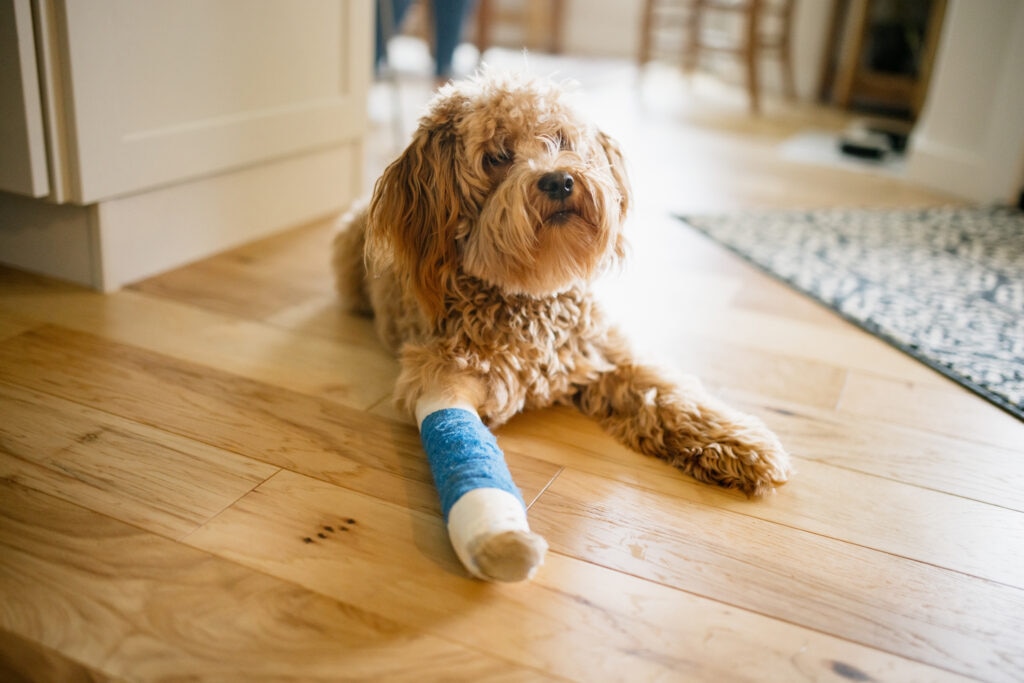
RyanJLane/E+ via Getty Images
A broken bone in a dog is a medical emergency that requires prompt veterinary care.
If you think your dog has a fracture, keep them as still as possible, avoid trying to straighten or splint the limb yourself, and seek emergency veterinary attention immediately.
Broken bones (fractures) are painful injuries that are most often caused by trauma, such as being hit by a car, falling from a height, or another serious accident. In addition to a fracture, your dog may have other life-threatening injuries that aren’t immediately visible.
Getting veterinary treatment as quickly as possible can relieve pain, reduce complications, and improve your dog’s chances of a full recovery.
Key Takeaways
- A broken bone in a dog is a medical emergency. Keep your dog as still as possible and seek veterinary care immediately if you suspect a fracture.
- Signs of a broken bone include limping, inability to bear weight, swelling, severe pain, or an abnormally positioned limb. Some fractures may not be obvious, especially after trauma.
- Most dogs recover well with prompt treatment and proper aftercare. Treatment may include splinting, casting, surgery, pain management, and restricted activity during healing.
What Are Broken Bones in Dogs?
Not only is breaking a bone a traumatic experience for your dog, the recuperation and stress involved make it one of the most challenging medical conditions. Broken bones in dogs are most often caused by falls, motor vehicle accidents, gunshot injuries, or cancer.
When there is excessive force against a bone, exceeding its core strength, a break or fracture occurs. Most breaks occur in the hindlimb.
The femur is the bone most often fractured, followed by the tibia and fibula, then the radius, ulna, and humerus of the forelimb. Pelvic fractures and fractures involving the mandible are also common, though less frequent.
Types of Broken Bones in Dogs
Types of broken bones in dogs include:
- Incomplete: Only one side of the bone is broken, or there is a partial break or bending of the bone.
- Complete: Both sides of the bone are broken.
- Comminuted: The bone has broken into at least three fragments.
- Open: Often seen with other wounds, but one in which the bone is exposed to the outside environment.
- Closed: Often referred to as an internal fracture, this occurs when there is no exposure to the outside environment.
- Salter-Harris: This kind of fracture goes through the growth plate of the bone.
- Articular: This is a fracture that involves the joint.
Symptoms of Broken Bones in Dogs
Most broken bones occur after some sort of activity or accident.
Not only will there be signs of a broken bone, but there may be other injuries that can be attributed to the accident.
For instance, a dog that has been hit by a car may have a broken leg but also experience internal bleeding and have difficulty breathing.
Signs most often associated with broken bones in dogs include:
- Lameness, often seen with the affected limb held up
- Pain
- Joint swelling
- Crepitus (crunching within the joint) or increased looseness of the limb
- Abnormal conformation (angularity or shortening) of the affected limb
- Broken bone protruding from the skin
- Swelling or bruising of the limb/body part
What To Do if Your Dog Breaks a Bone
If you determine or suspect that your dog has a fracture, seek emergency veterinary medical care immediately.
The fracture needs to be supported properly and the dog confined. Attempting to treat the fracture yourself is not recommended and can certainly make matters worse.
The first thing to do is to move your dog gently and safely out of harm’s way while doing your best not to manipulate the fracture.
Do not attempt to give any medications or clean the area unless directed to do so by your veterinarian.
Take precautions like placing a muzzle on your dog prior to transporting to the vet, as a dog in pain may bite.
How Veterinarians Treat Broken Bones in Dogs
Diagnosis of a broken bone in dogs is often straightforward and almost always involves a physical exam followed by radiographs (X-rays).
Treatment is often determined by three factors:
- The patient—Young or old? Healthy or affected by multiple health issues?
- The environment—Can the dog be confined and supervised?
- The injury—Type, severity, location, etc.
The first step after stabilizing your dog is to immobilize the affected segments so they can’t move or cause further trauma to any surrounding structures.
This often means heavy sedation or anesthesia followed by one of these four options:
- External coaptation (casts and splints) may be an option in younger dogs, or dogs with stable fractures or for fractures that occur below the knee and elbow.
- Intramedullary fixation with pins, rods, wires, and/or nails is the most common option.
- External skeletal fixation requires a device attached externally (outside of the bone) via pins, wires, etc. and is often the best option for open and comminuted fractures.
- Plates and screws are directly attached onto the bone.
Breaks or fractures that are associated with the joint where there are multiple open segments located in a major weight-bearing bone or digit are most often treated surgically. These types of fractures occur in larger breeds, or athletic dogs.
Small-breed dogs will often require surgery, as their bones lack sufficient blood vessels for the healing process.
How Much Does Treating Broken Bones in Dogs Cost?
Casts and splints are often less expensive, usually priced between $100 to $300 for the cast or splint itself. The overall vet visit will probably run closer to $500 to $800 after X-rays, an exam, and pain medications. Regular follow-up rechecks for splint or bandage changes often run around $150 to $300 per appointment.
Usually, pets require sedation for the X-rays and application of the cast or splint, as the broken bone is too painful to touch to get X-rays and secure the broken pieces.
Despite the lower cost of splinting, there are additional costs to consider if this method is a suitable treatment option. This includes the cost of recheck appointments, bandage care, and reapplication—in addition to home care, vigilance, and time required to care for the bandage itself.
Depending on where you live and the facility performing the surgery, you may expect to spend several hundred to several thousand dollars in care for your pooch.
Seek the advice of a veterinary surgeon to determine the best course of treatment. Amputation, although extreme, may have its practicality in certain cases.
Failure to treat a broken or fractured bone can leave your dog in a lot of pain and discomfort, and at risk of infection and whole-body sepsis; delayed union (longer timeline expected for the normal healing process); malunion (bones are healed but in an abnormal position); nonunion (fracture not resolved); and even angular limb deformities and long-term arthritis and joint disease.
Can a Broken Dog Bone Heal on Its Own?
Bones can heal on their own; however, there is a significant concern for malalignment or malunion, not to mention the risks of further instability, worsening of the fracture site, and prolonged pain and suffering.
Leaving a broken bone to just heal on its own is not recommended. Not only is this not very humane, but they are also more prone to chronic pain long term down the road.
Recovery and Management of Broken Bones in Dogs
Broken bones in dogs usually heal within three to four months for adult pets and six to eight weeks for puppies.
It’s important to follow your veterinarian’s guidelines throughout the healing process, as multiple rechecks with repeat radiographs are often needed to ensure that the bone is healing as expected, as well as to reshape or mold the cast and change the bandage, if present.
Adhere to all the recheck appointments and give the dog all medications as prescribed, which include pain medications, anti-inflammatories, and antibiotics.
Your dog’s activity will need to be restricted during the healing process—no jumping, running, or playing.
For limb and pelvic fractures, you may initially need to aid your dog when they stand or walk by utilizing a harness or a rolled towel underneath their chest or pelvis.
At some point during the recuperation process, physical therapy and rehabilitation will most likely be recommended to strengthen muscles, tendons, and improve function and overall comfort. Do your best to adhere to these recommendations and at-home exercises. A soft and well-padded bed can really improve your recuperating dog’s comfort and emotional well-being.
If your dog is wearing a bandage, be sure to always keep it clean and dry.
Do not attempt to change the bandage at home, but do monitor the bandage at least daily for signs of slippage, soiling, swelling of the distal extremities, and increased irritation by the dog (such as attempts to chew, lick, or scratch).
All can be signs that the bandage needs to be changed.
Prevention of Broken Bones in Dogs
The best way to prevent broken bones in your dog is to avoid letting them run off leash in unsafe areas. It only takes a moment for a dog to find themselves on the wrong end of a car or livestock animal.
If your dog enjoys off-leash exercise, stick to designated fenced areas away from traffic and other dangers so your dog can run safely.
If you have a toy dog, avoid letting children carry them around, as even a fall from someone’s arms can lead to broken limbs.
Broken Bones in Dogs FAQs
Can a dog's broken bone heal on its own?
While a dog’s bone can heal on its own, this is not recommended. Bone healing can take years, instead of a few months, when the fracture is not repaired first. Additionally, the bone can heal wrong, leading to chronic pain and malformed limbs.
How do you treat a dog's broken bone?
A broken bone is treated by stabilizing the fracture. Sometimes this is done with a cast or splint, other times surgery is recommended to fix the fracture.
How much does it cost to fix a broken bone on a dog?
Fractured bone repair can cost anywhere from several hundred to several thousand dollars depending on which bone is broken, how bad, and which treatment option is required.
How do you know if a dog's bone is broken or sprained?
X-rays are the best way to determine if a bone is just bruised or sprained versus broken.


