Flea and Tick Prevention and Treatment for Cats



Remains/iStock/Getty Images Plus via Getty Images
Flea and tick prevention is essential for cats. These common parasites can lead to itching, skin irritation, and even disease. That’s why treating active infestations and preventing new ones is a key part of your cat’s care routine. Using a monthly flea and tick treatment for cats keeps your kitty comfortable, healthy, and protected year-round.
Key Takeaways
- Fleas and ticks can cause several diseases in cats.
- Cats need year-round flea and tick prevention because parasites can enter the home on people, other pets, or shared environments.
- The most effective flea and tick prevention for cats is consistent use of a veterinarian-recommended product.
- Treating fleas requires addressing both your cat and your home to fully eliminate an infestation and prevent reinfestation.
Why Is Flea and Tick Prevention Important for Cats?
Flea and tick prevention is important for cats because these parasites can cause itching, skin disease, anemia, and transmit infections that affect both pets and people. Even a small number of fleas or a single tick bite can lead to significant health problems.
Fleas and ticks are ectoparasites, meaning they live on your cat’s skin and feed on blood. When they bite, they can trigger allergic reactions and introduce harmful bacteria or parasites into the body.
Flea infestations can cause:
-
Severe itching and skin irritation
-
Hair loss
-
Anemia in severe cases
Tick bites can lead to:
-
Local infections or abscesses
-
Blood infections
-
Tick paralysis (rare but serious)
-
Transmission of infectious diseases
Both fleas and ticks can spread diseases or other parasites to cats, including:
While cats are generally less susceptible to some tick-borne diseases than dogs, they are still at risk. In some cases, ticks can also carry zoonotic diseases that may affect people in the household.
Because fleas and ticks reproduce quickly and can be difficult to eliminate once established, consistent prevention is the most effective way to protect your cat’s health and avoid infestations.
Where Can Cats Get Fleas and Ticks?
Cats can pick up fleas and ticks from multiple environments, not just the outdoors. These parasites can find their way onto both indoor and outdoor cats through direct contact or by hitching a ride into your home.
Outdoors
Outdoor environments are the most common source of fleas and ticks. Cats who spend time outside are at higher risk because these parasites live in many natural settings.
Fleas and ticks are often found in:
-
Tall grass, weeds, and wooded areas
-
Leaf litter and soil
-
Parks, backyards, and gardens
-
Areas where other animals (wildlife or pets) spend time
Ticks typically wait on grass or plants and latch onto a passing animal, while fleas can jump onto your cat.
Indoors
Even indoor cats need preventive treatment to be protected from fleas and ticks. These pests can enter your home in several ways and quickly spread.
Common indoor sources include:
-
Fleas hitching a ride on clothing, shoes, or bags
-
Other pets bringing ticks inside
-
Infestations already present in carpets, furniture, or bedding
-
Shared spaces like apartment hallways or multi-pet buildings
Once inside, fleas can lay eggs on soft surfaces and in between tiny crevices, making infestations difficult to eliminate without treatment.
From Other Animals
Cats can also get fleas and ticks through contact with other animals.
This includes:
-
Dogs or cats in the same household
-
Visiting pets or animals at boarding facilities
-
Wildlife such as rodents, raccoons, or opossums
Parasites can easily transfer during close contact or shared environments, even if your cat only has brief exposure.
When Do Cats Need Flea and Tick Prevention?
Cats need flea and tick prevention year-round, not just during warmer months. Fleas and ticks are most active in spring and summer, but they can survive indoors or during mild winters, putting cats at risk any time of year.
Flea and tick prevention should be used consistently throughout the year because:
-
Fleas can live and reproduce indoors regardless of outdoor temperatures.
-
Ticks can remain active in temperatures above freezing.
-
Skipping doses can allow infestations to start or return.
Even indoor cats benefit from year-round protection, since parasites can be brought into the home on people or other pets.
For PetMD’s complete guide to flea and tick season for cats, click here. For the Spanish version, click here.
Age To Start Prevention
Most cats can begin flea and tick prevention as early as 8 weeks of age, depending on the product.
Keep in mind:
-
Age and weight requirements vary by medication.
-
Kittens may need specially formulated products.
-
A veterinarian can recommend the safest option based on your cat’s age, size, and health.
Starting prevention early and maintaining it consistently is the most effective way to protect your cat from fleas and ticks.
Types of Flea and Tick Prevention for Cats
There are several types of flea and tick preventives for cats. Each works differently, so the best option depends on your cat’s lifestyle, health, and how easy the product is to use consistently.
Topical Treatments (Spot-Ons)
Topical flea and tick treatments are liquid medications applied directly to your cat’s skin, usually between the shoulder blades. They spread across the skin’s surface and kill parasites on contact.
NexGard COMBO is a good example of a topical flea and tick treatment for cats. It protects against fleas, ticks, tapeworms, roundworms, hookworms, and heartworms for one month.
Key features of topical preventive treatments include:
-
Usually applied once a month (though some can last up to three months)
-
Kill fleas and ticks without requiring a bite (for many products)
-
Easy to apply for cats who won’t take pills
Cats should not be bathed immediately after application, and care should be taken to prevent other pets or people from touching the area until it dries.
For PetMD's guide to topical flea/tick preventives, click here. For the Spanish version, click here.
Flea and Tick Collars
Flea and tick collars release active ingredients over time to provide continuous protection. They are worn around your cat’s neck and can offer long-lasting coverage.
Flea and tick collars:
-
Can provide protection for several months (up to eight months)
-
Low-maintenance once the collar is on
-
Some collars kill parasites on contact
Collars must fit properly to be effective and safe. Not all collars protect against both fleas and ticks, so check the label carefully.
Oral Treatments
Oral flea and tick medications are given by mouth and work systemically, meaning the medication circulates in your cat’s bloodstream. When fleas or ticks bite, they’re exposed to the medication and die.
Highlights of oral medications:
-
Typically given monthly
-
Cats readily eat the flavored chewable like a treat
-
Start working quickly after administration
-
No residue left on the coat
It is important to confirm coverage with your veterinarian, since a product may cover both fleas and ticks, while another may cover only fleas.
What Is Broad-Spectrum Flea and Tick Prevention?
Not all flea and tick preventives for cats cover the same parasites. Some products only kill fleas, while others just target ticks—and many protect against both. There are also preventives that include coverage for other parasites, beyond just fleas and ticks.
“Broad-spectrum” flea and tick prevention refers to medications that protect cats against multiple types of parasites with a single product. Instead of targeting just one pest, these treatments are designed to provide wider protection.
Most broad-spectrum products for cats protect against:
-
Fleas
-
Ticks
Some may also include protection against other external and internal parasites, such as:
-
Tapeworms
Using a broad-spectrum product like NexGard COMBO can help simplify your cat’s parasite prevention routine and reduce the risk of gaps in coverage.
However, because protection varies by product, it’s important to:
-
Check the label carefully
-
Confirm parasite coverage with your veterinarian
-
Choose a preventive based on your cat’s lifestyle and risk factors
Consistent, year-round use of an appropriate preventive is one of the most effective ways to help protect your cat from fleas, ticks, and other parasites.
Over-The-Counter vs Prescription Flea and Tick Medicine
Over-the-counter (OTC) tick and flea treatments for cats do not require a prescription from a veterinarian. They are typically available for purchase online and in many retail pet stores.
Prescription flea and tick preventives require a prescription from your veterinarian and typically cost a little more.
Most veterinarians recommend prescription products, as they are typically more effective and safer for your cat.
Even if you’re using an OTC product that doesn’t require a prescription, always consult with your veterinarian to make sure it is a safe option for your cat.
Choosing Flea and Tick Prevention For Cats
There are many preventive options for cats available, which can make it confusing to pick the right product for your feline friend.
Speak with your veterinarian and discuss the options. When discussing flea and tick prevention options for cats, it's important to keep the following key factors in mind.
Species
Only use flea and tick products formulated specifically for cats. Dog products can’t be used on cats and will lead to severe (often fatal), reactions.
Thoroughly check the label and get approval from your vet before applying any tick and flea treatments to your cat.
Application Method
The best application method is one you can use consistently, and that fits your cat’s temperament, lifestyle, and health needs.
| Application Method | Pros | Cons |
|---|---|---|
| Topical | -Easy to apply -Many kill parasites on contact, so they don’t have to bite | -Can leave residue on the coat -Requires avoiding bathing or contact with the application site until dry |
| Collar | -Low-maintenance, long-lasting protection (often several months) | -Must fit properly to be effective and safe -Can be lost, damaged, or removed |
| Oral | -Most cats eat it readily like a treat -No mess on the coat -Not affected by bathing or grooming | -Can be difficult to administer if your cat does not like treats or is not food motivated -Requires parasites to bite in order to kill them |
Geography
Different geographic locations have different local parasite populations, including fleas and ticks, as well as other parasites such as heartworm and intestinal worms.
The Companion Animal Parasite Council is a terrific resource to identify the parasites in your specific area that put your pet at the most risk.
Access to Outdoors
Cats who are allowed outdoors, are taken for walks, or have access to a catio are at much higher risk of flea and tick infestation.
If your cat spends any time outside of your home, using a flea and tick preventive is especially important.
However, even indoor cats are at risk for fleas, which can enter the home on clothing, other pets, or through shared living spaces like apartments. Because of this, veterinarians recommend year-round flea and tick prevention for all cats, regardless of whether they go outside.
Life Stage
Not all products can be used in all life stages or weights. Most preventives have a minimum age of 8 weeks. Many tick and flea treatments for cats also have a minimum weight required for safe use.
If you have a new kitten or your cat is on the smaller side, talk with your veterinarian about which flea and tick preventives are safe before choosing a product.
Medical Conditions
Most parasite preventives are considered very safe, but there are some exceptions.
One class of preventives, called isoxazolines, has been associated with neurological side effects and should be used with caution in cats with a history of seizures or neurologic disease. No preventive should be used without thorough discussion with your veterinarian if:
-
Your pet has previously had an allergic reaction to the drug
-
Your pet is sick and/or underweight
-
Your pet is pregnant, nursing, or will be used for breeding in the future
MDR1 Gene
A very small percentage of cats (1%) carry a genetic risk factor for MDR1, a rare, mutated gene that causes drug sensitivity.
These cats cannot safely process certain drugs, including some ingredients in preventives, which can result in a life-threatening reaction. Washington State University has additional information on the mutation—and which drugs to avoid.
MDR1 in cats is rare, but if you have concerns about your cat, speak to your veterinarian about testing for this sensitivity.
Comparing Common Flea and Tick Preventives and Treatments
This chart outlines and compares common tick and flea treatments for cats to help you determine which option is best for your furry friend.
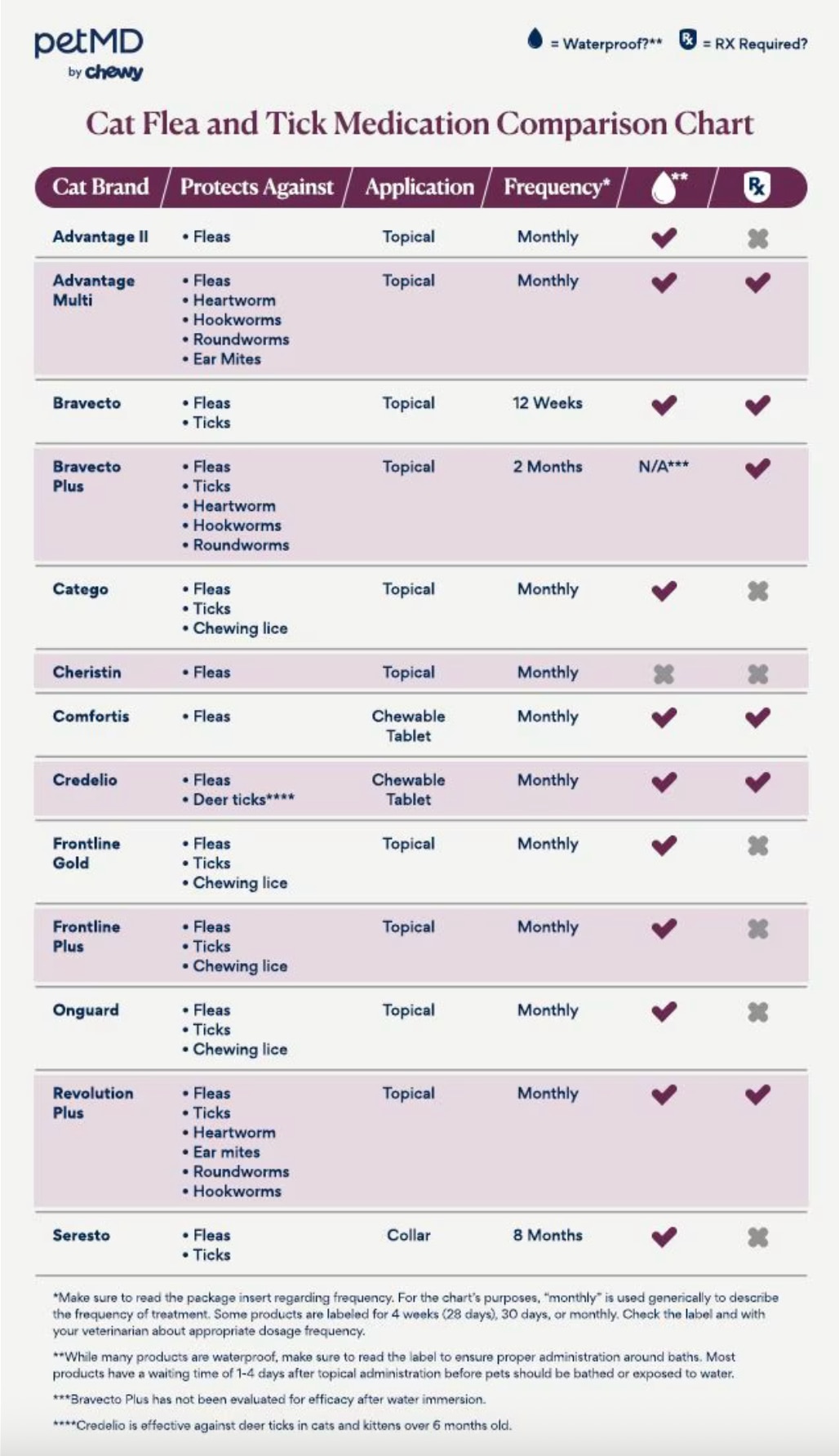
Refer to our Vet Verified series to see what products the PetMD Vet Advisory Panel has chosen as the best flea and tick medications for cats.
How To Check Your Cat for Ticks

Regularly checking your cat for ticks—especially after they’ve been outdoors—can help catch and remove parasites before they cause problems. Ticks often attach in hard-to-see areas, so a thorough, hands-on check is important.
Follow these steps to check your cat for ticks:
-
Run your hands over your cat’s body, feeling for small bumps on the skin.
-
Inspect common hiding spots where ticks tend to attach.
-
Part the fur to look closely at the skin for small, dark, oval-shaped dots.
-
If needed, use a fine-tooth comb to search through dense or long fur.
-
Check yourself and other pets too
If you find a tick, it should be removed promptly and safely. If you’re unsure how to remove it or if the area looks irritated, contact your veterinarian for guidance.
How To Safely Remove Ticks From Cats
If you find a tick on your cat, it’s important to remove it promptly and carefully to reduce the risk of disease transmission and skin irritation. Using the right technique helps ensure the entire tick is removed.
Follow these steps to safely remove a tick from your cat:
-
Use fine-tipped tweezers or a tick removal tool
-
Grasp the tick close to the skin
-
Pull straight out with steady pressure (don’t twist)
-
Clean the area and wash your hands
-
Dispose of the tick in alcohol or a sealed container
-
Monitor the site for irritation
Avoid using home remedies like petroleum jelly, heat, or essential oils to remove ticks, as these methods are not effective and may increase the risk of disease transmission.
If you’re unsure or uncomfortable removing a tick, your veterinarian can safely handle it.
Treating Fleas on Cats
Treating fleas on cats requires a combination of killing existing fleas and preventing new infestations. Because fleas reproduce quickly, addressing both your cat and their environment is key to effective control.
To get rid of fleas on your cat, follow these steps:
-
Use a vet-recommended flea treatment to kill fleas and prevent more from hatching.
-
Use a flea comb to remove fleas and eggs from the coat.
-
Give your cat a flea bath if needed for immediate relief.
-
Treat your home to eliminate fleas in the environment.
-
Ensure all pets in the home are on year-round flea preventive.
Treating Your Home for Fleas
Treating your home is a critical step in eliminating fleas, as eggs, larvae, and pupae can live in carpets, bedding, and furniture. In addition to treating your cat, thoroughly clean your environment by:
-
Vacuuming floors, rugs, and upholstery daily
-
Washing your cat’s bedding in hot water
-
Disposing of vacuum contents outside to prevent reinfestation
-
Using household flea control products
Because fleas can continue to develop in the environment for weeks, consistent cleaning and ongoing prevention are key to fully breaking the flea life cycle.
Flea and Tick Prevention and Treatment FAQs
Are flea and tick preventives for cats safe?
Flea and tick preventives for cats are generally safe when prescribed by a veterinarian and used as directed. However, safety depends on the specific product and your cat’s age, weight, and health, so it’s important to choose the right option with your vet.
Can fleas and ticks make cats sick?
Yes. Fleas and ticks can cause skin conditions, anemia, and transmit diseases that affect both cats and humans.
How do vets get rid of fleas on cats?
Veterinarians typically treat fleas by using fast-acting flea medications to kill existing fleas, followed by a longer-term preventive to stop the life cycle. They may also recommend treating your home and other pets to fully eliminate the infestation and prevent it from returning.
How often do indoor cats need flea treatment?
Indoor cats should still receive flea treatment year-round, typically once a month, depending on the product used. Even cats that stay inside are at risk, since fleas can be brought into the home on people, other pets, or household items.


