Is Your Cat at Risk for Heartworm Disease?
IN PARTNERSHIP WITH


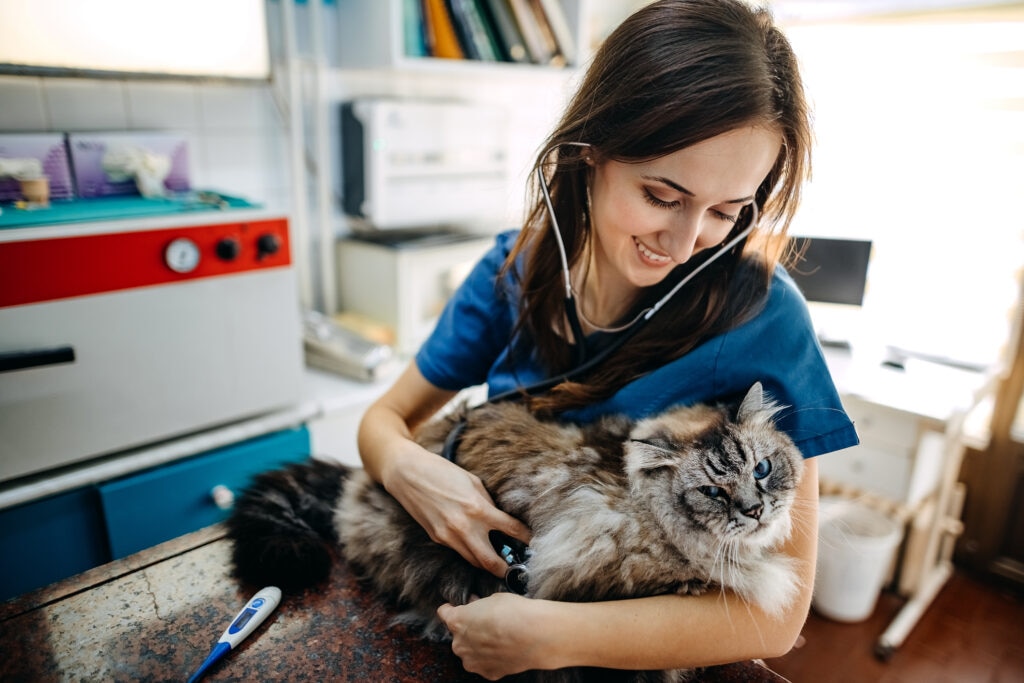
eclipse_images/E+ via Getty Images
If your cats spend most of their days moving from couch to window and back again, it may be easy to assume that a mosquito-borne disease like heartworm disease isn’t a threat.
Since the twentieth century, when heartworm was first recognized as a disease in cats, how veterinarians understand heartworm risk and how the disease affects cats has significantly expanded.
Key Takeaways
- Heartworm disease in cats is caused by the same parasite that infects dogs, but the disease impacts cats differently.
- In cats, heartworm infection leads to lung and airway disease, with most cats developing disease from immature heartworm infections.
- Heartworms are spread by mosquitoes, putting indoor as well as outdoor cats at risk.
- Signs of heartworm infection in cats can range from coughing and vomiting to anaphylaxis and even sudden death.
- Because there are no approved heartworm treatments for cats, prevention is critical.
What Is Heartworm Disease in Cats?
The word “heartworm” conjures an image of worms that infect and spread within the heart chamber of a pet. However, this picture is more descriptive of how heartworms affect dogs rather than how they impact cats.
Heartworm disease in dogs is a cardiovascular disease that occurs when adult heartworms—which can grow to be a foot long—lodge in dog’s heart and cardiovascular system, causing cardiovascular disease, fluid build-up, and congestive heart failure.
In cats, most heartworms are killed off by the immune system before the worms develop to the adult stage, but the presence of dead and dying worms in the small and large blood vessels of the airways and lungs can lead to significant inflammation and respiratory illness.
Meanwhile, heartworms can still survive to the adult stage in the cat. When this happens, cats are at significant risk of severe illness and even death. Some cats (as many as 10–20 percent) may suffer an immune reaction that leads to anaphylaxis. Anaphylaxis requires immediate veterinary intervention, and it can be fatal.
Another life-threatening complication of adult heartworm infection in cats is the migration of worms to areas outside the respiratory tract, including the eyes, brain, and spinal cord.
How Do Cats Get Heartworm Disease?
Heartworm disease is spread through the bite of infected mosquitoes. Many species of mosquitoes can transmit heartworms; but the one characteristic all mosquitoes must have is a willingness to feed between dogs and cats.
This is because dogs, as well as wild canids like coyotes, foxes, and wolves, serve as the reservoirs of the disease. For the heartworm life cycle to be completed, a mosquito first feeds on an infected dog with microscopic “baby” heartworms in their bloodstream.
Over the next several weeks, these heartworm babies mature to a larval stage within the body of the mosquito and can be spread to either another dog or a cat when the infected mosquito feeds on them. Mosquitoes typically feed on a cat’s sparsely coated areas, such as the ear tips and nose.
Approximately two and a half to three months after infection, immature heartworms reach their target within a cat—the larger arteries in the lung.
At this point, two things can happen:
-
The worms will grow to the adult stage and live for as long as two to four years within the cat.
-
Or the cat’s immune system will kill the immature worms as they travel through the pulmonary blood vessels.
Why Indoor Cats Are at Risk for Heartworm Disease
Because mosquitoes can enter indoor spaces through opened doors or windows, indoor cats are still at risk for heartworms. Cats with limited access to outdoor spaces, such as balconies, catios, or patios, are at a greater risk for heartworm disease due to exposing themselves to the outdoors.
Because of landscape changes from industrial and residential development, a mosquito population in any given area can survive harsh winter months. And due to changing climate conditions, early springs and prolonged summerlike temperatures are also becoming more common.
Mosquitoes breed in standing water, vegetation, and man-made objects (e.g., flowerpots, birdbaths, etc.) can hold enough water to support a mosquito life cycle in the most arid climates. Together these factors can ensure that the risk of heartworm disease never reaches zero.
Meanwhile, cats who travel or move with pet parents to regions with increased numbers of mosquitoes are also at increased heartworm risk.
Is My Cat at Risk for Heartworm Disease?
A variety of circumstances should be considered when determining the risk of heartworm infection to cats:
-
Whether a cat is considered an indoor or outdoor cat (any amount of outdoor time puts a cat at increased risk for heartworms plus other parasites)
-
A cat who is not actively on heartworm prevention
-
If a cat lives in or travels to an area with a large mosquito population
Signs and Symptoms of Heartworms in Cats
While some cats infected with heartworms have no apparent symptoms, others can experience a variety of clinical signs. Coughing and vomiting are noted early in the disease process and are the most common signs of heartworm disease in cats. Cats with heartworms may also exhibit:
-
Acute onset of difficulty breathing
-
Collapse accompanied with difficulty breathing, hypersalivation, dilated pupils, vocalizing
-
Sudden death
Keep in mind some cats may not show any physical symptoms of heartworm disease. This is why it’s important to schedule routine wellness check appointments with your vet to catch any signs of disease early.
Can Heartworm Disease Be Diagnosed in Cats?
Heartworm testing in cats is much less straightforward than it is in dogs, which has led to a significant underestimation of the disease in cats.
Dogs typically are screened for heartworms with antigen blood tests that detect the presence of adult heartworms. Since cats are less likely to harbor adult worms than dogs, antigen testing alone does not provide enough information for vets.
For this reason, the American Heartworm Society recommends that veterinarians routinely test cats with tests known as antibody tests as well as antigen tests. Antibody tests detect the cat’s immune response to either a present or a previous heartworm infection.
This is important since most heartworms are eliminated by the cat’s immune system before becoming adults. While antibody testing cannot differentiate between a past and present infection, it provides crucial information about the cat’s exposure.
In cats with suspected heartworm infection, X-rays or ultrasound testing can help veterinarians detect the presence of worms and possible respiratory changes associated with the disease.
Is There Treatment for Cats With Heartworm Disease?
Unfortunately, cats infected with adult heartworms don’t have the same treatment options as dogs. The medication used to eliminate adult heartworms in dogs is toxic for cats. Furthermore, the acute death of an adult worm in a cat may cause anaphylaxis and be fatal to the cat.
Therapy for cats with heartworm disease is usually confined to supportive care. Steroids, which are anti-inflammatory drugs, can be used to mitigate the pulmonary inflammation associated with infection and reduce coughing.
In cases where the cat is suffering from acute respiratory trouble or anaphylactic shock, oxygen therapy and anti-shock therapy can be administered by the veterinarian.
It’s also possible to surgically remove adult heartworms in cats, but this is a risky procedure that usually requires a referral to a specialist.
Cats diagnosed with heartworm infection should be placed on heartworm prevention as soon as possible since they have proven to be susceptible to the disease.
How To Protect Your Cat From Heartworm Disease
Because there’s no direct therapy to cure cats from heartworm disease, prevention is of paramount importance.
The American Heartworm Society recommends year-round heartworm prevention for cats—a practice that has the added benefit of ensuring cats are protected against other common parasites.
Depending on the product prescribed by the veterinarian, these parasites may include internal parasites, such as roundworms and hookworms, and external parasites, such fleas, ticks, and mites.
Many of these parasites can be spread from cats to humans, so protection is important to human health as well.
Options include both topical and oral products—all of which are easy to administer.
Because products differ in terms of which parasites they prevent, it’s important for pet parents to work with their veterinarian to determine which preventive best fits their cat’s needs.
Other ways pet parents can protect their cats:
-
Environmental control: While topical mosquito repellents are not safe to use on cats, pet parents can take steps to reduce the mosquito population in their cat’s environment. Getting rid of standing water that may propagate the mosquito lifecycle, fogging of the outside environment, and ensuring all windows have screens, can help prevent mosquitoes from entering a cat’s environment.
-
Vector control: Cat parents who also have dogs should ensure their dogs are routinely tested and on heartworm prevention.
Is Your Cat at Risk for Heartworm Disease FAQs
Can indoor cats get heartworm?
Yes. All it takes is the bite of one mosquito that has penetrated the indoor environment to transmit heartworm infection to your cat.
How common is heartworm in cats?
Studies conducted in areas with high heartworm rates have shown that the infection rate of unprotected cats can mirror that of unprotected dogs.
Can heartworm be spread directly between pets?
No. Heartworms can only be spread by mosquitoes that bite infected pets and spread infected heartworm larvae to uninfected dogs and cats.
References
Genchi C, Venco L, Ferrari N, et al. Feline heartworm (Dirofilaria immitis) infection: a statistical elaboration of the duration of the infection and life expectancy in asymptomatic cats. Vet Parasitol 2008; 158: 177–182. DOI: 10.1016/j. Vetpar.2008.09.005.
Atkins CE, DeFrancesco TC, Coats JR, et al. Heartworm infection in cats: 50 cases (1985-1997). JAVMA 2000; 217:355-358.


