Heartworm Disease in Cats: Symptoms, Treatment, and Prevention


Istock/konradlew
Heartworm disease in cats is caused by the parasite Dirofilaria immitis, which is transmitted by mosquitoes.
Although cats develop heartworm less often than dogs, infection can cause serious respiratory disease, permanent lung damage, and sudden death.
Treatment can be difficult, making heartworm prevention especially important for cats.
Key Takeaways
- Heartworm disease in cats is caused by Dirofilaria immitis and transmitted through mosquito bites.
- Some cats have no symptoms, while others may develop coughing, vomiting, breathing problems, neurologic signs, or sudden death.
- Heartworm disease can be difficult to diagnose and treat in cats, so veterinarians may use multiple tests and treatment approaches.
- Heartworm prevention is important even for indoor cats because mosquitoes can enter the home.
What Is Heartworm Disease in Cats?
Heartworm disease in cats is caused by the parasite Dirofilaria immitis, which is spread by mosquitoes.
Although cats are susceptible to heartworms, they are fairly resistant, imperfect hosts. Cats acquire heartworm far less often than dogs in the same geographic location, with only 5–20% affected.
Only around 25% of heartworms reach adulthood in cats. Cats also typically have a low worm burden—usually one to four worms compared with hundreds in dogs—and less than 20% of those worms produce microfilaria, the infective form of heartworm.
Cats also have higher rates of aberrant heartworm migration. This occurs when heartworms fail to migrate to the pulmonary arteries and instead travel to other body cavities, blood vessels, or the central nervous system.
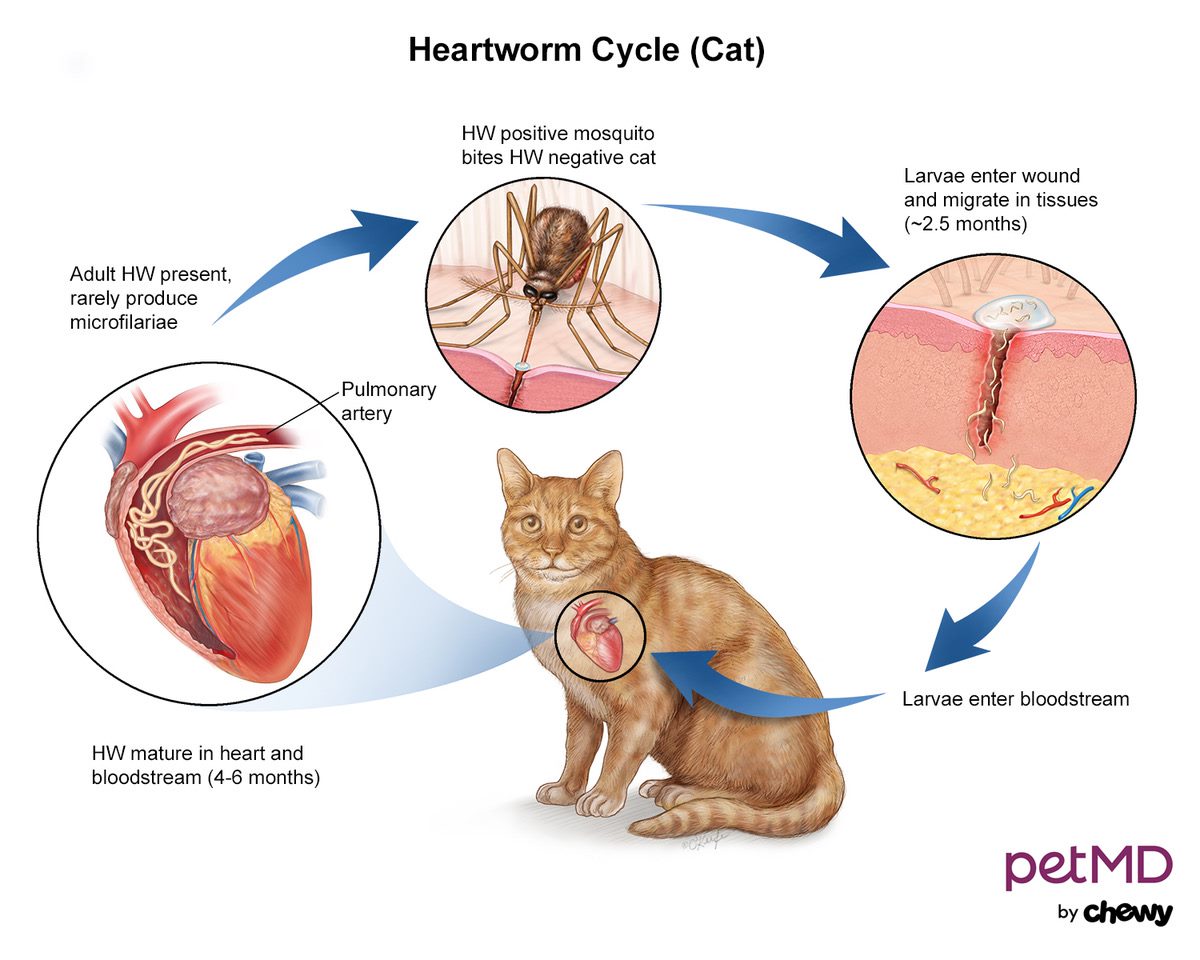
Download the medical illustration of the heartworm cycle in cats.
The life cycle of heartworms is complex and involves several larval, or immature, phases:
- A mosquito acquires microfilaria when it bites a dog infected with heartworm disease.
- Once ingested by the mosquito, the microfilaria molt, or transform, over the next 10–14 days into three different forms of larva: L1, L2, and L3.
- After the third molt, the L3 larva can infect new dogs and cats.
- The mosquito bites a cat and transfers the infective L3 through saliva into the bite wound.
- The L3 stays within the cat's tissues for three to four days until it molts again to L4.
- L4 remains in the tissues for approximately two months.
- L4 then molts to L5, the immature adult, which leaves the tissues through the bloodstream.
- L5 reaches the pulmonary arteries—the vessels responsible for bringing oxygen-poor blood from the heart to the lungs to re-oxygenate.
- L5 continues to develop in the pulmonary artery for another four to six months until it becomes an adult heartworm. Some adult worms are capable of releasing microfilaria into the bloodstream to start the cycle again.
Stages of Heartworm Disease in Cats
The American Heartworm Society divides heartworm disease in cats into two stages:
- Stage 1: This stage occurs when immature L5 worms arrive in the pulmonary arteries and many of them die. This causes a severe, acute inflammatory reaction as the vessels and heart respond to the parasite and is often misdiagnosed as asthma or other respiratory diseases.
Veterinarians and researchers call this acute inflammatory process heartworm-associated respiratory disease (HARD). As the living worms mature, the inflammatory response lessens, in part because adult worms actively suppress the immune system.
- Stage 2: This stage occurs when adult heartworms die, causing a highly inflammatory, anaphylactic, and often fatal response. The dead worms trigger a strong pulmonary inflammatory cascade, and a cat's blood vessels are small and narrow.
When an adult heartworm dies, it can cause an embolism. A cat who survives adult heartworm death will have permanent lung damage and chronic respiratory disease.
Check out PetMD's complete guide on heartworm disease in cats. The Spanish version of the guide is also available.
What Are the Symptoms of Heartworm Disease in Cats?
Some cats with heartworm disease have no clinical signs at all. When symptoms do occur, they can vary greatly in severity and may include lethargy, coughing, decreased appetite, weight loss, vomiting, and breathing problems.
Many noticeable signs occur when an adult heartworm suddenly dies and causes acute issues or when abnormal worm migration causes tissue damage.
Symptoms of heartworm disease in cats may include:
- Lethargy
- Coughing
- Decreased appetite
- Weight loss
- Exercise intolerance
- Vomiting
- Difficulty breathing
- Increased breathing
- Open-mouth breathing
- Neurologic abnormalities, including difficulty walking (ataxia) and possible seizures
- Heart murmur
- Sudden death
What Causes Heartworm Disease in Cats?
Heartworm disease in cats is caused by the parasite Dirofilaria immitis, which is transmitted by mosquitoes.
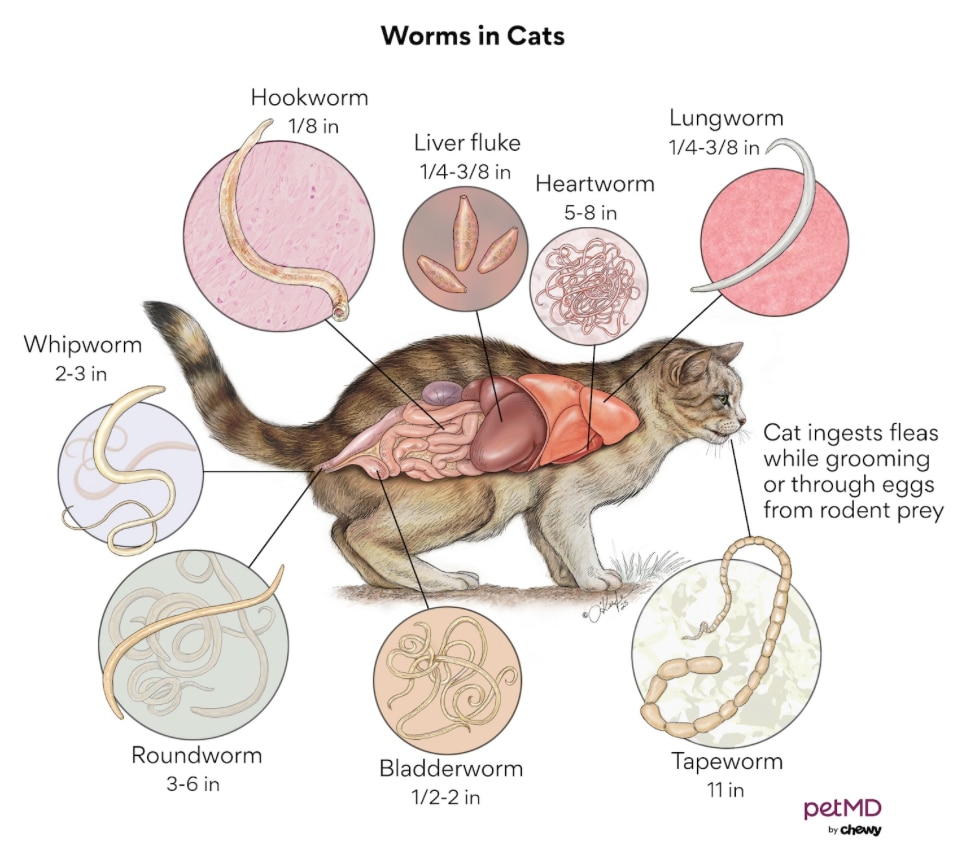
Download the medical illustration of worms in cats.
Warm areas, especially in the southern U.S., allow efficient mosquito reproduction, so southern states have a higher percentage of heartworm in cats.
Outdoor cats are more susceptible, but indoor cats can also acquire heartworm if a mosquito ventures inside.
How Is Heartworm Disease in Cats Diagnosed?
Heartworm disease in cats can be difficult to diagnose, especially compared with dogs. Because no single test is perfect, veterinarians use physical exam findings along with multiple types of tests to evaluate heartworm disease in cats.
Diagnostic tests may include:
- Tests for microfilaria: These tests may give frequent false negatives because cats rarely have circulating microfilaria.
- Antibody blood tests: These tests can detect immature infections early, even two months after infection. However, a positive result does not confirm an adult infection and can remain positive after a cat clears the infection.
- Antigen blood tests: These tests are the gold standard for diagnosing heartworm disease in dogs but can only test for the presence of female heartworms. Because cats can have very low or single-sex (such as all-male) worm burdens, antigen testing can miss some feline infections.
- Chest radiographs (X-rays): Enlargement of the pulmonary arteries and changes to the lung tissue may suggest heartworm disease. Common features of heartworms can be seen on X-rays in about half of cases.
- Echocardiography (ultrasound): An echocardiogram can visualize live worms in the pulmonary artery and right side of the heart. It can also help determine whether pulmonary pressures are abnormal while excluding or confirming cardiac disease.
Positive blood tests, enlarged arteries on radiographs, and changes in the heart can increase the level of suspicion for heartworm infection.
Your veterinarian will use these findings along with the physical exam and multiple types of tests to determine the severity of heartworm disease in your cat.
How Is Heartworm Disease in Cats Treated?
Treating heartworm disease in cats is difficult. Depending on the cat's condition, treatment may involve monitoring, medications, or surgical removal of the heartworms.
Many common therapies—including the most common canine treatment, merbromin—are toxic to cats. Merbromin, otherwise known as Immiticide, is used to kill adult heartworms in dogs, but its use in cats has been associated with serious side effects that occur from worm death.
The American Heartworm Society does not currently recommend using therapies that kill adult heartworms in cats.
Monitoring Cats Without Symptoms
Cats that do not have clinical signs may be monitored over time for a spontaneous cure. A spontaneous cure occurs when the cat's immune system naturally clears the heartworm infection without causing problems and without treatment.
Medications for Heartworm Disease in Cats
Your veterinarian may recommend:
- Ivermectin: May reduce worm loads when given over a long period of time—two years or more. Allergic shock or an inflammatory reaction are two supplied side effects in cats. Ivermectin is also a common ingredient in heartworm prevention medication.
- Prednisolone: A steroid that can decrease a cat's strong inflammatory response. It may be prescribed for cats with clinical signs such as coughing or evidence of lung disease on an X-ray and can help diminish breathing issues associated with heartworm-positive cats.
- Doxycycline: An antibiotic that helps remove bacteria that live inside heartworms and increase inflammation in cats.
- Terbutaline, theophylline, or albuterol: These medications may also be recommended to help with respiratory distress.
Surgery for Heartworm Disease in Cats
Because medical management of heartworm disease in cats is difficult, the supplied article identifies surgical removal of heartworms as the preferred treatment method.
An invasive surgery can remove worms by entering the chest cavity and using forceps to directly remove them through the heart. However, heartworm surgery in cats can lead to circulatory collapse and death.
Because heartworm disease is difficult to treat, prevention is key to helping protect cats from heartworms.
Recovery and Management of Heartworm Disease in Cats
Heartworm-positive cats should be monitored every six to 12 months with serologic testing, echocardiograms, and chest radiographs, whether they were treated or were asymptomatic.
Ideally, veterinarians will perform both antibody and antigen tests to gather the most information.
Veterinarians will cautiously declare a cat “recovered” from heartworm disease once blood tests are negative and clinical and radiological signs have resolved.
Without medication therapy or surgery, there is no cure for heartworm disease in cats. The goal is to keep the cat symptom-free for as long as possible in hopes that the cat outlives the worms.
The supplied median survival time for cats with heartworm disease is one and a half to four years.
Managing heartworm-positive cats involves close monitoring, in-depth discussions with veterinarians, and a full understanding of the risks of heartworm disease in cats.
How To Prevent Heartworm Disease in Cats
Heartworm disease in cats is preventable with heartworm preventive medication. Kittens can start preventives around 8 weeks of age and continue them throughout their lives.
There are many heartworm medications for cats available. In addition to preventing heartworm, many of these preventive medications also help protect against intestinal worms, fleas, and ticks.
Indoor cats also need heartworm prevention because mosquitoes can make their way inside the home and expose your cat to heartworms.
Talk to your veterinarian about heartworm prevention medication for your cat.
Heartworm Disease in Cats FAQs
How long can a cat live with heartworm disease?
The supplied median survival time for cats at the time of heartworm disease diagnosis is four years.
What are the first signs of heartworm disease in cats?
Some cats with heartworm disease are asymptomatic, but the most common first signs are lethargy, coughing, and vomiting.
Is heartworm disease in cats fatal?
Yes. Heartworm disease in cats can be fatal and unpredictable.
Is heartworm disease in cats contagious to other cats?
No. Heartworm disease is not transmitted directly from one cat to another. An intermediate vector, such as a mosquito, is required.
References
1. Atkins CE. Feline Heartworm Disease: What’s New-2008. Western Veterinary Conference 2010.
2. González-Miguel J, Morchón R, et al. Identification of Dirofilaria immitis immunoreactive proteins recognized by sera from infected cats using two-dimensional electrophoresis and mass spectrometry. Mol Biochem Parasitol. 2010;174:78–82.
3. Atkins C. Heartworm Disease. Textbook of Veterinary Internal Medicine, 7th ed. St. Louis, Saunders Elsevier: 2010; 1353-80.


