Lenticular Sclerosis: How Do Dogs Get It and How Is It Treated?



Morsa Images/E+ via Getty Images
Have you noticed any slight blue-gray changes in your senior dog’s eyes? Worried they might have cataracts?
They may have something called lenticular sclerosis. Lenticular sclerosis in dogs is very common, affecting about half of dogs age 10 and older.
Let’s look at everything you need to know—including common symptoms and how to help your dog.
Key Takeaways
- Lenticular sclerosis is a normal, age-related hardening of the eye lens that causes a bluish-gray tint in senior dogs' eyes but does not affect their vision.
- It is commonly mistaken for cataracts, but unlike cataracts, it does not block light or require treatment.
- While there's no cure, dogs can live comfortably with lenticular sclerosis, and simple lifestyle adjustments can help accommodate minor depth perception changes.
What Is Lenticular Sclerosis in Dogs?
Lenticular sclerosis, also known as nuclear sclerosis, is common in senior dogs. Dogs with lenticular sclerosis have changes to the lens in the back of the eye.
The lens is a clear disc that is behind the pupil. With age, the lens becomes more dense and harder, leading to the blue-gray color change. Often, it’s very subtle at first, and pet parents may notice a slight bluing of their dog’s eye when they look at them from the side.
Fortunately, these hardening changes to the lens do not lead to a loss in vision. Affected dogs may have some changes in their depth perception (like middle-aged adults needing reading glasses), but they should be able to see just fine.
While half of dogs 10 or older develop lenticular sclerosis, nearly all dogs over the age of 13 have hardened lenses.
Lenticular sclerosis in dogs is not considered a medical emergency.
Lenticular Sclerosis in Dogs vs. Cataracts in Dogs
While both lenticular sclerosis and cataracts can make your senior dog’s eyes look more blue-gray, they are not the same thing. Lenticular sclerosis is caused by your dog’s lenses becoming denser. This does not lead to any vision loss, and light is still able to travel through the lens. Depth perception is often affected over time, so objects are closer than they appear.
Cataracts, on the other hand, lead to deterioration (breakdown) of the lens. The parts of the lens affected by cataracts have an opacity (an unclear area) that does not allow light through to the retina in the back of the eye. Because these areas block light, blind spots are formed where pets are unable to see around the cataract.
Symptoms of Lenticular Sclerosis in Dogs
Symptoms of lenticular sclerosis in dogs include:
-
Cloudiness in the back of your senior dog’s eyes
-
Subtle, bluish-gray color change in both eyes symmetrically
-
Startle reflex when you approach your dog, as their depth perception may be slightly changed
-
Accidentally nipping your finger when taking treats
-
Not catching things thrown in the air as well as they once did
-
Taking more time on stairs and walking up to them with caution
Causes of Lenticular Sclerosis in Dogs
Lenticular sclerosis in dogs is caused by age. As a dog ages, their eyes continue to produce lens fibers as they always have. After a certain point in time, the lens becomes increasingly denser with more fibers. These lead to some compression (squeezing) and hardening changes.
All dogs are at risk of getting lenticular sclerosis in their senior years. Dogs age 10 and older have a higher risk of having this condition.
How Veterinarians Diagnose Lenticular Sclerosis in Dogs
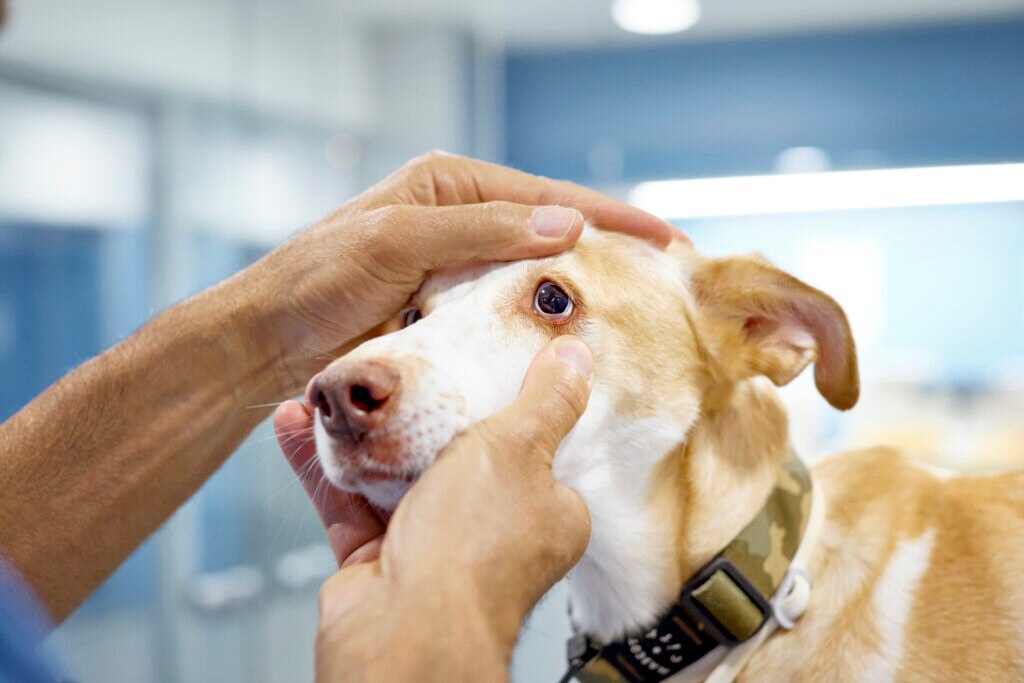
Lenticular sclerosis in dogs is diagnosed on an exam.
Your vet will use an ophthalmoscope to look in the back of your dog’s eye. Light from the ophthalmoscope will readily pass through the lens.
The retina and the fundus (structures in the back of your pup’s eye) will be visible through the hardened lens.
Treatment of Lenticular Sclerosis in Dogs
There is no treatment for lenticular sclerosis in dogs.
Your vet will want to continue to check your dog’s eyes as they age to watch for any developing cataracts. Lenticular sclerosis does not lead to cataracts, but cataracts are also common in senior dogs.
If cataracts develop, they can be treated surgically, but no treatment is needed for lenticular sclerosis.
Recovery and Management of Lenticular Sclerosis in Dogs
While there is no treatment for lenticular sclerosis in dogs, you can make some lifestyle changes to help manage your pet’s aging eyes.
Understand that while your dog has their vision, objects may be closer than they appear to your pet.
While handing your dog treats, such as Get Naked Biteables, use a closed hand method.
Show your dog the treat, then put it in the palm of your hand. Make a fist and hold it out to your dog before rotating your wrist and opening your hand wide so that your fingers are out of the way. Allow your dog to take the treat from the palm of your hand so that fingers are not accidentally nipped.
Consider using non-slip mats or floor runners at the base and foot of stairs to give your dog a textural cue that they’re coming close to some depth changes.
Dog gates, such as the MidWest steel gate, may help keep your dog safe if they often trip on steps.
Consider a senior supplement containing antioxidants, like VetriScience Golden Years, to support eye health.
Prevention of Lenticular Sclerosis in Dogs
There’s no way to prevent lenticular sclerosis in dogs.
Remember, this is a normal change to the eyes of senior dogs, and they can still see and live their best life with your family.
Lenticular Sclerosis in Dogs FAQs
How do you treat lenticular sclerosis in dogs?
There is no treatment for lenticular sclerosis in dogs. Fortunately, no treatment is needed, as affected dogs are not in any pain from the condition and can still see.
How does one tell the difference between lenticular sclerosis and cataracts?
Differentiating between lenticular sclerosis and cataracts usually is done by a veterinarian with an ophthalmoscope. Light will pass through lenticular sclerosis of the lens, and the back of the eye will be visible.
No light will pass through the cataracts on the lens, leading to spots where the retina is not visible.
What are the symptoms of lenticular sclerosis?
A slight blue-gray tint to the back of the eye is usually the first symptom that pet parents will notice when their dog has lenticular sclerosis.
What age do dogs get lenticular sclerosis?
Lenticular sclerosis can occur in any senior dog. It’s most common in dogs 10 years of age and older.


