Why Do Dogs Tilt Their Heads?


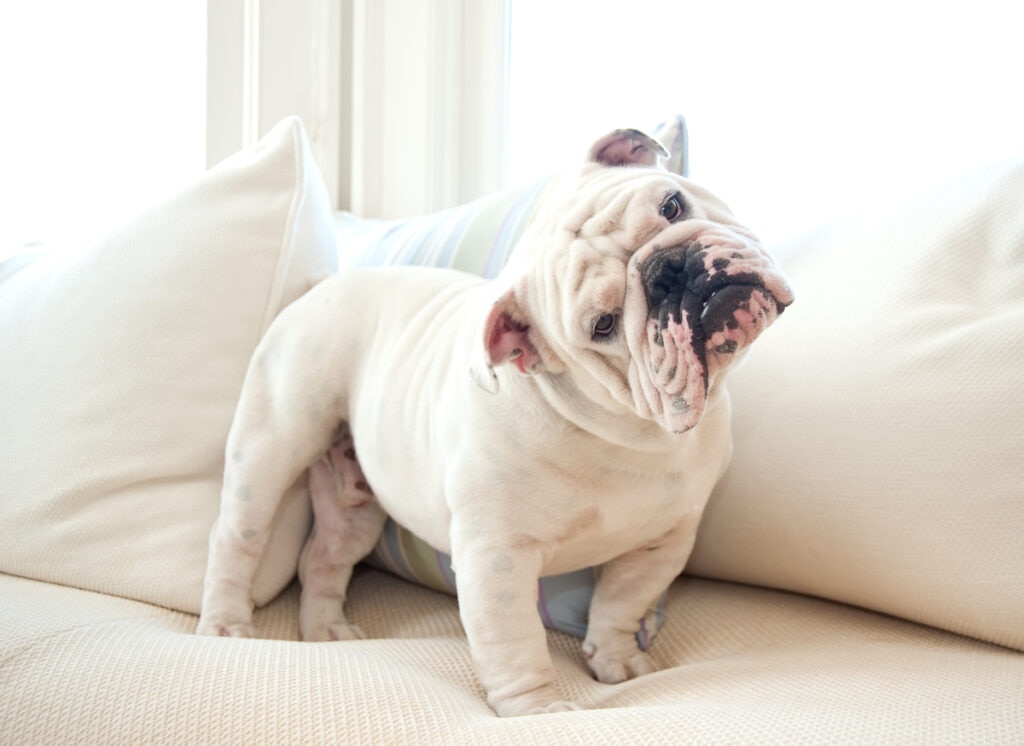
Istock/Philary
Dogs may tilt their heads to better process sounds, improve their view of something, gather information, or respond to words and cues they recognize.
Head tilting is a normal behavior in many dogs and is often associated with curiosity, attention, and learning. However, in some cases, a persistent head tilt can indicate an underlying medical problem.
While researchers are still studying the exact reason for this behavior, several interesting theories may help explain why dogs tilt their heads.
Key Takeaways
- Many dogs tilt their heads when listening, observing, or processing information.
- Head tilting may help dogs hear or see better.
- Some research suggests head tilting may be linked to cognition and word recognition.
- Individual dogs often tilt consistently to one side.
- A persistent head tilt accompanied by other symptoms may indicate a medical condition and should be evaluated by a veterinarian.
Why Do Dogs Tilt Their Heads?
Dogs tilt their heads for several possible reasons, including trying to better hear sounds, improve their view of something, process information, or respond to familiar words and cues.
Many people find head tilting endearing because it creates the impression that a dog is listening closely and paying careful attention.
While this behavior often strengthens the bond between dogs and their humans, researchers are still working to fully understand why it occurs.
For most dogs, head tilting is a normal behavior and is not a cause for concern. However, there are some medical conditions that can also cause a persistent head tilt, which is why context and accompanying symptoms are important.
Although research on canine head tilting remains limited, several theories may help explain why some dogs frequently tilt their heads when interacting with people or their environment.
Do Dogs Tilt Their Heads To Hear or See Better?
Possibly. Some researchers believe dogs may tilt their heads to better hear sounds or improve their view of something they are trying to focus on.
Head Tilting and Hearing
One theory suggests that head tilting helps dogs better orient themselves to sounds in their environment.
For example, many dogs will tilt their heads when hearing a new or unusual sound, such as air being blown across the top of a bottle. When encountering unfamiliar sounds, dogs may also show other signs of curiosity, such as forehead wrinkling or focused attention.
Research on how dogs localize sounds has shown that they commonly turn their heads, and the direction of the turn may be related to which side of the brain is processing the information.
However, there is currently limited research specifically examining whether head tilting serves the same purpose.
Head Tilting and Vision
Another theory is that head tilting helps dogs see objects more clearly.
Depending on the shape and length of a dog’s muzzle, tilting the head may improve their visual perspective and help them focus on something in front of them.
This idea is especially interesting for dogs with longer snouts, which may partially obstruct their forward field of view.
At this time, however, there is very little scientific research confirming or disproving whether vision plays a direct role in head-tilting behavior.
While hearing and vision remain two of the most commonly discussed explanations, researchers are still working to better understand exactly why dogs tilt their heads.
Is Dog Head Tilting Related to Cognition?
Possibly. Some research suggests that head tilting may be connected to how dogs process and interpret information.
A study on canine head tilting explored whether the behavior could be related to the way dogs use different sides of their brains when processing sounds and language.
Gifted Word Learners Tilt More Often
Researchers found that head tilting occurred most frequently in dogs classified as Gifted Word Learners (GWLs).
These dogs are capable of learning and remembering multiple toy names and retrieving those toys more reliably than would be expected by chance.
In one experiment, GWL dogs tilted their heads approximately 43% of the time when asked to retrieve a toy by name, compared with only 2% of non-GWL dogs.
Head Tilting May Help Dogs Process Information
One theory is that head tilting may help dogs identify and connect spoken words with stored memories or visual images.
For example, a dog may tilt its head when hearing a familiar phrase such as "Want to go for a ride?" because it is retrieving a learned association and anticipating a meaningful event.
This possibility suggests that head tilting may sometimes occur during active cognitive processing rather than simply as a response to sound or vision alone.
Many Dogs Have a Preferred Tilt Direction
Researchers also observed that dogs who tilted their heads tended to do so consistently in the same direction.
This may indicate that preferred tilt direction is an individual characteristic, similar to how humans often have a dominant hand or side of the body.
However, this observation may not fully align with theories that attribute head tilting solely to hearing or vision.
Positive Reinforcement Can Strengthen the Behavior
Regardless of the original cause, head tilting often receives enthusiastic responses from humans.
Because dogs learn through consequences, attention, praise, laughter, and affection may reinforce the behavior over time.
As a result, some dogs may begin offering head tilts more frequently and can even learn to perform the behavior on cue as a trained trick.
When Is a Dog's Head Tilt a Cause for Concern?
While occasional head tilting is usually normal, a persistent head tilt that occurs without an obvious trigger may indicate an underlying medical condition.
If your dog consistently holds their head to one side when they are not responding to sounds, people, or environmental stimuli, a veterinary evaluation is recommended.
Possible Medical Causes of Head Tilting
Several health conditions may contribute to an abnormal head tilt, including:
- Ear infections
- Damaged eardrums
- Nutritional deficiencies
- Vestibular disease
- Inner ear tumors or growths
Signs That Require Veterinary Attention
A medically significant head tilt is often accompanied by additional symptoms, such as:
- Circling
- Stumbling or loss of balance
- Difficulty walking
- Drooling
- Vomiting
Vestibular Disease and Head Tilting
One of the more common causes of an abnormal head tilt is vestibular disease, a condition that affects balance and spatial orientation.
Dogs with vestibular disease may develop a noticeable head tilt along with movement abnormalities and nausea-like symptoms.
In some cases, vestibular disease may be associated with inner ear problems, tumors, or other underlying conditions.
When To Contact a Veterinarian
If your dog develops a persistent head tilt or any of the symptoms listed above, contact your veterinarian as soon as possible for a diagnosis and treatment plan.
Many dogs with vestibular disease and other treatable causes of head tilting recover well when the underlying condition is properly addressed.
If your dog occasionally tilts their head while listening to your voice, responding to familiar words, or observing something interesting, the behavior is generally considered normal and may simply be one of your dog's most endearing traits.
Why Do Dogs Tilt Their Heads FAQs
Why do dogs tilt their heads when you talk to them?
Dogs may tilt their heads when you speak because they are trying to better hear, process, or interpret sounds and words they recognize.
Do dogs tilt their heads because they are confused?
Sometimes. Head tilting may occur when dogs are processing unfamiliar sounds, trying to understand information, or matching words with known experiences.
Do dogs tilt their heads to hear better?
Possibly. Some researchers believe head tilting may help dogs better orient themselves toward sounds.
Why does my dog always tilt their head to the same side?
Research suggests many dogs have a preferred head-tilt direction, which may be related to individual brain processing patterns or lateralization.
When should I worry about my dog's head tilt?
If the head tilt is persistent, occurs without obvious triggers, or is accompanied by symptoms such as stumbling, circling, vomiting, or drooling, contact your veterinarian immediately.


