Luxating Patellas in Cats: Symptoms and Treatment


FatCamera/E+ via Getty Images
A luxating patella in cats occurs when the kneecap slips out of its normal groove, causing limping, skipping, or trouble jumping. Mild cases may only cause occasional symptoms, but more severe cases can lead to pain, arthritis, and the need for surgery.
If your cat briefly holds up a back leg or seems hesitant to jump, a luxating patella could be the cause. Here’s what pet parents need to know about symptoms, causes, and treatment options.
Key Takeaways
- A luxating patella in cats occurs when the kneecap slips out of its normal groove, causing limping, skipping, or difficulty jumping.
- Severity is graded from I to IV, with higher grades more likely to cause pain, arthritis, and the need for surgical correction.
- Mild cases may be managed with rest, weight control, and pain medication, while severe or persistent lameness often requires surgery for the best outcome.
What Is Luxating Patella in Cats?
A luxating patella in cats is a physical condition in which a feline’s kneecap, called the patella, moves out or becomes dislocated from its normal position (luxates).
In people, this condition is sometimes referred to as a “trick knee.”
In cats, the knee joint is set between the thigh (femur) and the shin (tibia). The kneecap itself is an oval-shaped bone set in a deep groove called the trochlear groove at the end of the thigh.
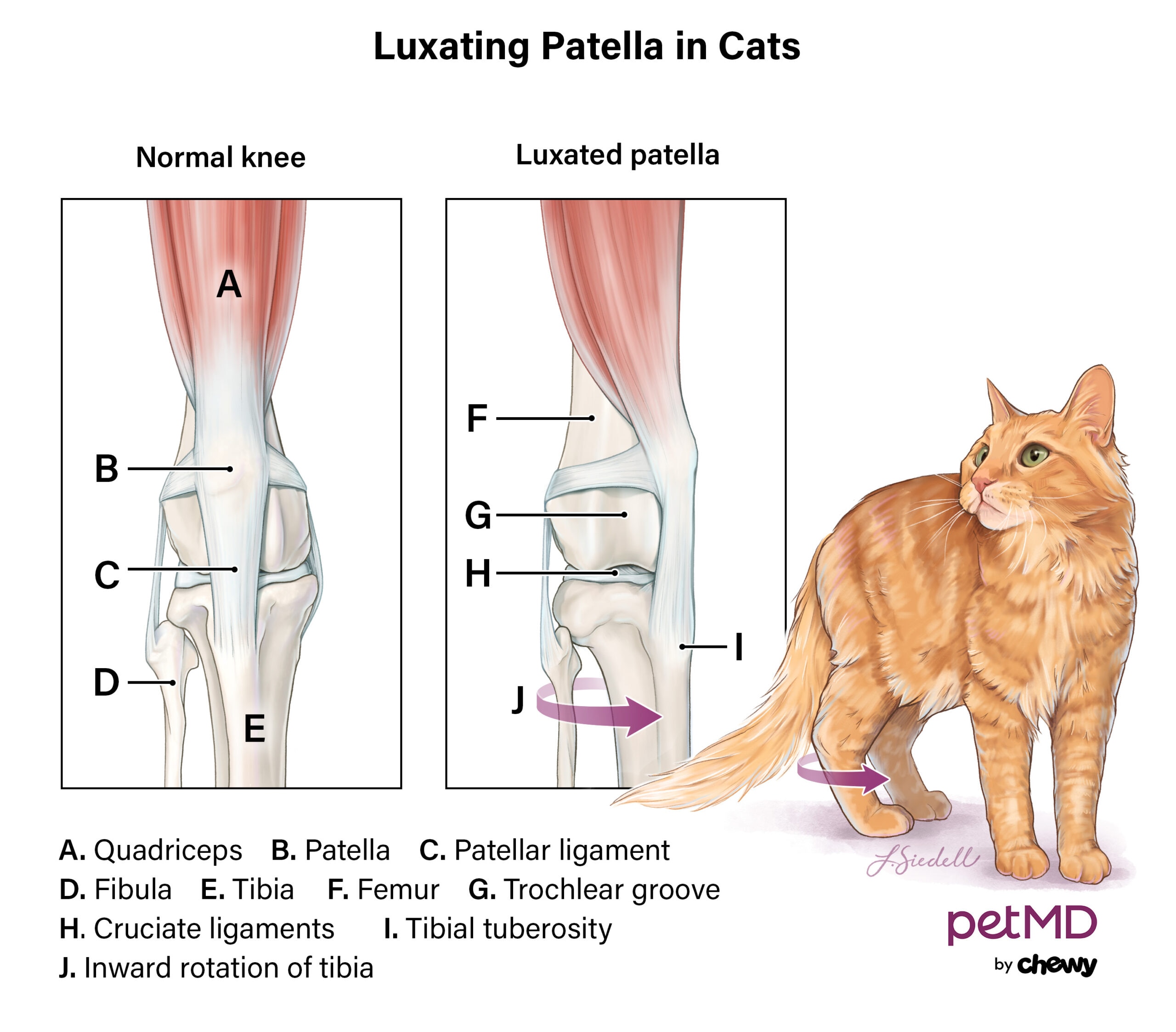
Click here to download this medical illustration.
A patella luxation occurs when the kneecap moves away (either inside or outside) from this groove.
Types of Luxating Patella in Cats
If a cat’s knee moves to the inside, it’s known as a medial patellar luxation (MPL).
When the kneecap moves outside the groove, a vet will diagnose it as a lateral patellar luxation (LPL).
Grading Luxating Patella in Cats
For either type, a luxating patella is diagnosed based on a grading system (I to IV), with the severity increasing as the grades go higher. The grades are:
-
Grade I patellar luxation means that the patella can be pushed out of the trochlear groove with manual pressure but will immediately return to its original position when pressure is removed.
-
Grade II patellar luxation means that the patella will sometimes move in and out of the trochlear groove on its own and only moves back to its original position when the leg is extended and rotated (most cats will do this on their own and do not need help replacing the kneecap).
-
Grade III patellar luxation means that the patella is out of the trochlear groove most of the time but can be pushed back into the groove with manual pressure (basically the opposite of Grade I).
-
Grade IV patellar luxation means that the patella is always out of the groove and cannot be replaced with manual pressure.
Over time, the kneecap’s constant movement in and out of the trochlear groove will rub away the cartilage in the joint, causing inflammation and eventually arthritis.
Arthritis causes pain and stiffness and can eventually lead to the breakdown of other vital ligaments in the knee joint, such as the cranial cruciate ligament (CCL), making the cat more prone to CCL tears.
Symptoms of Luxating Patella in Cats
Symptoms of luxating patella in cats include:
-
Occasional or constant limping on one or both back legs
-
Difficulty jumping onto things like beds and tables
-
“Skipping” on a back leg (holding it up for a few steps then replacing weight onto that leg)
-
Persistent lameness
-
Bow-legged stance (if both knees are affected)
-
Unwillingness to move around
Health Tools
Get quick answers with our vet-created Symptom Checker
Causes of Luxating Patella in Cats
Luxating patella in cats is not common in most breeds. Typically, they are due to:
-
Genetics, in breeds like Abyssinians, the Devon Rex, and the American Shorthair
-
Abnormalities in a cat’s anatomy
-
Injury, such as falling or other blunt force trauma, like getting hit by a car
How Veterinarians Diagnose Luxating Patella in Cats
A luxating patella in cats is typically diagnosed during a physical examination by a veterinarian.
Your vet will massage and feel the knee and manipulate the leg and patella to see if movement is possible. They will also monitor your cat’s gait while he walks to note any lameness or “skipping” motions.
If the luxation is chronic, the vet may detect a grating sound when palpating the affected joint.
Radiographs (X-rays) of the knee joint are usually taken to determine the severity of arthritis, if any, and to check for any other abnormalities. This is especially important if the luxation is due to trauma.
Treating Luxating Patella in Cats
Treating luxating patella in cats depends on its severity, as well as the cat’s age, their symptoms, and any other anatomical abnormalities or injuries.
Mild to moderate luxation may be treated with rest and anti-inflammatory medication (like Onsior and gabapentin) while more severe cases often require surgical correction.
Surgery should be considered for any cat that continually or intermittently limps, lameness that lasts over one to four weeks, or is diagnosed with a grade III or IV patellar luxation.
After surgery, your vet will usually suggest that the pet parent restricts exercise for at least two weeks, while encouraging mild activity such as passive range of motion exercises (PROM) and stretching.
If the luxation requires more aggressive surgical correction (usually for grade III and IV luxation), the vet may recommend four to six weeks before any exercise.
Recovering from Luxating Patella in Cats
As with treatment, recovery depends on the severity of the luxating patella in cats.
Typically, recovery involves rest and pain and anti-inflammatory medication.
If arthritis has already developed in the joint, there may be intermittent soreness/pain in the leg.
-
Prognosis for grade I, the mildest type, is typically positive, even without surgery
-
Prognosis for grade II and III is typically positive although the cat may require surgical correction
-
Prognoses for grade IV and chronic luxations are guarded due to a higher likelihood of arthritis
Cats with grade IV patellar luxation (or had a previous femoral fracture or knee surgery) have a higher risk of complications.
Managing the condition for all grades may include:
-
Managing healthy weight of the affected cat
-
Non-steroidal anti-inflammatory medication (NSAIDs)
-
Pain medications (such as gabapentin or buprenorphine)
-
Joint supplements (glucosamine, chondroitin, omega 3/6 fatty acids) and Adequan)
Be aware of your cat’s environment, especially if they seem uncomfortable or are recovering from surgery, help to avoid the stairs, and place the litter box and food/water near the cat’s sleeping area.
Luxating Patella in Cats FAQs
Are there any home remedies for luxating patellas in cats?
Unfortunately, there are no home remedies for a luxating patella in cats. There are no safe over the counter pain medications available for cats and treatment should include a trip to the vet for an exam and appropriate treatment.
How much does cat luxating patella surgery cost?
Depending on the surgery performed luxating patella surgery in cats can be from $1500 - $5000 per knee. Variables include the type of vet doing the surgery (orthopedic surgeon vs general surgeon), the kind of hospital the surgery is done at, your location, and the degree of severity of the luxation.
Can a luxating patella correct itself in cats?
With a grade I patellar luxation, they can correct themselves, but it is temporary. Over time, luxations do get worse and will need medical or surgical treatment for pain and arthritis support.
Can luxating patella in cats be treated without surgery?
Grade I and mild grade II patella luxation's can be corrected without surgery if the pain and arthritis can be controlled medically.
How long does it take a cat to recover from luxating patella?
The amount of time it takes to recover from a luxating patella depends on a few factors.
It depends on the degree of the luxation and the type of treatment plan.
A grade I or mild grade II can take four to six weeks of strict rest and medication while the more serious grades can take months to recover from surgery.


