Heart Murmur in Cats: What It Is and How To Manage It


Istock/Vasyl Dolmatov
Heart murmurs in cats are abnormal heart sounds caused by turbulent blood flow through the heart.
Some heart murmurs are innocent and aren’t associated with heart disease, while others can be caused by congenital defects, heart disease, or other underlying health conditions.
Because an innocent murmur can sound similar to one caused by severe heart disease, all heart murmurs in cats should be evaluated by a veterinarian.
Key Takeaways
- A heart murmur in cats is an abnormal heart sound caused by turbulent blood flow through the heart.
- Heart murmurs are graded from I–VI based on how loud they sound and may be congenital, acquired, or innocent.
- Cats often have no noticeable symptoms until underlying heart disease progresses.
- An echocardiogram is considered the gold standard for investigating the underlying cause of a heart murmur.
- Treatment depends on the underlying cause; innocent heart murmurs generally do not require treatment.
What Is Heart Murmur in Cats?
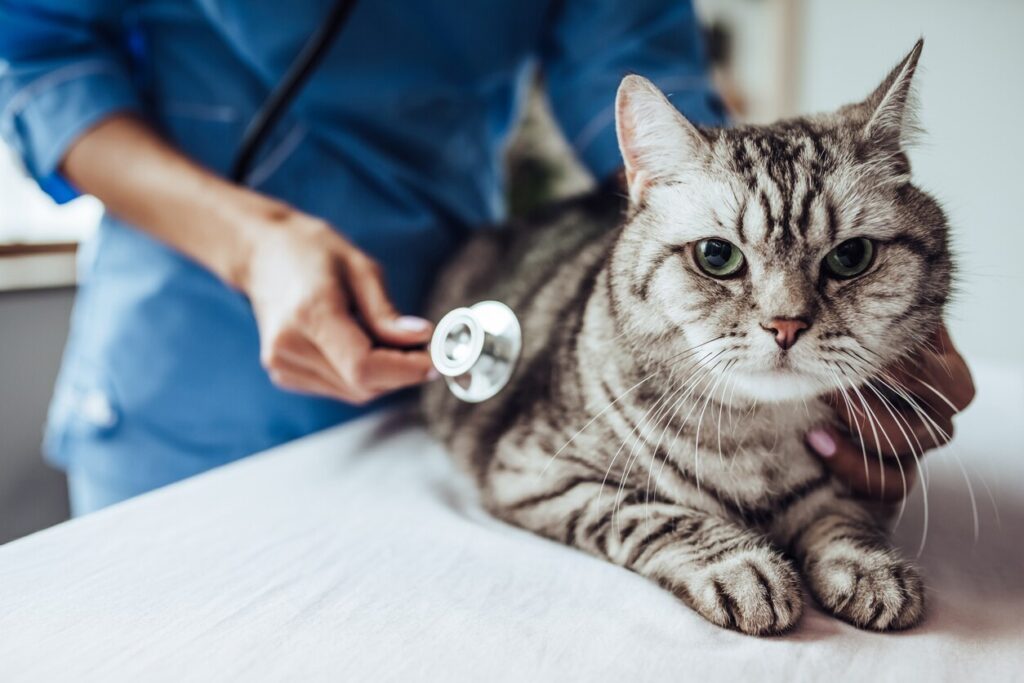
A heart murmur in cats is an abnormal heart sound heard with a stethoscope and is caused by turbulent (rough) blood flow through the heart.
Normally, the heart produces two sounds—the familiar “lub” and “dub.” An extra sound or “whooshing” noise heard when the heart beats is considered a heart murmur.
Heart murmurs are common in middle-aged to older cats, although they can also occur in younger cats with congenital issues.
Blood normally flows smoothly through the heart’s four chambers and valves. When something disrupts that flow, turbulence occurs and changes the normal heart sounds.
Turbulent blood flow can result from heart valve malfunctions, holes in the walls of the heart or arteries, narrowing of blood vessels or heart chambers, excitement and fast heart rates, or thinning of the blood (anemia).
How Heart Murmurs in Cats Are Classified
Heart murmurs are classified in three ways:
- Grade: How loud the murmur sounds
- Configuration: When the murmur is loudest during contraction and relaxation of the heart
- Location: Where the murmur is heard with a stethoscope
The grade, location, and configuration can help veterinarians identify the underlying cause.
Heart Murmur Grades in Cats
Veterinarians grade heart murmurs on a scale of I–VI based on how loud the murmur sounds through a stethoscope. This is a subjective scale based on what the veterinarian hears.
- Grade I: Audible only to a trained ear or hardly heard at all
- Grade II: Soft but audible
- Grade III: Intermediate and the most common grade of heart murmur
- Grade IV: Louder murmur that radiates across the heart, often on both sides of the chest
- Grade V: Loud murmur with a noticeable “thrill” or vibration felt when touching the chest wall
- Grade VI: The loudest murmur, heard before the stethoscope even touches the chest, often with a noticeable “thrill” or vibration felt at the chest wall
Finding the exact location of a heart murmur can be difficult in cats because of their small chest cavities, and murmurs are often heard best along the sternum.
Types of Heart Murmurs in Cats
Congenital heart murmurs: These are present at birth or soon after birth and are often associated with heart defects. They can be quiet early in life and may not be found until later as the cat grows and matures.
Acquired heart murmurs: These develop at any point in life. They may be benign or associated with heart disease such as hypertrophic cardiomyopathy (HCM).
Innocent or benign heart murmurs: These occur without underlying heart disease. They can be found in cats of any age and are usually intermittent, meaning they come and go, and are quiet when heard with a stethoscope.
What Are the Symptoms of a Heart Murmur in Cats?
Cats with a heart murmur often do not show noticeable symptoms until underlying heart disease progresses and signs of congestive heart failure or thromboembolism (blood clots) develop.
Heart murmurs are often found incidentally during a routine physical examination. Your veterinarian will discuss possible causes and next steps for diagnosis.
Symptoms associated with severe heart disease, heart failure, or thromboembolism may include:
- Chronic weight loss or muscle wasting
- Decreased appetite
- Hiding behavior
- Weakness
- Coughing or wheezing
- Exercise intolerance, including panting with mild exertion
- Increased respiratory rate at rest
- Increased effort to breathe
- Fluid from the mouth or nostrils
- Gums that appear blue, gray, or white
- Lethargy
- Collapse
- Paralysis of the hind limbs
- Painful vocalization
- Stunted growth in kittens with severe congenital causes
What Causes Heart Murmurs in Cats?
Heart murmurs in cats can be caused by underlying conditions that affect blood flow, including anemia, anxiety, high blood pressure, heart disease, congenital heart defects, and other cardiovascular conditions.
Causes of heart murmurs in cats can include:
- Anemia
- Anxiety
- High blood pressure
- Heart disease
- Hypertrophic cardiomyopathy (HCM)
- Heart wall defects or holes in the heart walls (atrial or ventricular septal defects)
- Heart valve deficiencies involving the mitral, tricuspid, or aortic valves
- Stenosis (narrowing) of the subaortic, aortic, mitral, tricuspid, or pulmonic valves
- Patent ductus arteriosus (PDA), a congenital heart defect in which an important blood vessel fails to close properly after birth
- Tetralogy of Fallot, severe congenital malformations of the heart
- Thromboemboli (blood clots) in the heart or vessels
- Heartworm disease
- Endocarditis (infection of one or more heart valves)
Breed predispositions: Certain cat breeds are prone to some of the heart conditions associated with heart murmurs.
- Maine Coons are prone to moderate to severe HCM and HOCM.
- Persian cats, American Shorthairs, and British Shorthairs are prone to less severe cases of inherited HCM.
- Siamese cats have a higher rate of congenital PDA and inherited dilated cardiomyopathy (DCM).
How Is a Heart Murmur in Cats Diagnosed?
Veterinarians evaluate a heart murmur in cats with a physical examination and may use blood work, chest X-rays, an echocardiogram, or an electrocardiogram (EKG) to investigate the underlying cause.
Listening with a stethoscope can help determine the murmur's location, configuration, and grade, but it typically cannot identify the underlying cause on its own.
An innocent or benign heart murmur can sound similar to a murmur caused by severe heart disease, so all heart murmurs should be thoroughly evaluated by a veterinarian.
Blood work: Your veterinarian will likely recommend full blood work, which may include cardiac proBNP. This provides a quantifiable value for the amount of stretch on the heart muscle.
Concerning symptoms and consistently increased proBNP levels can suggest underlying heart disease in cats.
Blood work can also help rule out anemia or an underlying systemic disease, such as hyperthyroidism, that can contribute to heart disease.
Chest X-rays: Chest radiographs may be recommended to assess the size of the heart, evaluate the vessels going to and from the heart, and check the lungs for fluid or signs of congestive heart failure (CHF).
Echocardiogram: An echocardiogram, or ultrasound of the heart, is considered the gold standard for investigating the underlying cause of a heart murmur.
Electrocardiogram (EKG): An EKG may be recommended if an abnormal heart rhythm is noted.
How Are Heart Murmurs in Cats Treated?
A heart murmur itself does not require treatment, but the underlying condition causing the heart murmur may need to be treated. Treatment depends on the underlying cause and severity.
Innocent or benign heart murmurs: These usually do not require treatment.
Congestive heart failure (CHF): Depending on its severity, CHF may require hospitalization, diuretics such as furosemide, cardiac medications such as benazepril, and oxygen therapy.
In many cats with CHF, pleural effusion (fluid buildup around the lungs) may need to be removed through a procedure called thoracocentesis to allow the lungs to fully expand again.
Congenital heart disease: Some congenital heart murmurs associated with small holes in the heart walls (septal defects) may resolve within six months as the cat grows. In some cases, surgery is necessary to close a patent ductus arteriosus (PDA) or septal defect.
Other underlying conditions: Treating health conditions such as anemia or hyperthyroidism may help with the underlying heart murmur.
Your cat's age, overall health, and the cost of therapy may also be important considerations when treating heart disease.
Each case is different. Your veterinarian will work with you to determine the appropriate diagnostic and treatment plan and discuss your cat's prognosis.
Recovery and Management of Heart Murmur in Cats
Recovery, management, and prognosis for a heart murmur in cats depend on the underlying cause and response to treatment. Close monitoring is important to check for progression of heart disease.
Veterinary monitoring: Cats with congestive heart failure (CHF) or congenital cardiac issues may need veterinary checkups every few months, along with blood work and X-rays to determine whether their condition is stable or medications need to be added or adjusted.
Prognosis: Prognosis can range from excellent for benign heart murmurs to grave for severe congenital or acquired heart disease.
In most cases, long-term management focuses on your cat's quality of life and comfort rather than a cure.
Heart Murmur in Cats FAQs
Do all heart murmurs in cats sound the same?
No. Heart murmurs in cats vary based on their grade (loudness), configuration (whether the murmur is heard during contraction or relaxation of the heart), and location.
What is the prognosis for cats with a heart murmur?
The prognosis for a cat with a heart murmur depends on the underlying cause and response to treatment.
Prognosis is typically excellent for benign heart murmurs but can be grave when severe heart disease is present.
What is an “innocent murmur” in cats?
An “innocent” or benign heart murmur is an abnormal heart sound that occurs without underlying heart disease.
Innocent heart murmurs can occur in cats of any age and are usually intermittent, meaning they come and go, and quiet when heard with a stethoscope. Innocent heart murmurs can only be confirmed with an echocardiogram, or ultrasound of the heart.
Do heart murmurs in cats always mean heart disease?
No. Some heart murmurs in cats are innocent or benign, meaning there is no underlying heart disease causing the abnormal heart sound.
However, an innocent heart murmur can sound similar to one caused by severe heart disease, so heart murmurs should be thoroughly evaluated by a veterinarian.
Can a heart murmur in a cat go away?
Some congenital heart murmurs associated with small holes in the heart walls (septal defects) may resolve within six months as a cat grows.
Innocent heart murmurs can also be intermittent, meaning they may come and go.


