Wound Care for Horses


Jacob Wackerhausen/iStock / Getty Images Plus via Getty Images
Horses are naturally very curious creatures, which unfortunately makes them prone to getting cut or injured.
Face and leg wounds are extremely common in horses, so it’s important to be prepared in case your inquisitive equine runs into some trouble.
Key Takeaways
- Always keep a first aid kit for horses on hand and restock items regularly.
- Do not remove anything large or metal punctured in your horse’s skin and wait for a veterinarian to assess.
- All wounds should be cleaned thoroughly and bandaged accordingly to prevent infection and promote healing.
Basic Equine First Aid Kit for Horses
Every horse owner should keep a basic first aid kit in their tack box. Essentials include:
-
Your vet’s phone number—any time your horse has a full-skin cut, or major wound, the first step should be to call your veterinarian
-
Thermometer
-
Gloves
-
Non-stick Telfa pads
-
White gauze roll or cast padding
-
Combine Redi-Rolls or sheet cotton
-
Brown gauze
-
Elastikon
-
Hydrogen peroxide
-
Saline
-
Chlorhexidine or betadine solution (always dilute with bottled water before using)
-
Rubbing alcohol
-
4x4 gauze sponges
-
Bandage scissors
-
Epsom salt
-
Diapers
-
Duct tape
-
Hoof pick
Assessing a Horse’s Wound
If your horse has a large wound, is in distress, or is painful when you attempt to clean the wound, wait for your vet to arrive so they can treat the wound safely with sedation.
If the wound is small and easy to clean, call your vet in the morning, rather than in the evening during emergency hours.
Before cleaning a wound, check to see if there are any foreign objects within it.
-
If there is a small foreign body within the wound, you can try to remove it, but save the object for your veterinarian to evaluate.
-
If there is a large, or metal penetrating object, wait for your veterinarian to arrive so they can take X-rays if needed.
-
If your horse has stepped on a nail, DO NOT REMOVE the nail. It’s important for your veterinarian to evaluate the puncture before removal to determine potential damage. Removing the nail yourself could cause further damage.
How To Clean a Horse Wound
For uncomplicated wounds, the first step is to apply pressure to the wound if possible to slow any bleeding that is more than a drip. Small wounds should generally stop bleeding in less than 10 minutes.
If the wound is not actively or significantly bleeding, you can clean the wound while you wait for your veterinarian to arrive.
-
If your horse has a facial wound, clean it with some saline-soaked 4x4s or with a gentle rinse.
-
Do not use chlorhexidine or betadine near the eyes, as it can be irritating.
-
-
If your horse has a wound on the leg or body, clean the area gently with the hose by running cool water over it, then rinse the wound with chlorhexidine and saline or isopropyl alcohol.
Do not apply any wound powders before your veterinarian arrives, in case the wound needs to be sutured closed. The powders can be very hard to clean out.
How To Bandage a Horse Wound
If the wound was bleeding significantly, is on the lower half of the limb, or created a flap, applying a bandage will help keep tissues clean until your vet can examine the damage.
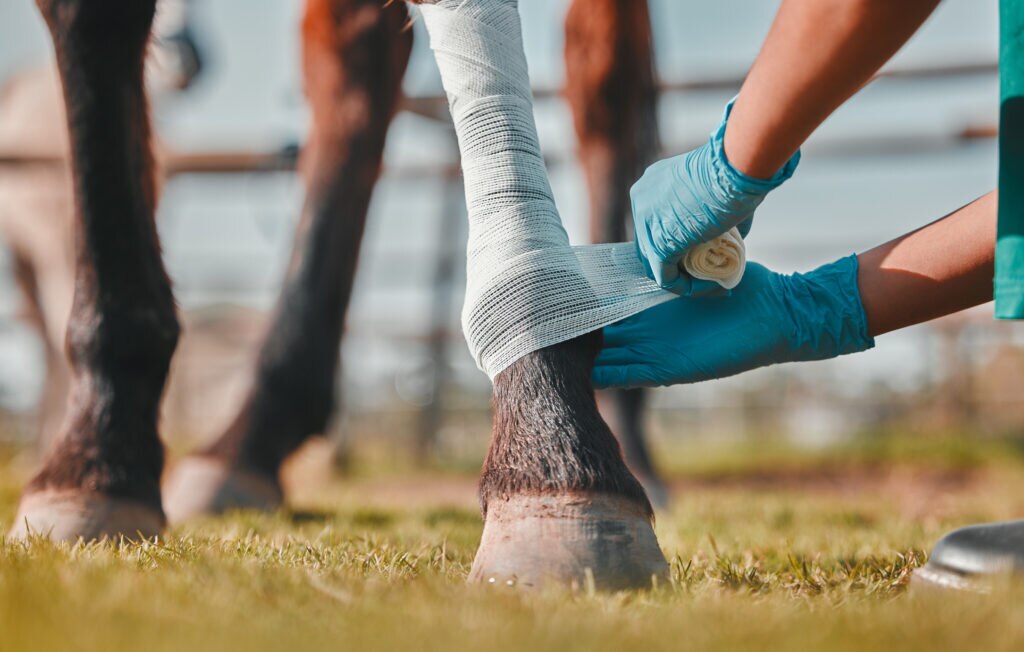
Apply a lower leg bandage by following these steps:
-
Clean the area well (see above).
-
Apply a non-stick pad to the wound.
-
Gently cover and wrap with a self-adhesive bandage such as Vetrap.
For right legs, wrap clockwise, for left legs, counter-clockwise.
It’s very important not to wrap too tightly. These practices will help prevent tendon damage.
If the leg wound is still bleeding, you can apply a thicker bandage wrap using these steps:
-
Apply the non-stick pad(s) over the wound, then gently wrap (without tension) a few circles around the leg with cast padding or white gauze to keep the non-stick pad in place.
-
Wrap a few times with the combine roll or sheet cotton to add some padding. As noted above, wrap in the correct direction depending on which leg you’re working on.
-
Wrap with brown gauze rolls. Apply even tension to the roll to prevent creating areas of focal pressure. Start 1 inch below the top of the bandage, work down and back up to finish the roll. Each circle around the leg should cover about 50% of the wrap segment before it to apply even coverage.
-
Apply Vetrap with even tension to avoid wrinkles, but don’t pull too tight where the Vetwrap looks thin or see-through. Leave the top and bottom inch or so exposed of the combine roll.
-
Apply a few circles of Elastikon around the top and bottom of the bandage. Start by covering both the exposed combine roll and skin above the bandage. Wrap a few times gently, without too much tension; this is to help keep the bandage up at the top, and to keep dirt out of the bottom.
-
Keep your horse stalled or in a small quiet area until your veterinarian arrives.
If the wound is large on the hips, chest, or back, you can attempt to cover it with a clean sheet or towel with Elastikon to prevent further irritation and drying of the tissues. If that’s not possible, frequent cold hosing will be beneficial.
Sutures and Antibiotics for Horse Wounds
If your horse cut themself through full-skin thickness, they should be evaluated by your veterinarian. Sutures (stitches) may be needed depending on how long ago the wound occurred, the thickness, and surrounding structures.
Drains may also be placed if the area is producing fluid, which prevent bacteria from growing in a “closed” space, then busting the sutures open as the tissue dies. Alternatively, you can leave the wound open and allow healing supportively.
Antibiotics will typically be given if the wound warrants suturing. If there’s excess tissue damage, your veterinarian may prescribe anti-inflammatories (phenylbutazone, Banamine) for several days to help with inflammation and pain.
If the wound doesn't require stitches, your vet may prescribe an antibiotic or healing ointment to help facilitate healthy tissue growth during recovery, and instruct you to bandage the area on a specific schedule.
Lacerations near the eyes, nostrils, or lips will likely need sutures to help the face heal with minimal scarring and to prevent excess dirt and debris from getting in.
If the wound is anywhere near a joint, tendon sheath, or penetrating the body, your veterinarian will perform a thorough evaluation to check for spots of potential complications and secondary infections. This may include:
-
Ultrasound
-
X-rays
-
Tapping a joint (placing a needle in the joint space), then pushing saline with antibiotics through
If a joint becomes infected, treatment becomes much more aggressive; septic joints can spread bacteria throughout the body. This can lead to significant joint damage, future arthritis, or in significant cases, sepsis and death.
Wounds with flaps will likely need sutures, as these pieces of tissue do not keep adequate blood supply on their own, and often die away.
Tetanus Protection in Horses
A wound as small as a paper cut can allow the bacteria Clostridium tetani into the bloodstream. This often-fatal disease can progress rapidly and is difficult to treat.
If your horse has not had a tetanus vaccine within six months, your veterinarian will recommend giving them a booster vaccine.
Always keep your horse’s routine vaccines up to date.
Horse Wound Healing Complications
If you notice any of the following symptoms during the healing process, give your veterinarian a call so a recheck exam can be scheduled:
-
Dehiscense, or opening up, of the sutures before the wound has healed
-
Drainage or foul-smelling discharge/pus
-
Proud flesh or excessive granulation tissue development
-
Increased swelling or lameness if the wound was on a leg
-
Decreased appetite due to pain
-
Fever (body temperature over 101.5 F)
Horse Wound Prevention
Although horses will always try to find new ways to injure themselves, there are some common injuries that can be easily avoided.
-
Do not leave snaps on water buckets; feed and other buckets should have the handle hooks covered with tape, since they commonly cause eye laceration injuries.
-
Avoid barbed-wire fencing, and keep your pasture clear of debris.
-
Avoid housing horses together that do not get along. If possible, leave at least one stall, run, or spaced fence line between them if there are personality conflicts. Do not house stallions near mares as they may act up and hurt themselves around each other due to hormones.
Overall, wounds small and large are inevitable at one point or another when owning a horse. But a well-prepared horse owner can make treating and preventing wounds on their horses much easier.


