BOAS in Dogs: Everything You Need To Know


FatCamera/E+ via Getty Images
Brachycephalic obstructive airway syndrome (BOAS) is a breathing disorder that affects flat-faced dog breeds, such as Bulldogs, Pugs, Boston Terriers, and French Bulldogs, due to abnormalities in their upper airways.
Dogs with BOAS may snore, have noisy breathing, struggle to exercise, or experience serious breathing difficulties, especially in hot weather or during physical activity.
Because BOAS can worsen over time and significantly affect a dog’s quality of life, it’s important for pet parents to recognize the signs early.
Understanding the symptoms, causes, diagnosis, treatment options, and long-term management of brachycephalic obstructive airway syndrome can help affected dogs breathe more comfortably and reduce the risk of complications.
Key Takeaways
- Brachycephalic obstructive airway syndrome, or BOAS, is a set of airway abnormalities in flat-faced (brachycephalic) dogs—most narrowed nostrils, an elongated soft palate, and , that can restrict airflow and make breathing harder.
- Common signs include noisy breathing/snoring, gagging or retching, increased panting, exercise intolerance, overheating, and—when severe—blue gums or collapse, which should be treated as urgent.
- Management often includes weight control and avoiding heat, humidity, and overexertion, but surgery (often correcting multiple issues at once) may be recommended when symptoms are progressing or causing significant distress.
What Is BOAS in Dogs?
Brachycephalic is a term that refers to dog breeds with shortened snouts and flat faces. The term brachycephalic comes from the Greek words brachy, meaning short, and cephalic, meaning head.
Brachycephalic airway syndrome, BOAS in dogs, refers to a specific combination of abnormalities affecting a dog’s airway and breathing, resulting from selectively breeding for this appearance.
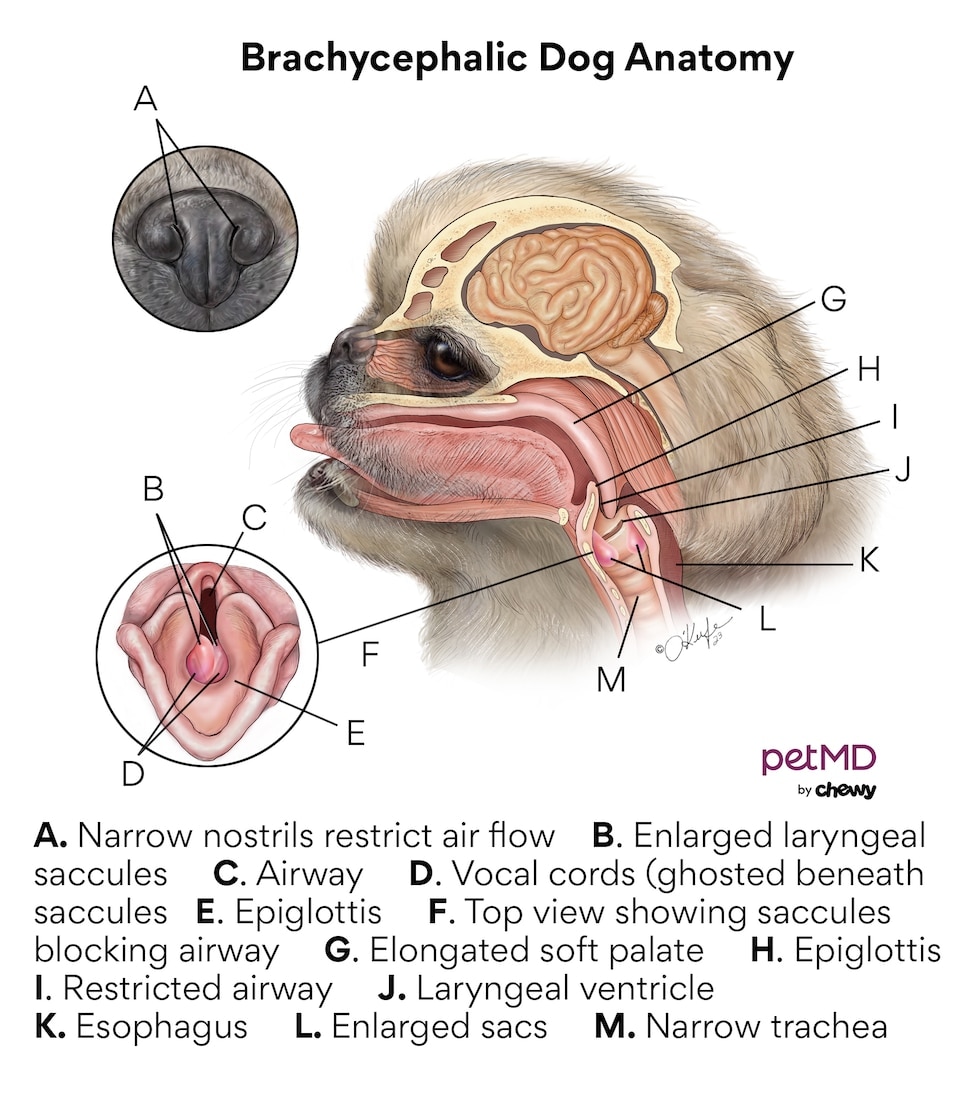
Click here to download this medical illustration.
Their unique smooshed face is a result of shortened skull, facial, and nasal bones. This structural shortening of the face also results in anatomical changes to their throat and airways, creating brachycephalic airway syndrome.
Specifically, BOAS in dogs refers to the combination of three functional abnormalities:
-
Stenotic nares: Referring to narrow nostrils or small nostril openings. This results in a decreased ability to breathe through the nose and restricted airflow, which leads to increased panting and a higher risk of overheating.
-
Elongated soft palate: The soft palate is the part of the roof of the mouth made up of tissue that separates the nasal passage from the oral cavity. Given brachycephalic dogs’ shorter snout, the soft palate is often too long for the length of their mouth. The excess flaps into the throat, causing snoring sounds and blocking airflow into the windpipe and lungs.
-
Everted laryngeal saccules: In normal anatomy, there are two small pockets (saccules) in the back of the throat. In brachycephalic dogs, there is an increased effort to breathe due to the stenotic nares and elongated soft palate. This increased effort to breathe can cause the saccules to turn inside out and further block the airway.
Additional airway-related conditions to brachycephalic airway syndrome include:
-
Hypoplastic trachea: This means the trachea, or windpipe, is congenitally smaller in diameter than normal. This can make it harder for dogs to breathe in enough air with each breath (like breathing through a straw).
-
Laryngeal collapse: The larynx, or voice box, can become damaged by chronic stress to the cartilage from working too hard to breathe. Laryngeal collapse leads to more blockage of the airway, and potentially trouble breathing.
Health Tools
Get quick answers with our vet-created Symptom Checker
Which Dog Breeds Are At Risk of BOAS in Dogs?
The following breeds are more at risk of developing BOAS in dogs:
Symptoms of BOAS in Dogs
Signs of BOAS in dogs are typically related to upper airway blockage due to the congenital anatomical conditions causing brachycephalic airway syndrome.
Symptoms may range from mild to severe and include:
-
Gagging or retching
-
Trouble breathing or increased effort to breathe
-
Exercise intolerance (tire easily with exercise)
-
Distended abdomen or vomiting from swallowing too much air while working to breathe
Causes of BOAS in Dogs
BOAS in dogs is a genetic condition resulting from intentionally breeding dogs for a cosmetic appearance of short snouts with flat faces.
Their anatomically shortened heads lead to structural changes to their throats and airways, which can cause trouble breathing and make these dogs prone to overheating.
Diagnosis of BOAS in Dogs
Diagnosis of BOAS in dogs will be largely based on the dog’s breed, clinical signs, and physical examination findings, such as stenotic nares (narrowed nostrils).
A classic breathing noise characterized as a low-pitched, snoring-type sound called stertor may be noted in dogs with brachycephalic airway syndrome.
Your veterinarian may want to perform a sedated oral examination to evaluate for elongated soft palate and everted laryngeal saccules (small pouches in the neck).
An X-ray of the neck and chest may also visualize the trachea (windpipe) and assess the heart and lungs. Blood work and urinalysis will also be recommended by your vet.
Treatment of BOAS in Dogs
Medical management of BOAS in dogs may be an option if symptoms are mild or infrequent.
Excessive weight worsens the symptoms, so medical management for brachycephalic airway syndrome includes weight loss if your dog is overweight or obese.
Heat and humidity can also worsen symptoms, so care should be taken to limit time outside during hot summer days.
Excessive exercise can increase stress of breathing and may exacerbate brachycephalic airway syndrome.
If your dog is having trouble breathing while at the vet, they may use mild sedatives to help your dog calm down and breathe easier.
Additional therapy may be initiated if appropriate, including steroids (dexamethasone), oxygen, and cooling measures, all designed to alleviate acute respiratory distress.
Medication may also be administered to address any gastrointestinal signs, such as vomiting. These medications may include famotidine or Cerenia.
Surgery may be considered if the structural abnormalities cause distress to your dog, become worse over time, or result in life-threatening trouble breathing from upper airway blockage.
Life-threatening would be defined as more than one episode where your pet has had trouble breathing and needed medical assistance.
Multiple procedures are usually required to alleviate the signs of brachycephalic airway syndrome, and include:
-
Stenotic nares resection: Surgically widening the nostrils.
-
Soft palate resection (staphylectomy): Surgical trimming of the soft palate to shorten the tissue.
-
Laryngeal saccule removal: Removing the everted saccules.
All three procedures can be performed at the same time, and this is typically most recommended.
Most dogs with brachycephalic airway syndrome are diagnosed by 4 years old, but surgical correction can be performed as early as 4 months of age.
Early diagnosis and surgical intervention may help reduce complications of chronic upper airway disease, such as developing laryngeal collapse.
If you have a brachycephalic breed, discuss brachycephalic airway syndrome with your veterinarian and ask if your dog is a possible candidate for surgery.
Recovery and Management of BOAS in Dogs
Dogs undergoing brachycephalic airway surgery are monitored carefully after surgery, as inflammation and bleeding are possible.
Typically, they will remain hospitalized in a 24-hour ICU for one to two days of observation.
The prognosis is good for young dogs, and most pet parents see a significant improvement in their pup’s breathing and ability to exercise.
However, prognosis may be more guarded in older dogs with a chronic history of trouble breathing, especially if they have started to develop laryngeal collapse. In cases of advanced laryngeal collapse, a tube may need to be inserted in the neck (permanent tracheostomy) to provide improvement in breathing.
For long-term management, it’s crucial to keep brachycephalic dogs lean and at an appropriate weight.
Working with your vet on a weight goal and, if needed, a weight loss plan may be very beneficial. A harness collar is recommended to take pressure off the neck, which is seen with a traditional neck collar.
Extreme care should always be taken to ensure that brachycephalic dogs do not overheat. Minimal activity or time outside during hot and humid weather is recommended, and always give them plenty of fresh water and access to shade.
Prevention of BOAS in Dogs
The main way to prevent brachycephalic airway syndrome in dogs is to refrain from breeding affected dogs, as the condition is genetic.
If you already have a flat-faced breed, you can reduce their risk of developing BOAS through the following:
-
Schedule veterinary checkups to identify abnormalities within the airway early so that corrective measures can be taken.
-
Keep your dog at an optimal weight through a healthy diet and exercise.
BOAS in Dogs FAQs
How long can a dog live with BOAS?
Dogs can live long lives with BOAS if the condition is appropriately managed and monitored by a veterinarian. However, due to the chronic stress on their bodies, dogs with BOAS do have shorter lifespans than other dogs.
Is BOAS painful for dogs?
BOAS is generally not painful, but it can cause extreme discomfort due to difficulty breathing. These dogs experience significant stress due to the way their airways are built.
How much does BOAS surgery cost for dogs?
BOAS surgery costs vary widely depending on geographic location. However, in general surgery the costs range from $2,000 to $5,000 or more to correct BOAS.
How do I tell if my dog has BOAS?
You may recognize your dog is snoring when breathing, getting tired after exercise, or panting more, which could all indicate abnormalities within their airway. The only way to know for sure whether your dog has BOAS is to see a veterinarian for a thorough exam.