Why Horses Can’t Breathe Through Their Mouths


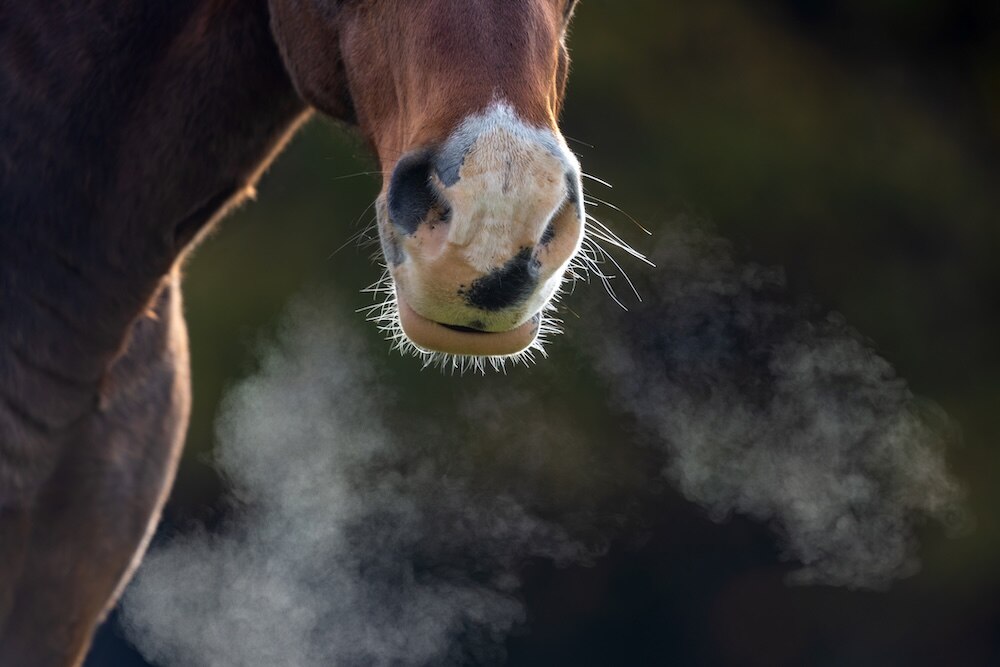
Have you ever noticed that horses can’t simply take a breath through their mouths like people can? It all comes down to the unique design of their upper airway.
Horses are considered “obligate nasal breathers,” meaning that under normal conditions, air travels to and from their lungs only through their nostrils. It’s important to understand how horses breathe to identify any respiratory issues, and to know how they can best perform as athletes.
Key Takeaways
- Horses are obligate nasal breathers, meaning they breathe through their nostrils rather than their mouths.
- The soft palate and structures around the larynx separate the mouth from the normal breathing pathway.
- Horses cannot switch to mouth breathing during exercise the way people can.
- Significant nasal or upper airway obstruction can interfere with breathing and may require urgent veterinary care.
Why Can’t Horses Breathe Through Their Mouths?
A horse’s upper airway begins at the nostrils and continues through the nasal passages, which are separated by a cartilage structure called the nasal septum. From there, air moves into the nasopharynx and then through the larynx and trachea, or windpipe, on its way to the lungs.
The nasopharynx sits above the soft palate. The soft palate is a flexible extension of the hard palate—the bony roof of the mouth—and is unusually long in horses. It extends from the back of the hard palate to the base of the epiglottis, a triangular piece of cartilage at the back of the tongue.
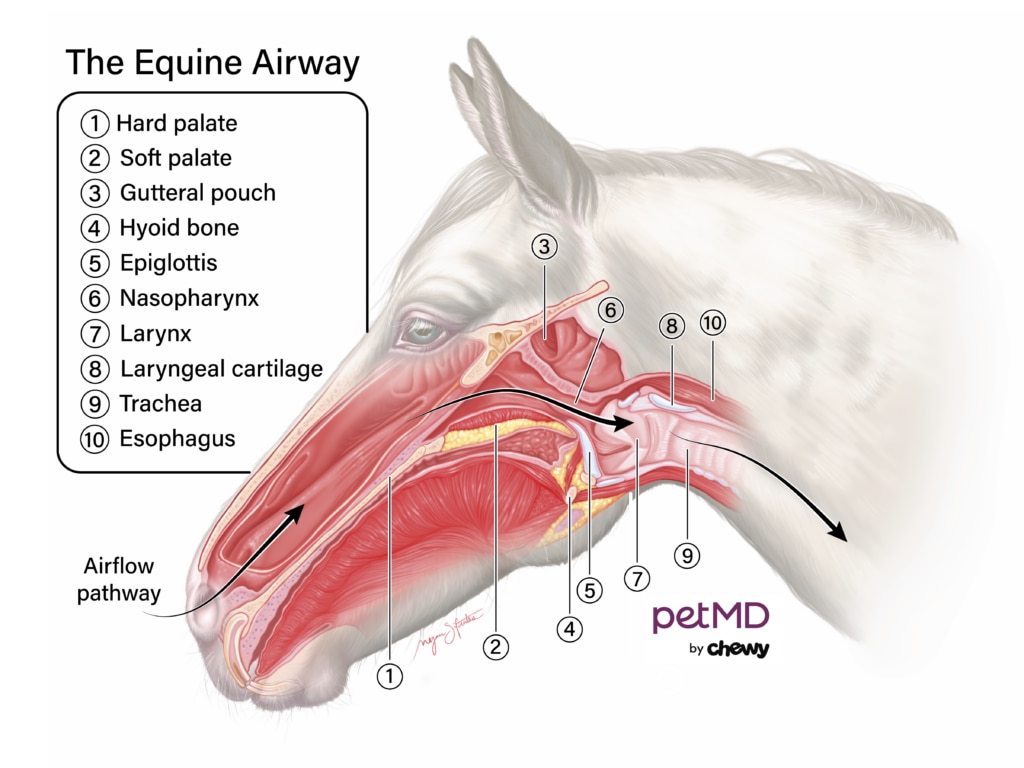
Click here to download this medical illustration.
When a horse swallows, the epiglottis helps cover the opening to the larynx, keeping food and water out of the airway. Because the horse’s soft palate fits snugly against the epiglottis, it also separates the mouth from the airway during normal breathing. As a result, air that enters through the mouth cannot pass into the trachea. Horses must breathe through their nostrils to move air into their lungs.
How Do Horses Breathe During Exercise?
During exercise, the demand for oxygen delivery to the body greatly increases. At rest, horses breathe 12–20 times per minute. However, during exercise, this can increase to up to 150–180 times per minute.
In humans, when we exercise and can’t get enough airflow through our nasal passages, the instinct is to breathe through our mouths to increase airflow. But horses cannot do that. Instead, they adapt to the increased breathing by flaring their nostrils and nasal passages and dilating their larynx in order to reduce resistance.
The horse's upper airway is subject to changes in airflow and pressure during breathing at this intensity. This creates pressure on the nasal passages.
Some riders help horses breathe easier by applying nasal strips during intense exercise or competition. These strips support the soft tissues overlying the nasal passages that can collapse during intense exercise, allowing the horse to move the air they need with less resistance.
Upper airway problems, like dorsal displacement of the soft palate or laryngeal paralysis, are more noticeable during exercise because they impede airflow. These airway problems may not be noticeable at rest but may decrease your horse’s performance during exercise.
Diagnostic tools like video scoping have been developed to diagnose these conditions; an endoscope is attached to your horse's nasal passage while they exercise.
Why Can Breathing Problems Be Serious in Horses?
Breathing problems in horses are not just a concern for maximal athletic performance, but also for general health and wellbeing.
Horses cannot simply bypass a blocked nasal airway by opening the mouth. The anatomy of their elongated soft palate blocks airflow from their mouth to their trachea (windpipe), so any nasal or upper airway obstruction may impede airflow.
Problems that may affect your horse’s breathing include:
- Nasal tumors
- Strangles, a serious respiratory disease
- Foreign material (like a stick that a horse may have inhaled)
- Swelling due to a snake bite
- Cicatrix (end-stage of tissue repair where normal skin is replaced by dense, fibrous connective tissue)
- Nasal polyp, a small, abnormal clump of cells
- Trauma to the nasal passage
Contact your veterinarian for an evaluation of your horse if you notice failure to quickly recover from exercise, new or unusual breathing noises, or labored or rapid breathing at rest.
Signs of a respiratory emergency that warrants an immediate call to a veterinarian include obvious difficulty moving air, signs of stress and panic, or marked nostril flaring at rest.
FAQs About Horse Breathing
Can horses breathe through their mouths?
Horses cannot breathe through their mouths. The way their upper airway is designed prevents this—air entering their mouth is blocked from getting to the trachea by the soft palate.
Why are horses called obligate nasal breathers?
Horses are described as obligate nasal breathers because they can only breathe through their nose.
Can horses breathe through their mouths while exercising?
No. Even while exercising, horses can still only breathe through their noses. This makes it imperative to have an unobstructed airway.
What happens if a horse’s nose is blocked?
If a horse’s nose is blocked, they need to be evaluated by a veterinarian. A complete blockage could be fatal.