Cat Body Condition Score


sdominick/iStock / Getty Images Plus via Getty Images
Obesity has a terrible impact on your cat’s health.
Being obese can predispose your cat to several diseases, like diabetes, lead to early arthritis, and even cancer.
Keeping your cat at a healthy body condition score can improve their life.
Key Takeaways
- The body condition score (BCS) is a 1–9 scale used to assess a cat’s weight and body fat, helping determine if they're underweight, overweight, or at an ideal weight.
- You can evaluate your cat’s BCS at home by checking for visible waistlines, belly tucks, and how easily ribs and bones can be felt—but your vet can give the most accurate assessment.
- Maintaining a healthy BCS can lower your cat’s risk for serious health conditions like diabetes and arthritis and improve their overall quality of life.
What Is a Cat Body Condition Score?
A body condition score (BCS) is a number assigned to your pet to help determine how fit they are.
A larger number is associated with being overweight, while a smaller number means your pet is underweight. Depending on which scale is used, there is an ideal body condition score range that you should aim to keep your cat at.
Although there are a few BCS systems out there, most veterinarians use a 1-9 system. It’s something you can learn so you can evaluate your cat.
The body condition score system is independent of the actual size of your cat, how muscular they are, or even how much fur they have. It helps to go beyond the number of pounds and see if they’re at a healthy weight for their body.
While your veterinarian will do a full body analysis of your cat to determine their BCS, there are ways that you can physically and visually evaluate your cat to get a general idea of was their BSC might be.
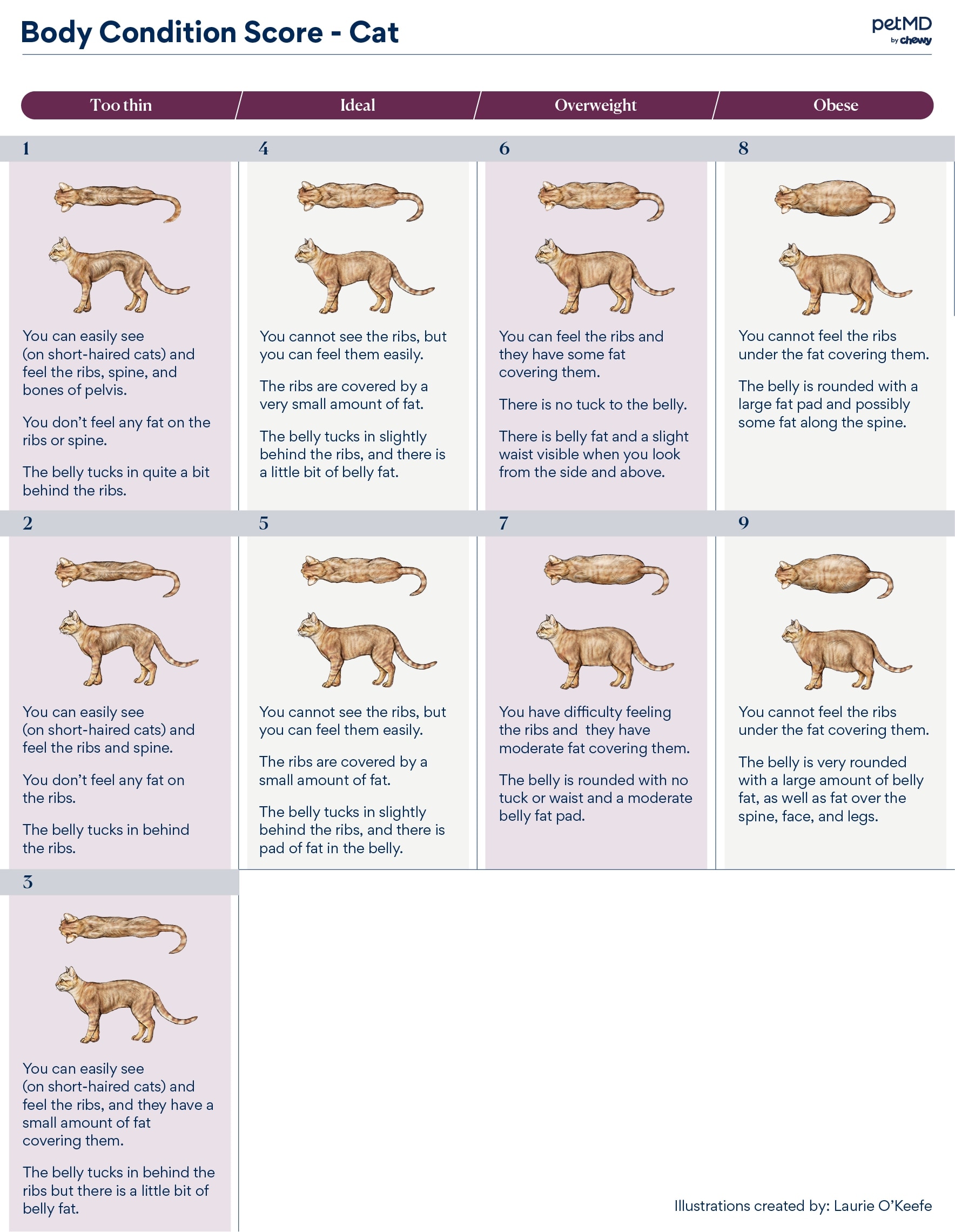
Click here to download this medical illustration.
How To Determine Your Cat's Body Condition Score
Cats will fall into three categories:
-
Underweight
Within these categories, your vet will determine the severity by giving a specific BCS from 1 to 9.
Here’s a breakdown of how you can evaluate your cat and what the characteristics are for each category.
Healthy Cat Weight: BCS 5
The ideal BCS for a cat is 5. A cat with a BCS of 5 will have the perfect blend of a little extra “reserve” fat without so much as to be causing health problems.
When viewed from the side, a cat at an ideal weight will have a small “tuck” right where the belly meets the area of the hips—in other words, the belly doesn’t drag across the floor.
The stomach should be held nice and tight up to the cat and will curve up to meet the hind legs.
When you look at the same cat from the top, you can see small indentations—a “figure 8” waist right in front of the hips.
If you pet a BCS-5 cat, you can feel both the backbone and the ribs, but you really can’t see them from any distance.
Underweight Cat: BCS 1-4
Occasionally, we see cats that are “too thin,” which will earn a score of 1-4. If a cat is a 1, that means they are extremely emaciated to the point of starvation. A cat at a 4 would be slightly underweight and will typically require a physical exam to determine the extent.
For these kitties, we see a severe tuck of the belly as it comes up to the hind legs, as well as a very noticeable “waist” from the top.
When you pet a cat with a low BCS, you can really feel the bones of the spine as well as those of the ribcage.
Although there are other reasons these bones can stick out (particularly in old kitties that have thyroid, kidney, or other diseases), in a younger healthy cat, being too thin is the most common cause.
Overweight Cat: BCS 6-9
Much more commonly, however, are the cats that rate above a BCS of 5. These cats have become too heavy for their frame, so they will look more block-like.
From above, an overweight cat will look more like a rectangle than a nice, tapered figure 8. An overweight cat will have a belly that doesn’t come up to meet their hips but rather drags all the way down and sways when they walk.
When petting an overweight cat, you won’t be able to feel any ribs or their backbone.
The Importance of Maintaining a Healthy Cat Weight
Being at a healthy weight is essential to a cat’s overall health. Overweight cats are more prone to diabetes, heart disease, arthritis, and other problems.
By keeping your cat at a healthy weight, you can help to minimize their risk for these diseases as well as ease any unnecessary stress on their joints and bones.
At home, you can keep track of your pet’s weight with a scale, like the Brecknell MS20S Digital Pet Scale.
However, your veterinarian will be your best ally in keeping track of your cat’s weight.
They can help you understand what is normal for your cat and how to monitor their weight to make sure they are maintaining a healthy weight.
Working with your veterinarian to monitor your cat’s weight is also helpful because it’s much easier to address a cat that is at a BCS of 6 or 7 than a cat that has made it all the way to a BSC of 8 or 9. Once a cat has reached the severely obese levels, they require specialized care to ensure that their weight-loss plan is safe and effective.
Keeping your pet at a healthy body condition score can mean more years of quality time to spend with your furry loved one.


