Spleen Cancer in Dogs: Types, Symptoms, and How To Help Your Pup



gilaxia/E+ via Getty Images
Spleen cancer in dogs is a serious condition in which tumors develop in the spleen, often without causing noticeable symptoms until they become advanced.
Some splenic tumors are benign, but many are cancerous and can rupture unexpectedly, leading to life-threatening internal bleeding that requires emergency veterinary care.
Because early signs can be subtle—such as decreased energy, reduced appetite, or brief episodes of weakness—many dogs are diagnosed only after a mass is discovered during testing or after a medical emergency occurs.
Understanding the symptoms, diagnosis, treatment options, and prognosis of spleen cancer can help pet parents make informed decisions and seek care as quickly as possible.
Key Takeaways
- Spleen cancer in dogs usually refers to a splenic tumor that can be benign or malignant, and the risk increases in older (often larger breed) dogs.
- Splenic tumors can cause few or no symptoms until they bleed or rupture, which may lead to sudden weakness or collapse and a life-threatening internal hemorrhage.
- Splenectomy (spleen removal) is a common treatment, and a biopsy is needed for a definitive diagnosis; prognosis varies widely, but malignant tumors (especially hemangiosarcoma) often carry a guarded-to-grave outlook.
What Is Spleen Cancer in Dogs?
Cancer is abnormal cell division and growth. In the case of the spleen, cancer occurs when the splenic cells divide and multiple inappropriately, leading to tumor formation. Splenic tumors can either be benign (not cancerous) or malignant (cancerous). Cancerous tumors will spread throughout the body and lead to death.
Splenic tumors are very common in dogs, especially as they grow older. Because the spleen stores and produces red blood cells, even benign tumors may be at risk of rupture and bleeding, causing acute illness.
Veterinarians class tumors as:
-
Benign (non-cancerous)
-
Malignant (cancerous)
-
Primary (originated in the spleen) or secondary (spread from another tumor somewhere else)
-
Focal (located in one area) or diffuse (spread throughout the entire organ)
Hemangioma and hemangiosarcoma are two of the most common primary tumors found in spleens.
Hemangiomas are benign, while hemangiosarcomas are cancerous.
The prognosis for any specific spleen tumor depends on the type of tumor. Benign tumors, which may still require treatment and removal, carry a better prognosis overall than malignant tumors, especially if treated early.
Any dog can develop tumors in their spleen, but older, larger-breed dogs are at higher risk. Breeds most at risk include:
Benign Spleen Tumors
Benign spleen tumors are non-cancerous but are easy to confuse with malignant tumors. When veterinarians find any tumor on the spleen, they may recommend additional tests to rule out more life-threatening diseases. Benign tumors do not spread to other parts of the body and do not pose a risk of metastasis (spread). Many benign tumors may still be removed if they are caught early.
Malignant Spleen Tumors
The outcome for malignant tumors varies based on how aggressive the cancer is. Common malignant tumors in the spleen include:
-
Hemangiosarcoma: This aggressive cancer arises from the cells that line blood vessels. These tumors are most often seen in the spleen or heart.
-
Lymphoma or lymphosarcoma: This is a highly variable type of round cell tumor that typically involves the lymph nodes as well as other organs. Lymphoma is typically aggressive with a poor prognosis.
-
Leukemia: Leukemia is typically a cancer of cells within the bone marrow, but it can also originate in or infiltrate the spleen. Canine leukemia is rare but typically carries a poor prognosis with splenic involvement.
-
Other round cell tumors include mast cell tumors, plasma cell tumors, and multiple myeloma. Prognosis varies with severity and metastasis but is generally guarded.
-
Histiocytic sarcoma: This type of sarcoma is very common in Bernese Mountain Dogs, as well as other breeds. Prognosis is very poor to grave in most cases of histiocytic sarcoma.
-
As with all other types of splenic neoplasia, the type, aggressiveness, and location determine prognosis. There are many other less common types of malignant splenic tumors, most of them carrying a similar poor prognoses, including:
-
Leiomyosarcoma
-
Melanoma
-
Carcinoma
Secondary tumors are also common in the spleen. These are caused by cancerous spread from other sites in the body. Because the spleen is very vascular, meaning it has a rich blood supply, it’s a common site for secondary tumors.
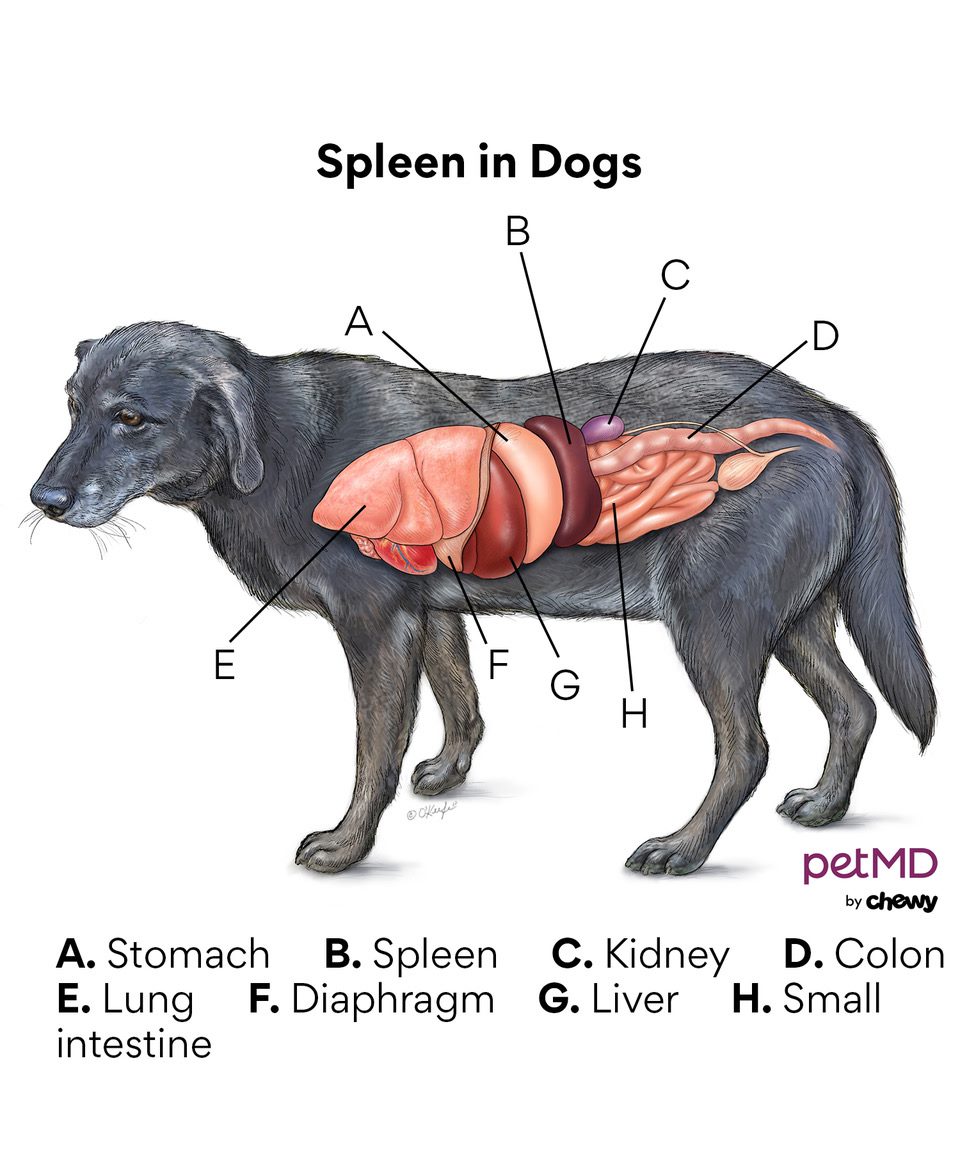
Click here to download this medical illustration.
Symptoms of Spleen Cancer in Dogs
Signs of splenic tumors in dogs can be vague or even nonexistent, and they are often found during a diagnostic test for other conditions.
A major concern of most tumors in the spleen is rupture. Because the spleen contains many blood vessels, even benign tumors have the potential to break open and cause either a slow or fast bleed. Slow bleeds will show more mild signs, while a fast bleed can result in an acute, severe, life-threatening blood loss into the abdomen.
Common signs of a spleen tumor or bleeding include:
-
Weakness
-
Abdominal enlargement (such as bloating or swollen abdomen)
-
Cold limbs
-
Not able/willing to get up
Causes of Spleen Cancer in Dogs
The cause of most splenic tumors is unknown.
The following breeds may have a higher risk of splenic tumors:
-
German Shepherds
-
Labrador Retrievers
-
Golden Retrievers
-
Boxers
-
Standard Poodles
-
Bernese Mountain Dogs
-
Flat-Coated Retrievers
Splenic cancer can occur in all ages of dogs, but veterinarians most often diagnose it in older dogs.
How Veterinarians Diagnose Spleen Cancer in Dogs
A vet will start with a thorough physical exam. Rarely, splenic tumors may be large enough that they can be felt on abdominal palpation.
More often, splenic tumors are diagnosed after they have ruptured.
Dogs with a ruptured splenic mass may have pale gums and a belly full of fluid, often blood. Pet parents sometimes report that their dog was acting normally that morning, then within a few hours was unable to stand up.
Splenic tumors are found with imaging. X-rays are taken first. If there is suspicion for a mass, an abdominal ultrasound will likely be recommended.
Chest X-rays will also be done to see if there is any spread to the lungs.
If there is fluid in your dog’s belly, your vet may recommend sampling to see if it’s true blood or a more serum-like substance called ascitic fluid.
They will also run lab work to see how anemic your dog is and if there are signs that the cancer has spread to other organs, such as the liver.
The way to diagnose a splenic tumor as cancerous is to remove the spleen and send it off for biopsy.
Unfortunately, unless there are signs of obvious spread of the cancer, there’s not a way to know if the splenic tumor is malignant (cancerous) or benign without doing surgery.
Treatment of Spleen Cancer in Dogs
Because most dogs with spleen cancer are diagnosed after the tumor has ruptured, treatment requires emergency surgery.
Removal of the spleen, called a splenectomy, is most often recommended as treatment. When the spleen ruptures, the dog begins to bleed out into their belly. This is time-sensitive and life-threatening.
As we discussed above, unless there is an obvious spread of cancer to other places (like the liver, lungs or heart), there is no way to know for sure if the splenic mass is cancer or benign.
This is very stressful and emotional for many pet parents. Affected pups are often advanced seniors who seemed fine until the mass ruptured.
Roughly two-thirds of splenic tumors are cancerous and have already spread microscopically at the time of diagnosis. It’s a tough decision to decide at that point whether to move forward with surgery or consider humane euthanasia.
On the other hand, about one third of dogs with splenic tumors will be cured by removing the bleeding mass.
Some dogs may require blood transfusions prior to surgery.
If a splenic mass is found incidentally while doing X-rays, a pet parent has more time to consider options.
If the mass has not ruptured, a patient is not a candidate for surgery, or bleeding is not significant, some pet parents may elect for medical management to buy a little more time and improve their dog’s quality of life.
Dogs who don’t have the spleen removed are still at risk of splenic rupture, and many vets utilize the Chinese herbal supplement yunnan baiyao to help control bleeding.
Steroids, like prednisone, are also prescribed in some types of cancer.
Unfortunately, these medications are not a cure. But they can make the dog’s quality of life better for a short period of time.
Your vet may also prescribe pain medication, like gabapentin, to make your dog more comfortable.
Sometimes, anti-nausea medications like Cerenia can also help with visceral (gut) pain associated with cancer.
If the biopsy confirms the spleen mass is cancerous, chemotherapy may be recommended. Your vet will likely refer you to see a veterinary oncologist if this is the case.
Recovery and Management of Spleen Cancer in Dogs
Dogs with their spleen removed require normal postoperative care, including incisional monitoring and routine pain management. They will likely have an incision from the sternum down to the pelvis. These patients should have decreased activity and be monitored at least 10-14 days.
It’s very important that you keep them resting until the sutures or staples have been removed. No running, jumping, or playing is recommended while they’re recovering, along with leash walks only for all outdoor time.
For patients with more advanced disease, rechecks with surgeons and oncologists may be scheduled initially at two weeks, then every one or two months.
The veterinarian will likely check blood work, X-rays, and ultrasounds at these visits to monitor disease progression and quality of life.
Based on the severity of the disease, some complications may require more intensive care and monitoring, such as:
-
Blood transfusions from coagulation issues
-
Blood transfusions from blood loss
-
Nutritional support
Prevention of Spleen Cancer in Dogs
There is no way to prevent spleen cancer in dogs. Vets suspect it’s largely genetic in nature but are not sure why some dogs get cancer and others don’t.
Good rules of thumb to reduce your dog’s cancer risk are to maintain them at a healthy body weight, keep up good activity and nutrition, and minimize exposure to carcinogens, which include secondhand smoke, lawn chemicals, and radon.
Spleen Cancer in Dogs FAQs
How quickly does hemangiosarcoma spread?
Very quickly. Hemangiosarcoma has usually spread microscopically by the time it is diagnosed.
How long can my dog live with a spleen tumor?
If the spleen tumor has already ruptured and is bleeding internally, your dog will likely not live more than a day or so. If it has not ruptured, their lifespan depends on if that rupture occurs or not. They could live weeks or even years.
Is canine hemangiosarcoma painful?
Hemangiosarcoma itself is not considered outright painful, but it does lead to a general feeling of being under the weather. If it has spread to the lungs or heart, it can lead to some struggle and stress while your dog is trying to breathe. If it has spread to the liver or other organs, it may lead to nausea and general abdominal discomfort. Prior to spread and rupture, many dogs seem to feel normal.


