New Puppy Checklist: Essential Supplies and What To Do First


Istock/iStock by Aleksey
Bringing home a new puppy is exciting and often a bit overwhelming. It helps to have a plan. Our new puppy checklist covers the supplies you’ll need (including food, collar and leash, and flea and tick protection) as well as steps you should take right away to help keep your dog safe, healthy, and comfortable.
Key Takeaways
- New puppy essentials include food, bowls, crate/pen, bedding, toys, leash, collar, ID tag, potty supplies, and flea and tick prevention.
- Schedule a vet visit ASAP for vaccines, parasite prevention, nutrition advice, and a personalized care plan.
- Puppy-proof your home and use gates/crates to prevent accidents, chewing hazards, and unsafe roaming.
- Start socialization early and gently. Positive exposure builds confidence and helps prevent fear later.
- Build a consistent routine so your puppy knows what to expect each day.
The Ultimate New Puppy Checklist
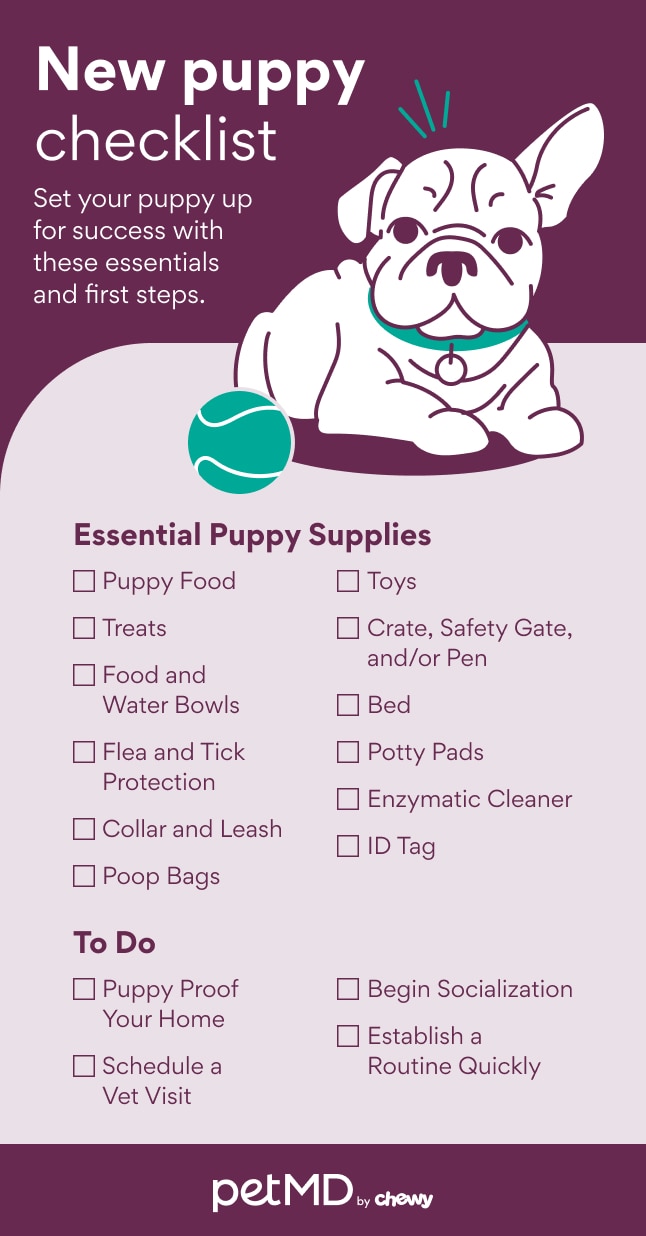
Use our new puppy checklist to make shopping and planning easier.
Essential Puppy Supplies
-
Puppy food
-
Treats
-
Food and water bowls
-
Flea and tick protection
-
Collar and leash
-
Poop bags
-
Toys
-
Crate, safety gate, and/or pen
-
Bed
-
Potty pads
-
Enzymatic cleaner
-
ID tag
To Do
-
Puppy proof your home
-
Schedule a vet visit
-
Begin socialization
-
Establish a routine quickly
Take a screen shot of our new puppy checklist to make shopping and planning a breeze:
Essential Puppy Supplies
These essential puppy supplies help you cover the basics from day one—nutrition, training, safety, hygiene, and comfort—so your new puppy can settle in smoothly at home.
Puppy Food
You’ll need to have plenty of high-quality puppy food on hand for your new addition.
To help them power through their days, select a puppy food with a nutritional adequacy statement for growth from the Association of American Feed Control Officials (AAFCO). You’ll find this info on the pet food label.
“It’s always a good idea to ask your vet for nutritional counseling, to make sure your dog’s specific calorie requirements and other nutritional needs are being met,” says Efrem Hunter, DVM, MBA, veterinarian and owner of PetVet365 in Cypress, Texas.
If your puppy will be 50 pounds or more by adulthood, they may require large-breed puppy food.
Here are a few vet-recommended puppy food brands:
Puppy Training Treats
Bonding over treats is also an important part of raising a pup.
“Rewards, such as toys or tasty treats, can help shape your dog into understanding how to volunteer good manners and behavior,” explains Chrissy Joy, a celebrity dog trainer and host of The Dog Moms. “We do this by rewarding our puppy soon after they offer the new behavior.”
Because they have a sensitive stomach, it’s not a good idea to share human food with your puppy.
Small treats or treats that break into smaller bites allow you to provide frequent rewards without overfeeding your dog. Dogs should get 10% or less of their daily calories from treats.
Food and Water Bowls
Dog food and water bowls come in a variety of materials, heights, and designs. For puppies, you’ll likely want a shallow one with a nonslip base.
Dog bowls made for on-the-go pet parents generally come in two designs—the collapsible doggy bowl and the doggy water bottle. Both designs are lightweight and portable, which makes them easy to take with you on walks, hikes, or to the park.
Flea and Tick Prevention
Parasite prevention is important to protect your dog against fleas and ticks that can cause discomfort and infectious diseases. Starting your puppy on an all-in-one preventive, such as Simparica Trio, can also protect them against heartworm disease and intestinal worms.
Most puppies can start flea and tick products at 8 weeks old and at a minimum weight of about 2–4 pounds. Always talk with your vet before starting your puppy on flea and tick prevention.
Collar and Leash
A properly fitted collar (or harness) and a sturdy leash are essential for safe walks and early training.
Choose a dog collar that is the appropriate size for your puppy to ensure safety and comfort. You should be able to fit two fingers between the collar and your puppy’s neck. You may consider a dog harness to reduce pressure on your puppy’s throat.
Using a fixed-length leash is helpful for training purposes and to maintain better control on walks.
Poop Bags
It may not be the most desirable topic, but having poop bags on hand when you’re walking your puppy is essential. They even make bag holders that clip directly onto your leash for added convenience.
Toys for Your New Puppy
Providing both mental and physical stimulation is fundamental for the well-being of your new puppy. A mix of interactive play, training, and safe chew toys can help support healthy development while strengthening your bond together.
Puppy Toy Do’s:
-
Choose toys that encourage mental stimulation, such as puzzle toys and training games, to keep your puppy engaged and learning.
-
Incorporate daily physical activity through playtime and short walks to help burn off energy and promote physical health.
-
Introduce a variety of sounds and textures to help expose your puppy to new experiences. Toys with crinkles, squeaks, and other fun noises can make playtime more enriching.
-
Use safe chew toys during teething, since puppies naturally mouth and chew while adult teeth come in. Freeze treats in toys like KONGs to help soothe sore gums.
-
Supervise your puppy with new toys to make sure they are playing safely and not chewing off and swallowing pieces.
Puppy Toy Don’ts:
-
Don’t give toys that are too hard or too small, which can become a choking hazard.
-
Don’t ignore signs of wear and tear. Replace toys immediately if they have loose strings, stuffing, squeakers, or broken pieces, which can also become choking hazards.
-
Don’t let your puppy swallow non-food items, including toy parts or household objects like socks.
-
Don’t assume all chew items are safe to ingest. Anything your puppy chews on should either remain intact or be fully digestible.
Puppy Gates, Playpens, and Crates
Puppy pads typically have a scent that attracts puppies, encouraging them to go to the bathroom on them.
They’re especially useful for puppy parents who live in high-rise buildings and may not have quick access to the outdoors.
“Ideally, you want to move this potty pad closer and closer to the door that you will use to take your puppy outside,” Joy says.
Don’t forget to add enzyme cleaner to your cart, too.
Dog Bed
Add to your list of puppy supplies a dog bed that your pooch can call their own, to promote a healthy sleeping schedule.
“A puppy’s sleeping area should be a quiet space where they can get used to sleeping apart from you and any distractions or activity,” Joy says.
Consider these factors when choosing a bed for your new puppy:
-
Durability. Pick a bed that can withstand puppy teeth. Joy says she prefers placing a puppy bed with minimal fillers in her pooch’s crate.
-
Ease of cleaning. Accidents are bound to happen. When they do, you’ll want a bed that you can wipe off or toss in the wash.
-
Size. Puppies come in all shapes and sizes; they should have a bed that suits their frame.
-
Design. Dog beds come in a variety of shapes and sizes to suit different dog preferences and needs. The design of the bed you choose will depend on your dog’s preferences and intended use. For example, if your puppy likes to curl up, a round donut-style bed might be a good option.
When your puppy can no longer stretch out or get comfortable in their bed, it’s time for a larger size.
Puppy Pads
Puppy pads typically have a scent that attracts puppies, encouraging them to go to the bathroom on them.
They’re especially useful for puppy parents who live in high-rise buildings and may not have quick access to the outdoors.
“Ideally, you want to move this potty pad closer and closer to the door that you will use to take your puppy outside,” Joy says.
Don’t forget to add enzyme cleaner to your cart, too, for when accidents happen.
ID Tags and Microchipping
Identification devices are essential for dogs. If your puppy gets lost, these devices can help the person who finds them contact you. Two common identification methods are ID tags and microchipping.
ID tags attach to a puppy’s collar and list the pet parent’s name and contact information in case the puppy gets lost.
A microchip is a tiny electronic device that is implanted under your dog’s skin.
It’s about the size of a grain of rice and contains a unique identification number for your dog. This number is linked to your personal information, such as your name, address, and phone number.
If your dog ever gets lost, a veterinarian or animal shelter can scan the microchip and contact you to bring your pet home, even if their collar has slipped off.
To ensure peace of mind, discuss the advantages of microchipping your new puppy with your vet.
Things To Do When Bringing Home a New Puppy
Bringing home a new puppy comes with a list of must-dos that set them up for lifelong health and good behavior—from scheduling a vet visit and puppy-proofing your home, to socializing safely and establishing a daily routine.
Establish a Relationship With Your Veterinarian
Veterinary visits are crucial when it comes to caring for pets. Puppies should visit their veterinarian about every three to four weeks.
Joy, who has four pups of her own, says that the first few veterinary visits are critical, even for pups who come from healthy moms.
“Meeting with your vet soon after bringing your puppy home is important,” she says.
Puppies need essential vaccines that allow them to safely explore the outdoors and socialize with other pups. They’re prone to parasites, which your vet can check for by using a fecal test and quickly beginning treatment if necessary. Puppies also need to be started on parasite prevention, such as Simparica Trio, to protect them against fleas, ticks, heartworms, and intestinal worms.
Setting your puppy up with a qualified vet makes it easy to navigate their primary medical care. Consider these factors when choosing your vet:
-
Distance from home: You don’t want to drive far for routine visits, and you’ll want to be able to get to the vet quickly in case of an emergency.
-
Services provided: Make sure the vet offers the services you want, such as dental care, nutrition counseling, and spay and neuter surgeries. Having all services in one office can be a perk, though it’s not mandatory.
-
Experience: Choose a vet who routinely works with your pet’s breed. Additionally, fear-free certified vets can prevent and reduce fear, anxiety, and stress in pets.
-
The space: Ask whether you’re able to enter the examination room with your pet and if the office has separate waiting areas and rooms for cats and dogs, as this can help prevent potential stress and conflicts between them.
In talking with your vet, you’ll quickly understand that preventive care is key to your pup’s well-being, including keeping vaccinations up to date and protecting your precious pooch against fleas, ticks, and heartworms.
Puppy Proof Your Home
Puppy proofing your home is critical to keep your new canine companion safe. Before you bring your puppy home, consider the following:
1. Remove hazardous houseplants.
While houseplants are decorative, many of them are toxic for dogs if ingested. If you know the name of your plant, you can check whether it is safe in the ASPCA Plant Lists. If it is considered toxic or you are unsure, it is best to remove the plant from the house or put it on a shelf safely out of reach of your puppy.
2. Cover or remove electrical cords.
Because puppies are avid chewers, they will gnaw on just about anything they find. Unfortunately, this means that power plugs and extensions cords are a huge safety risk as they can cause electrocution.
Ideally, remove all electrical cords and keep them safely out of reach. If this is not feasible, use chew-resistant covers or zip ties to keep them elevated off the ground and out of reach.
3. Keep household chemicals and medications out of reach.
Lock up all household cleaning products, hazardous chemicals, and human or pet medications so they cannot be reached by your puppy and accidentally ingested.
4. Block stairs or unsafe areas with puppy gates.
If there are areas of your home that simply cannot be puppy-proofed entirely (like the bathroom), use a puppy gate to restrict your new dog’s access to the area. You may also consider adding a gate to the top of the stairs to prevent accidental falls.
5. Secure trash cans.
Because garbage cans contain many hazardous items for your puppy, such as toxic food, batteries, and choking hazards, it is important to always keep the lid on and to secure it away from your dog.
Socialize Your Puppy
Socialization is extremely important for puppies. It teaches them how to interact with new people and animals in a positive way while reducing fear and anxiety. All in all, socialization encourages the development of a happy, well-mannered dog.
The best time to start socializing your puppy is 3–12 weeks of age. This window of time is when they are developing core memories of new experiences. You can start with letting them see new people, children, people wearing hats, people on bikes, people in wheelchairs, or seniors with canes, for example.
Establish positive happy interactions with a variety of new people while they’re in this impressionable stage. See if the delivery person or mail carrier is willing to give your new puppy a treat.
After their first round of vaccinations, you can broaden their exposure to fully vaccinated pets of friends and family. While they’re young, let them meet a friendly cat or other species of pets they may later be exposed to, and try to make the interaction as positive as possible.
Talk to your veterinarian about when it’s safe to take your puppy to dog parks or other places where potentially unvaccinated dogs may be.
General exploration of the world with new sights, smells, and experiences will help socialize your puppy.
Here are a few activities to consider:
-
Observing other people and pets from a distance
-
Short greetings with other pets and people
-
Doggy daycare
-
Puppy kindergarten
-
Visiting dog-friendly establishments
Joy warns that rushing your puppy into a social situation before they’re ready can cause them to lose confidence. Instead, slowly introduce them to new stimuli using positive reinforcement techniques.
Establish a Routine
A consistent routine helps your puppy feel safe, learn faster, and settle into your household with fewer accidents and behavior hiccups. Aim to keep mealtimes, potty breaks, naps, play, and short training sessions on a predictable schedule. Then you can adjust as your puppy grows, their bladder control improves, and your veterinarian recommends changes.
A typical day for your puppy would include the following:
-
Early wake-up time followed by a potty break before and after breakfast.
-
Potty breaks every two to three hours throughout the day.
-
Three to four meals at consistent intervals during the day.
-
Short training sessions two to three times for 10–15 minutes each.
-
Multiple naps for up to two hours at a time.
-
Frequent play time throughout the day.
-
Potty breaks before and after dinner.
-
Consistent nightly routine and bedtime.