Lumps, Bumps, and Cysts on Dogs


razyph/iStock / Getty Images Plus via Getty Images
There are two major types of lumps and bumps on dogs—malignant (cancerous) and benign (not cancerous).
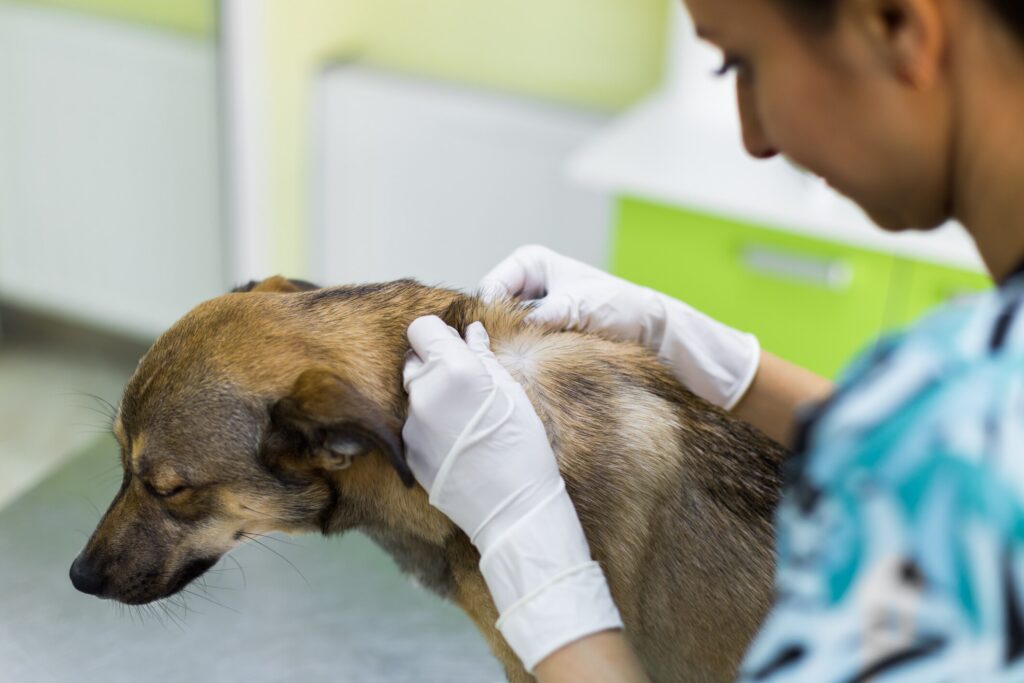
However, you can’t tell the type or severity of a growth just by looking at it—a veterinarian can take a sample of cells to give you a diagnosis and appropriate treatment plan.
Types of Lumps and Bumps on a Dog's Skin
Let’s look at several common skin growths found in dogs, what they look like, and what pet parents should watch out for.
Benign Tumors
Tumors that are benign are not likely to spread to other areas on the body.
Histiocytoma
A histiocytoma is a benign skin growth that usually occurs in dogs less than 2 years of age. They are found on the front half of a dog’s body, usually as a lump on a dog’s head or a lump on a dog’s legs.
Rarely, they can be seen in older dogs or on other areas of the body.
Histiocytomas are pink and fleshy but may get bigger and seem more irritated before improving.
These tumors usually regress spontaneously over time without treatment and arise from the skin’s immune cells. They can be diagnosed through microscopic examination of a sample of cells from the growth.
Lipoma
A lipoma may show up anywhere on a dog’s body but is common on the trunk and legs. Lipomas come from fat cells under the skin or are found in muscle tissue.
They usually develop in older, overweight dogs. They may become quite large or appear in multiple locations.
A vet can diagnose a lipoma by taking a small sample of cells from the growth to look for fat droplets.
No treatment is needed if they are not bothersome, but these should be monitored for rapid changes.
They will gradually enlarge with time and may bother your dog if they’re located in an area that interferes with motion. When lipomas start to bother your pet, you can consider surgical removal.
Lipomas should be carefully monitored over time as they can transform into cancerous growths called liposarcomas.
Papilloma
A papilloma in young dogs is a contagious, wart-like growth that usually occurs in and around the mouth. In older dogs, they might be seen around the eyes or on other areas of the body.
Papillomas are caused by a virus that can be spread through direct contact with an infected dog or contaminated items, such as toys or feeding bowls.
They appear small, fleshy, and round with a cauliflower-like texture to the surface.
Many will dry up and fall off within a few months as the dog’s immune system matures. Severe cases may make eating or swallowing difficult and require treatment by surgical removal.
Medications and other treatment methods are also available, including crushing of the warts to stimulate the immune system.
Skin Tag
A skin tag grows in places where a dog’s skin rubs together. They are overgrowths of the connective tissue in the skin. They are the same color as the skin but extend out from the surface on thin stalks.
Skin tags are common in older dogs and certain breeds. No treatment is needed, but these can be surgically removed if they are bothersome.
Sebaceous Gland Tumor
A sebaceous gland tumor is commonly found in older dogs. They are typically smaller than a pea and may develop in any location. Some will bleed or secrete a material that forms a crust.
Large breeds often form these on their head, specifically their eyelids, and they may be black in color. Treatment is not necessary, but surgical removal may be considered when the growth is bothersome.
Meibomian
A meibomian gland tumor is a slow-growing benign lump that forms in the meibomian gland at the edge of the eyelid. This gland functions to produce tear film and when they get clogged, a growth can result.
They are often cystic and filled with fluid. The tumor can stick out or grow into the eyelid. They may become inflamed, irritated, painful, or ulcerated. They may also cause inflammation of the cornea and conjunctiva.
Large tumors may cause problems when your dog blinks, because they cause extra tearing and tear staining.
They are diagnosed by their appearance and location, and they can be removed with surgery, or the tissue can be frozen for removal.
They rarely grow back after removal, but regrowth is possible.
Epulis
An epulis is a common benign growth found in the mouth of dogs. They may form when a tooth rubs against the gums, as with an underbite in brachycephalic (flat-faced) breeds.
These smooth, fleshy, pink bumps grow on the gum tissue near the outer surface of an incisor, canine, or premolar tooth.
They can appear to grow on a stalk of tissue, like a mushroom, or as an unmoving mass, and they may have a bony interior. Certain types can invade surrounding bony tissue.
Diagnosis of an epulis is made by recognizing it from appearance and confirming with a biopsy. An X-ray of your dog’s head will show if it has invaded surrounding tissues.
These growths should be removed surgically, along with the adjacent tooth and any bony tissue that may be affected.
They do not usually regrow if the entire tumor is removed. Radiation therapy may help cases where the growth is inoperable.
Follicular Cysts
Follicular cysts are large, benign bumps on the skin that grow up from the hair follicle. They may release a thick material that is white, yellow, or brown when you push on them. As they get bigger, they can become itchy or painful.
These types of cysts are diagnosed on physical examination and may be confirmed with microscopic examination of a small sample of cells aspirated with a needle.
Follicular cysts may become infected and require antibiotic treatment. If they are growing or become painful, they may be surgically removed and should not regrow.
Perianal Adenomas
Perianal adenomas are benign growths common in older, unneutered male dogs. They grow from oil glands near the anus but can also occur in similar glands along the abdomen, on the back, and near the tail.
These commonly show up as multiple small lumps. Larger tumors may develop bleeding ulcerations and can compress the anal canal, making it difficult for your dog to poop.
Almost all male dogs are cured by neutering alone, but large or ulcerated tumors may also be surgically removed. Females improve with surgical removal, but the growths often recur.
Laser surgery or freezing the growth may be necessary to avoid fecal incontinence when surgery involves the anal sphincter.
Hemangiomas
Hemangiomas are benign tumors that occur in adult dogs and closely resemble blood vessels. You usually see them in areas of sparse hair growth such as on a dog’s legs and trunk or on their underbelly.
They may be single growths or multiple, compressible, reddish-black circular lumps that can resemble a blood blister. Some may become large and even ulcerate. The recommended treatment is surgical removal.
Nevus
A nevus is a dark raised or flat benign growth on the skin, commonly called a mole. These are found on areas prone to trauma, such as the legs, head, and neck, usually in older dogs. Treatment is surgical removal.
Trichoepitheliomas
Trichoepitheliomas are small, benign lumps that pop up from the hair follicles of adult dogs.
They are cyst-like and filled with condensed, yellow, cheesy, granular material. They can occur anywhere on the body, but especially on the face and trunk.
Treatment is surgical removal, but they are likely to continue to form at other locations, even after surgery.
Cornifying Epitheliomas
Cornifying epitheliomas are benign growths that stick up from the skin surface and look like horns.
They arise from hair follicles and may form anywhere on a dog’s body, but they are more common on the back, tail, and legs of adult dogs.
No treatment is necessary unless there is evidence of self-trauma, ulceration, or secondary infection. In those cases, surgical removal is the ideal treatment.
Basal Cell Tumors
Basal cell tumors are benign growths that develop on the head, ears, neck, and forelimbs of older dogs. They are raised swellings that are typically firm, solitary, dome-shaped, and small.
Some may be hairless, ulcerated, and stick out like stalks from the surface of the skin. They are dark in color and may form cysts that break open and drain fluid or pus.
Treatment is surgical removal, especially when the dog is uncomfortable.
Malignant Tumors
Malignant tumors are cancerous growths that can invade tissue and spread to organs.
Angiosarcomas
Angiosarcomas, are highly malignant blood vessel tumors that may vary in appearance. One or more red lumps in the skin, or underlying soft tissue are commonly seen, but they may also appear as a poorly defined bruise.
All types grow rapidly and destroy surrounding tissue.
They also spread to or originate in the spleen, lungs, and liver. Angiosarcomas may occur in response to sun exposure in dog breeds with short, white coats, but dogs with dark, thick coats can develop them as well.
They usually form on the underside of the trunk, hip, thigh, and lower legs. A biopsy is required for a diagnosis.
Freezing and laser surgery can help control smaller surface tumors. Surgical removal is needed for tumors below the skin’s surface.
Chemotherapy may also be recommended to treat any remaining tumor cells.
Basal Cell Carcinomas
Basal cell carcinomas are flattened or raised growths that appear anywhere on the body of an older dog.
They may spread to surrounding skin, forming new ulcerations, but they rarely spread to other organs. Surgical removal is recommended, including enough skin around the tumor to ensure that no tumor cells remain.
Liposarcomas
Liposarcomas are rare but may develop in older male dogs on the chest and legs.
They can be soft or firm lumps that are slow to spread to other locations. Treatment is surgical removal, but recurrence is common. If this happens, radiation treatment may also be required.
Lymphosarcoma
Lymphosarcoma rarely develops directly on a dog’s skin but may be seen as a surface tumor or along with internal tumors.
It can look like flaky skin, red patches, raised and ulcerated areas, or lumps deep within the skin.
There are two forms of skin lymphosarcoma that differ in their expected progression and response to treatment, so it's important to determine which type your dog has early on.
Treatments include surgical removal, chemotherapy, and radiation, done separately or combined.
These treatments may improve the signs of the disease but do not lengthen the dog’s life expectancy.
Mast Cell Tumors
Mast cell tumors are the most common malignant tumor seen in dogs.
They often affect older dogs but can occur in dogs of any age—even puppies.
They develop solitary growths anywhere on the body, especially the limbs, lower abdomen, and chest. Larger or rapidly growing tumors and those in certain locations are more likely to spread.
Their appearance can greatly vary, but most are red, raised and either soft or firm to the touch. These tumors release chemicals and compounds such as histamine which can cause this type of tumor to get larger and smaller and larger again, similar to that of an allergic reaction.
Your vet will need to examine a sample of cells from the growth under a microscope to confirm a diagnosis. There is variation on how aggressive these tumors are.
Surgical removal is necessary. If the tumor regrows or spreads, other treatments—including chemotherapy and radiation—may be used.
Malignant Melanomas
Malignant melanomas are another type of skin tumor of older dogs. They commonly develop on the lips, mouth, and nail beds of male dogs.
They appear as raised, ulcerated lumps and may be dark, light gray, or pink. If they appear in the nail bed, the toe is often swollen.
These tumors grow quickly and may spread quickly to other organs. Complete surgical removal is the preferred treatment, but it may be difficult and involves removal of adjacent tissue to prevent recurrence.
Chemotherapy and radiation are not effective treatment options. A vaccine is available that helps shrink the size of the tumor, which may prolong your dog’s life expectancy.
Fibrosarcomas
Fibrosarcomas are common, fast-growing malignant tumors in dogs. Most are on the trunk and legs and vary in appearance and size.
Those under the skin’s surface appear lumpy, while those deep under the skin may be firm and fleshy.
They can invade underlying muscles, but most do not spread to other areas of the body. Treatment consists of surgical removal, though complete removal may not be possible, and regrowth is common.
Fibrosarcomas may also be treated with radiation and chemotherapy.
Squamous Cell Carcinomas
Squamous cell carcinomas can be found in two places on a dog—on the surface of the skin or under a nail.
Most appear as firm, raised, irregular, and ulcerated areas.
Many are solitary, but areas of prolonged sun exposure may produce multiple tumors. These growths invade surrounding tissues. Some are slow to spread, while others grow more rapidly.
Treatment involves complete surgical removal of the tumor along with some normal tissue.
How Vets Diagnose Lumps, Bumps, and Cysts on Dogs
When you find a growth on your dog, have your vet do a physical exam. If your dog is biting, scratching, or licking at a bump, consider putting a recovery cone or suit on them until you can get an appointment with your vet.
It’s helpful to note the location of the lesion, how long it’s been there, any changes that have occurred since you first noticed it, and whether your dog seems bothered by the growth.
Taking a series of photographs can be helpful for your veterinarian to make a diagnosis.
A sample of cells may need to be taken and evaluated under a microscope for a diagnosis.
This can come from taking an impression of the surface of the growth, using a syringe and small needle to withdraw a small sample of cells in the exam room (FNA), or surgically removing a small tissue sample (biopsy) while your dog is under local or general anesthesia.
Most veterinarians evaluate impression smears or fine needle aspirates by staining the slide and examining it under a microscope in the veterinary office.
Trained veterinary pathologists are available to analyze these same samples or small tissue samples to determine a diagnosis. Then your vet can determine the appropriate treatment recommendations and explain the expected outcome.
Treatment for Dog Lumps, Bumps, and Cysts on Dogs
Options for treatment of bump on a dog’s skin may include:
-
Monitoring for changes
-
Removal by freezing or laser treatments
-
Surgical removal of the lump with or without also removing some normal tissue
-
Chemotherapy
-
Radiation
Keep a log where you write down:
-
When you first noticed the lumps and/or bumps
-
How many there are and where they are located
-
The size, color, and texture
-
Whether it’s moveable or seems to be fixed to underlying tissue
-
Whether there is any discharge present
Take pictures and note any changes from day to day in any of these factors.
Make an appointment with your vet as soon as possible and bring your log and photos along with any questions you may have.
Skin Lumps, Bumps and Cysts on Dogs FAQs
Why does my dog have lumps on his skin all of a sudden?
There are many causes for sudden bumps to form on your dog.
Possible causes are an allergic reaction, hives, skin infection, bug bites, a reaction to plant or foreign material in the skin, or even cancer.
If your dog suddenly has small red bumps that are itchy with or without swelling of the face, an allergic reaction is most likely.
Allergic reactions can be life-threatening, and you should contact your vet as soon as possible if you suspect this is happening in your dog.
Other causes of lumps should be monitored and evaluated by your vet for a diagnosis and treatment plan.
How do I know if the bump on my dog is cancer?
To know if your dog has cancer, your veterinarian will need to examine the bump and take a sample. Samples of a bump can be taken during a routine vet visit such as a fine needle aspiration (FNA) or an impression smear.
A biopsy can also be done by surgically removing the bump.
Once your vet obtains a sample of the bump, they will make a microscope slide to visualize the cells that make up the bump.
This will make the diagnosis of what the bump is to determine if it’s cancer or not. From there, your vet will make the treatment plan recommendations.
Can I pop a bump on my dog?
Don’t pop a bump you see on your dog.
This process could cause pain and discomfort as well as a skin infection.
Another concern would be that skin bumps that are popped can cause the tumor cells to seed into other areas causing more lumps and bumps.
Have all bumps on your dog evaluated by your veterinarian before taking any action at home.


