Luxating Patella in Dogs: What Is It, and How Is It Treated?


Peter_C_Henderson/iStock / Getty Images Plus via Getty Images
What Is a Luxating Patella in Dogs?
A luxating patella in dogs—also called a dislocated knee—is a common condition in which the kneecap (patella) shifts sideways (luxates) away from its normal position at the front of the knee.
About 75% of the time, the patella tends to dislocate towards the inside of the knee, or toward the other hind limb. This version of a luxating patella is called medial patellar luxation (MPL) and is more common in smaller dogs.
Sometimes the dislocation occurs towards the outside of the knee, or away from the other leg. This condition is known as a lateral patellar luxation (LPL).
Although both small and large dogs are more likely to have MPL than they are to have LPL, most cases of LPL occur in larger dogs.
Patellar luxation can affect one or both knees in dogs.
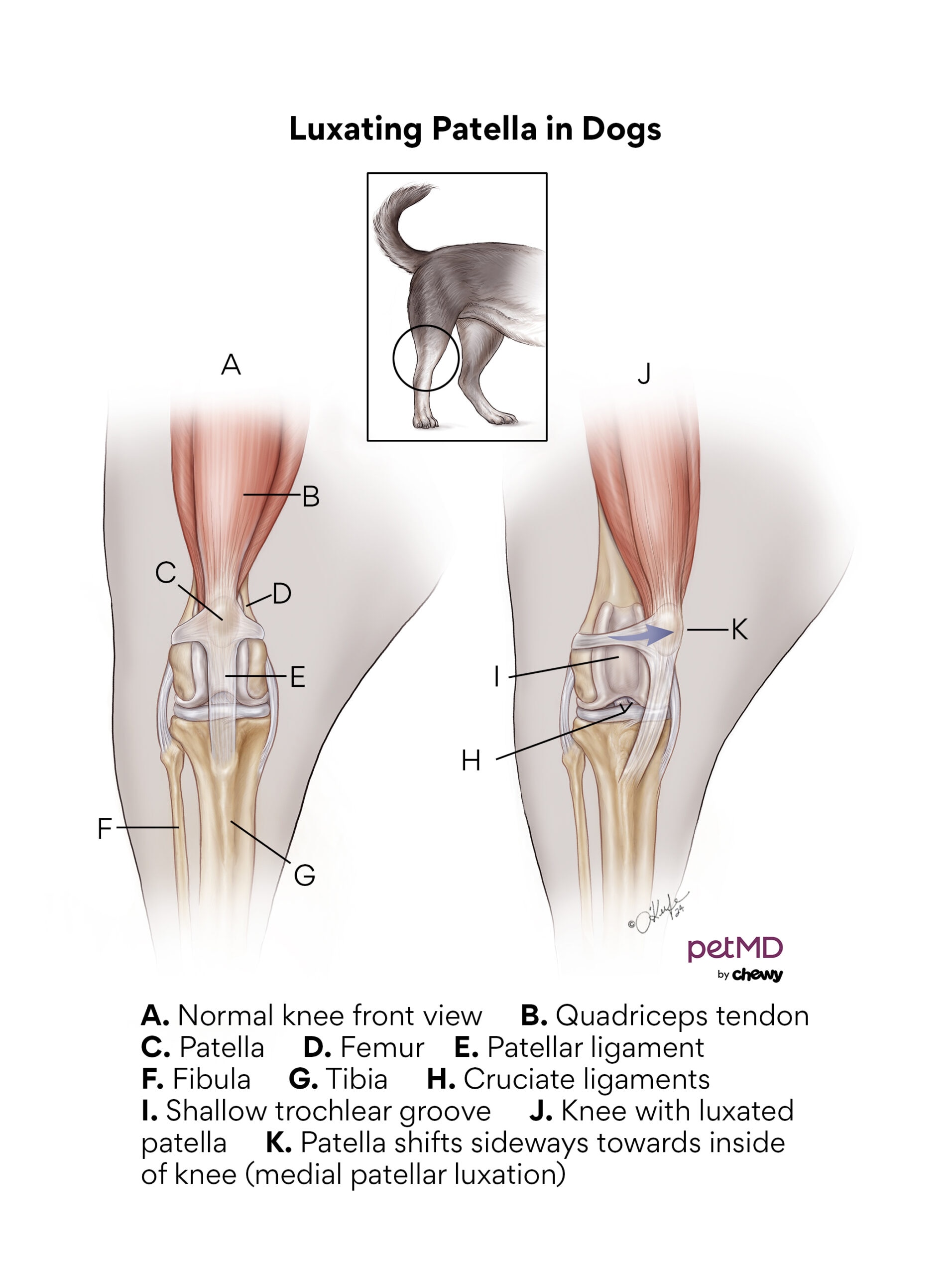
Click here to download this medical illustration.
Symptoms of a Luxating Patella in Dogs
The main symptom of a luxating patella in dogs is the sudden lifting of one hind limb while walking or running.
In this brief, sudden limp, a dog will hold their hindlimb off the ground for a short period of time before walking normally again. The affected leg may be held close to the body or extended backwards. This is often termed a “skip” by owners and vets.
Some dogs will yelp when this occurs, but others will show no signs of discomfort aside from the sudden, short-lived limp.
The following symptoms of patellar luxation, however, can also be seen in other orthopedic conditions:
-
Limp that comes and goes
-
Bowlegged stance in the hind limbs
-
Hunched lower back
-
Cracking or popping noises when the knee is bent
In some cases, the dog’s knee(s) are permanently luxated, meaning they’re always dislocated. These dogs appear to have a stiff, awkward, bowlegged gait. With the kneecap permanently out of place, the leg won’t extend properly.
Your vet will combine these symptoms with the findings of their physical exam to make a definitive diagnosis.
Causes of a Luxating Patella in Dogs
A luxating patella in dogs is generally hereditary and has to do with the unusual knee anatomy of dogs that are affected.
In some cases, trauma causes the luxation.
Although obesity does not directly cause a luxating patella in dogs, it can contribute to the severity of the disease and can increase complication rates if surgery is pursued.
Many small-breed and large-breed dogs are predisposed to having a luxating patella, including:
Small-Breed Dogs
-
Mi-Ki
Large-Breed Dogs
How Vets Diagnose a Luxating Patella in Dogs
Usually, a physical exam is the only thing needed to diagnose a luxating patella in dogs.
In fact, a luxating patella is often diagnosed incidentally during a routine wellness exam, or during an exam for a different problem.
A luxating patella in dogs can also show up on imaging like X-rays, CT scans, or MRIs, but these diagnostics are not usually used to make the diagnosis.
Treatment for a Luxating Patella in Dogs
Medical treatment of a luxating patella in dogs often involves anti-inflammatory medications like Galliprant or carprofen, weight loss, and temporary exercise restriction. Your veterinarian may also recommend joint supplements like Dasuquin.
Exercise restriction varies based on the severity of your dog’s condition. For patellar luxation, it might be as simple as not letting your dog run up the stairs or jump on furniture, and only going on short potty walks on a dog leash.
If your dog needs to be confined to their crate, the duration can vary based on the severity of your dog’s condition. Crate rest usually lasts at least six weeks, and sometimes more than 12.
Surgical Treatment for Luxating Patella in Dogs
Surgery for a luxating patella in dogs is significantly more involved. This procedure involves making alterations to the knee joint to help the joint have a more normal anatomy, such as:
-
Changing where certain ligaments attach in the knee (tibial tuberosity transposition)
-
Deepening the groove at the end of the femur that the patella rests in (trochlear wedge resection)
-
Tightening the joint capsule around the knee (lateral capsular imbrication)
Pet parents may pursue surgery in severe cases, or in cases where medical treatment has failed. As with any surgery, it comes with risks and the potential for complications.
The most common postoperative problem in MPL surgery is that the luxating patella will come back.
Other potential complications include:
-
Implant failure (breakage)
-
Under-/overcorrection
-
Avulsions (separations or detachments)
-
Infections
-
Seromas (fluid-filled pockets)
Large-breed dogs and obese dogs are at higher risk for these issues due to increased strain on the knee joints.
Recovery and Management of Luxating Patella in Dogs
Medical management of a luxating patella in dogs, meaning the pet doesn’t get surgery, can take several weeks to show improvement.
This option may also need to be repeated periodically throughout your dog’s life, depending on how often flare-ups occur.
Exercise is a common reason for flare-ups, but sometimes flare-ups occur for no apparent reason.
Surgical correction has a much longer recovery period—at least eight weeks, often longer. Regular rechecks with the veterinary surgeon are a crucial part of your dog’s recovery after surgery.
Prevention of Luxating Patella in Dogs
Most dogs with a luxating patella are genetically predisposed to the condition. This means there is nothing a pet parent can do to prevent the condition.
Although a pet parent cannot prevent most cases of kneecap dislocation, they can help their pet by keeping them at a healthy weight. A healthy body condition slows the progression of arthritis that can result from patellar luxation.
Traumatic luxation of the kneecap can be prevented by keeping your dog on a leash or in a fenced yard to prevent injury.
Luxating Patella in Dogs FAQs
How long can a dog live with luxating patella?
Most dogs with a luxating patella can live a long, normal lifespan. Large-breed dogs and obese dogs may develop significant arthritis more quickly, which could impact a pet’s quality of life as they age.
Dogs with severe patellar luxation can have their quality of life and lifespan improved by pursuing treatment, including surgery.
Can a dog recover from a luxating patella without surgery?
A dog with a luxating patella will continue to have a luxating patella in the absence of surgery.
However, dogs with mild forms of kneecap dislocation, especially small-breed dogs, often continue to have a good quality of life even without surgery. Some dogs do very well with as-needed medical management.
What is the cost of luxating patella surgery in dogs?
The cost of luxating patella surgery in dogs could range from $1,000 to $3,000 per affected knee. The cost will be higher for large-breed dogs and dogs with severe kneecap dislocation.


