Cushing’s Disease in Dogs: Symptoms, Diagnosis, and Treatment



SeventyFour/iStock / Getty Images Plus via Getty Images
Cushing’s disease is a common hormonal disorder in middle-aged and senior dogs that occurs when the body produces too much cortisol.
Although the disease cannot usually be cured, early diagnosis and treatment can help control symptoms and improve your dog’s quality of life.
Here’s what you need to know about the causes, symptoms, diagnosis, treatment, and long-term management of Cushing’s disease in dogs.
Key Takeaways
- Cushing’s disease causes excessive cortisol production.
- Most cases are caused by pituitary or adrenal gland tumors.
- Increased thirst, urination, appetite, and panting are common early signs.
- Most dogs require lifelong medication and monitoring.
- Early diagnosis helps improve quality of life.
What Is Cushing’s Disease in Dogs?
Cushing’s disease in dogs is a hormonal disorder that develops when the body produces too much cortisol, a hormone involved in metabolism, stress response, and many other normal body functions.
Also known as canine Cushing’s syndrome or hyperadrenocorticism, this common endocrine disorder most often affects middle-aged and senior dogs.
Excess cortisol can lead to symptoms such as increased thirst, excessive panting, hair loss, and other health problems that can significantly reduce a dog's quality of life if left untreated.
The condition involves two important glands:
- Pituitary gland: Located at the base of the brain, the pituitary gland produces adrenocorticotropic hormone (ACTH), which signals the adrenal glands to produce cortisol.
- Adrenal glands: Located just above the kidneys, these glands produce cortisol, a steroid hormone that helps regulate stress responses and many normal body functions.
In healthy dogs, once enough cortisol has been produced, the adrenal glands signal the pituitary gland to reduce ACTH production.
In dogs with Cushing's disease, this normal feedback system no longer works properly, so cortisol continues to be produced even when the body no longer needs it.
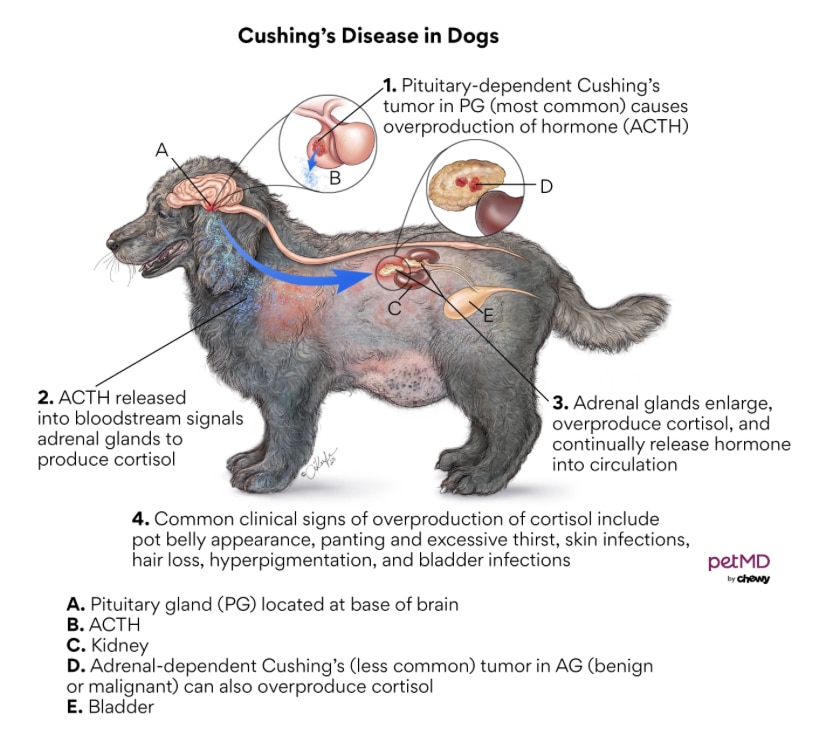
Download the medical illustration of Cushing's disease in dogs.
Types of Cushing’s Disease in Dogs
Cushing’s disease in dogs occurs in two main forms: pituitary-dependent and adrenal-dependent hyperadrenocorticism.
Although both types result in excessive cortisol production, they differ in where the disease originates and how they are diagnosed.
Pituitary-Dependent Cushing's Disease
Pituitary-dependent hyperadrenocorticism is the most common form of Cushing's disease in dogs.
It develops when a slow-growing, benign tumor forms in the pituitary gland and continually produces adrenocorticotropic hormone (ACTH). The excess ACTH overstimulates both adrenal glands, causing them to enlarge and produce excessive amounts of cortisol.
Advanced imaging, such as a CT scan or MRI, is typically required to identify a pituitary tumor.
Adrenal-Dependent Cushing's Disease
Adrenal-dependent hyperadrenocorticism occurs when a tumor develops on one of the adrenal glands and produces excessive cortisol.
These tumors may be benign (adenomas) or malignant (carcinomas).
Unlike pituitary-dependent disease, only the affected adrenal gland becomes enlarged, while the opposite adrenal gland usually remains normal in size.
Diagnosis typically involves abdominal ultrasound or CT imaging to evaluate the adrenal glands.
Symptoms of Cushing’s Disease in Dogs
The most common early signs of Cushing’s disease are increased thirst, increased appetite, increased urination, and excessive panting.
Monitoring your dog's daily food and water intake with a measuring cup, automatic feeder, or marked water bowl can help you recognize these changes early and provide helpful information to your veterinarian.
Additional symptoms of Cushing's disease may include:
- Panting
- Weight loss
- Lethargy
- Pot-bellied appearance
- Thin skin
- Hair loss
- Skin infections
- Calcified skin (firm, hardened tissue beneath the skin)

Causes of Cushing’s Disease in Dogs
Most cases of Cushing’s disease are caused by a benign pituitary gland tumor, although adrenal tumors and long-term steroid use can also lead to the condition.
Common causes of Cushing's disease include:
- Pituitary gland adenoma: The most common cause. This slow-growing, benign tumor produces excess adrenocorticotropic hormone (ACTH), which overstimulates the adrenal glands and causes them to produce too much cortisol.
- Adrenal gland tumor: Less commonly, a benign adenoma or malignant carcinoma develops on one of the adrenal glands and produces excessive cortisol.
- Iatrogenic Cushing's disease: Dogs receiving long-term corticosteroid medications, such as prednisone, for conditions like allergies or autoimmune diseases may develop Cushing's-like symptoms because these medications act similarly to cortisol.
In cases of iatrogenic Cushing's disease, symptoms are often reversible once the corticosteroid medication is gradually reduced or discontinued under a veterinarian's supervision.
Some breeds appear to have a higher genetic risk of developing Cushing's disease, including:
- Poodles
- Yorkshire Terriers
- Dachshunds
How Veterinarians Diagnose Cushing’s Disease
Veterinarians diagnose Cushing's disease using a combination of a physical examination, laboratory testing, and specialized hormone tests.
Your veterinarian will begin by reviewing your dog's symptoms, medical history, and any medications they are currently taking before performing a physical examination.
If Cushing's disease is suspected, additional diagnostic testing is recommended.
|
Test |
Purpose |
|
Low-dose dexamethasone suppression test (LDDST) |
Preferred screening test that evaluates how well cortisol production is suppressed after dexamethasone administration. |
|
ACTH stimulation test |
Measures how the adrenal glands respond to ACTH by comparing cortisol levels before and after stimulation. |
Low-dose Dexamethasone Suppression Test
This is the preferred and typically least expensive screening test for Cushing's disease.
A baseline blood sample is collected to measure cortisol levels before dexamethasone is administered by injection. Additional blood samples are collected four and eight hours later.
In healthy dogs, cortisol production is suppressed after dexamethasone administration. Dogs with Cushing's disease continue producing elevated cortisol despite the medication.
ACTH Stimulation Test
The ACTH stimulation test measures the adrenal glands' response to ACTH.
A baseline cortisol level is measured before ACTH is administered. A second blood sample is collected one hour later. Dogs with Cushing's disease typically have elevated cortisol levels before and after ACTH administration.
Additional Diagnostic Tests
Additional testing may be needed to determine whether Cushing's disease is pituitary-dependent or adrenal-dependent.
These tests may include:
- High-dose dexamethasone suppression test: Similar to the low-dose test but uses a higher dose of dexamethasone. Dogs with pituitary-dependent disease usually suppress cortisol production, while dogs with adrenal-dependent disease typically do not.
- Imaging: Abdominal ultrasound, CT scans, or MRI can help identify pituitary or adrenal tumors.
- Blood work and urinalysis: These tests help evaluate overall health and commonly reveal elevated cholesterol, elevated triglycerides, changes in white blood cell counts, and dilute urine.
Treatment for Cushing’s Disease in Dogs
Most dogs with Cushing’s disease require lifelong treatment to control cortisol levels, improve symptoms, and maintain a good quality of life.
Although the condition usually cannot be cured, it can often be successfully managed.
Medications
The most common treatments are medications that reduce cortisol production.
- Trilostane (Vetoryl®): A steroid analogue that blocks an enzyme required for cortisol production. This is the preferred treatment for most dogs with Cushing's disease.
- Mitotane (Lysodren®): A chemotherapeutic medication that destroys part of the adrenal gland, reducing cortisol production.
Surgery and Radiation
Treatment options vary depending on the type of Cushing's disease.
- Dogs with adrenal-dependent Cushing's disease may be candidates for surgery to remove the affected adrenal gland, depending on the type of tumor and the dog's overall health.
- Dogs with pituitary-dependent Cushing's disease may be treated with surgery or radiation therapy, although these options are not routinely performed because of limited availability and the potential for complications.
Dietary Management
Because many dogs with Cushing's disease have elevated cholesterol and triglyceride levels, veterinarians often recommend a low-fat prescription diet.
Examples include:
Managing Cushing’s Disease in Dogs
Managing Cushing’s disease requires lifelong monitoring, regular veterinary checkups, and medication adjustments to keep symptoms under control.
Naturally occurring Cushing’s disease cannot be prevented because it develops from pituitary or adrenal gland tumors. However, iatrogenic Cushing’s disease may be prevented through careful dosing and monitoring of dogs receiving long-term corticosteroid medications.
Dogs diagnosed with Cushing’s disease typically require lifelong follow-up care, including routine blood work and ACTH stimulation tests, to ensure treatment remains effective and medication dosages stay appropriate.
Keep all scheduled veterinary recheck appointments and monitor your dog closely at home.
If you notice changes in symptoms—especially increased thirst, increased urination, or other returning clinical signs—contact your veterinarian promptly, as medication adjustments may be needed.
Health Tools
Get quick answers with our vet-created Symptom Checker
Life Expectancy for Dogs With Cushing's Disease
Most dogs diagnosed with Cushing's disease live one to five years after diagnosis, although life expectancy varies depending on the type of disease, treatment, and overall health.
While Cushing's disease can shorten a dog's lifespan, many dogs maintain a good quality of life for months or even years with appropriate treatment, routine monitoring, and regular veterinary care.
Prognosis depends on several factors, including the underlying cause of the disease, how early it is diagnosed, the treatment selected, and how well the dog responds to therapy.
Cushing's Disease in Dogs FAQs
What is an ideal diet for a dog with Cushing’s disease?
Dogs with Cushing's disease often benefit from a low-fat diet because many affected dogs have elevated cholesterol and triglyceride levels.
Your veterinarian may recommend a prescription low-fat diet based on your dog's overall health and any other medical conditions.
Are there natural remedies for dogs with Cushing’s disease?
No. There are no natural remedies that have been proven to effectively treat Cushing's disease in dogs.
Most dogs require prescription medication or, in some cases, surgery to manage the disease.
How often should my dog have their adrenal function tested during treatment?
Dogs receiving medications such as trilostane typically require monitoring approximately every three months for the rest of their lives.
Monitoring schedules may be adjusted based on your dog's response to treatment and any additional medical conditions, such as diabetes.
How long can a dog live with Cushing’s disease?
Many dogs live one to five years after being diagnosed with Cushing's disease.
Life expectancy varies depending on the type of Cushing's disease, the treatment selected, and how well the dog responds to therapy.
What are the early signs of Cushing's disease in dogs?
Early signs commonly include increased thirst, increased appetite, increased urination, and excessive panting.
As the disease progresses, dogs may also develop weight loss, lethargy, hair loss, and a pot-bellied appearance.
Can Cushing’s disease in dogs be cured?
No. Most cases of Cushing's disease cannot be cured, but they can often be successfully managed with medication, regular monitoring, and veterinary care.
Is Cushing's disease painful for dogs?
Cushing's disease is not usually painful itself, but untreated disease can significantly reduce a dog's comfort and quality of life because of its effects on multiple body systems.
Can Cushing's disease be prevented?
Naturally occurring Cushing's disease cannot be prevented because it develops from pituitary or adrenal gland tumors.
However, iatrogenic Cushing's disease may be prevented through careful veterinary monitoring of long-term steroid medications.
References
Cushing’s syndrome. (2024, January 19). Cornell University College of Veterinary Medicine. https://www.vet.cornell.edu/departments/riney-canine-health-center/canine-health-information/cushings-syndrome


