Nonulcerative Keratitis in Cats



What Is Nonulcerative Keratitis in Cats?
The clear surface of the eye is called the cornea. When the cornea becomes inflamed, it’s referred to as keratitis. This inflammation is often the result of an injury to the cornea called a corneal ulcer. When inflammation occurs that isn’t related to a sore or lesion, it’s called nonulcerative keratitis.
Besides injuries, several conditions can cause inflammation of the eye’s surface. Eosinophilic keratitis, stromal keratitis, and corneal sequestra are all more common causes of nonulcerative keratitis in cats. All of these conditions can be exacerbated by feline herpes virus infections.
Sometimes this condition is painful, but not always. If your cat is squinting and displaying signs of eye discomfort, it is important that you seek veterinary care right away. However, if your cat is not squinting and is eating, drinking, and behaving normally, it may not be an emergency and you can schedule a full ophthalmic exam with their regular veterinarian.
Symptoms of Nonulcerative Keratitis in Cats
Here are some signs to watch for:
-
White, tan, gray, or pink discoloration of the cornea
-
Plaque-like, raised lesion on the surface of the eye
-
Squinting
-
Drainage from the eye
-
Development of new blood vessels on the eye’s surface
-
Presence of a clear-gray film over the eye
-
Presence of a raised black spot in the middle of the eye
Causes of Nonulcerative Keratitis in Cats
Feline herpes virus is a very common viral infection, affecting 80% or more of cats worldwide. Affected cats often experience sneezing, runny or watery eyes, and conjunctivitis. Some cats might experience additional complications from herpes, which can lead to lasting changes in the deeper layer of the cornea and chronic inflammation. The most common causes of nonulcerative keratitis in cats are:
-
Feline eosinophilic keratitis (FEK)
-
Stromal keratitis
-
Corneal sequestrum
Feline eosinophilic keratitis (FEK) is one of the most common causes of nonulcerative keratitis in cats, often affecting cats under 4 years old. It involves eosinophils, a type of white blood cell, accumulating on the cornea. Cats with FEK typically develop plaque-like lesions on the surface of their eyes, which can appear white, tan, gray, or pink.
In cases of stromal keratitis in cats, white blood cells called lymphocytes invade the cornea in an attempt to fight the herpes virus. This invasion results in a haziness on the otherwise clear surface of the eye.
Certain breeds, such as Persians, Burmese, and Himalayans, have a predisposition to corneal sequestrum (a piece of dead tissue on the cornea). These breeds have more shallow eye sockets, leading to protruding and dryer eyes that are susceptible.
Keratoconjunctivitis sicca, or dry eye, can also lead to nonulcerative keratitis. An infection with the herpes virus can lead to inflammation of an eye that already has poor tear film production. This can result in a black raised lesion on the eye called a sequestrum. Fortunately, this is not as common in cats as it is in dogs.
How Veterinarians Diagnose Nonulcerative Keratitis in Cats
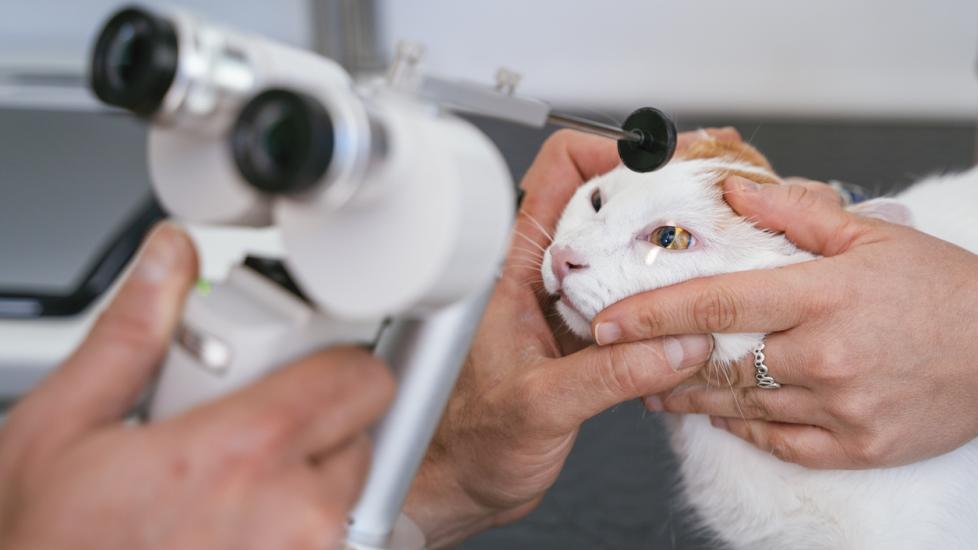
If nonulcerative keratitis is suspected, your veterinarian will start with a thorough ophthalmic exam. They will use an instrument called an ophthalmoscope to look inside your cat’s eye.
One of the first steps in determining if a cat has nonulcerative keratitis is to rule out the presence of ulcers. This is done by staining the surface of the eye and looking to see if the stain collects in any scratches or defects on the cornea. The most common type of stain used is fluorescein, which is lime-green in color. If your veterinarian has suspicions of ulcers related to herpes virus, they may opt for an alternative stain called rose bengal.
After ulcers have been ruled out, your vet will likely check your cat’s eye pressure and tear production.
In some cases, your vet might recommend corneal cytology, a procedure in which a small amount of cells is collected from the surface of the eye for examination under the microscope.
Treatment of Nonulcerative Keratitis in Cats
While some causes of nonulcerative keratitis are treatable, many are related to an underlying infection with the feline herpes virus and may require chronic, long-term medication. Because many underlying causes of nonulcerative keratitis have a link to the feline herpes virus, antiviral medications may be prescribed. Topical antiviral products such as idoxuridine and cidofovir may be prescribed for use as eye drops. In some cases, oral antiviral medications like famciclovir could be recommended.
Often, supplementation with the amino acid lysine is recommended to support the immune system. Lysine comes in a variety of forms, from powder you can add to your cat’s food (Viralys®) to oral treats (VetriScience® Vetri Lysine).
Treatment often involves the use of topical anti-inflammatory medications, which can be either non-steroidal anti-inflammatory drugs (NSAIDs) or steroids. Steroid drops or ointment, such as 1% prednisolone acetate ophthalmic suspension or 0.1% dexamethasone ophthalmic solution, are sometimes prescribed. In some cases, topical antibiotics may also be necessary, often administered before steroid treatment starts.
Sometimes surgery is recommended for treatment. This is more likely if your cat has a corneal sequestrum. Following the surgery, your vet will likely prescribe topical antibiotics and/or pain medications for the recovery period.
Recovery and Management of Nonulcerative Keratitis in Cats
For most cats affected by nonulcerative keratitis, lifelong therapy is required. Response to treatment is usually fairly quick, with improvement often noted within a week or two. Once the eyes look clearer, the medications will be tapered to the lowest effective dose.
Given that the herpesvirus is often an underlying cause of this condition, flare-ups and recurrences of nonulcerative keratitis are common. While this can be frustrating, most cats respond well to treatment and have a good prognosis for a long and high-quality life.
Featured Image: iStock.com/beavera
References
Collins, K. DVM360. Feline corneal diseases: Herpes and more. (2009)
Glaze, M. DVM360. Herpesvirus and the feline eye. (2019)
Maggs, D, Miller P, Ofri, R. Slatter’s Fundamentals of Veterinary Ophthalmology. Ch. 10, pp 209–210. 2013.