Deafness in Dogs


What Is Deafness in Dogs?
Deafness is the loss of the ability to hear, most associated with senior dogs. However, deafness can happen in dogs of any age, and for several reasons.
Hearing in mammals requires a precise transmission of sound waves through the soft tissue and bony structures of the inner and outer ear. If any of these structures are interfered with through infection or trauma—or if they don’t develop properly—this pathway is disrupted. This results in a loss of the ability to properly perceive sound.
Loss of hearing in dogs may be complete or partial, depending on the cause.
Partial Deafness in Dogs
Partial deafness, which involves losing hearing on one side or only being able to perceive sounds at certain frequencies, can be extremely difficult to diagnose because dogs compensate for any hearing loss extremely well.
Partial deafness in both ears is more commonly seen in infectious or inflammatory conditions, such as ear infections (otitis externa). Recovery of a pup’s hearing is more likely in such cases.
While deafness itself is not a medical emergency, painful conditions like otitis and trauma, which can lead to deafness, should be promptly treated by your veterinarian.
Prolonged inflammation makes it less likely for your dog’s hearing to recover.
Symptoms of Deafness in Dogs
The following are symptoms commonly associated with deafness in dogs:
-
Lack of response to environmental sounds
-
Difficulty rousing a sleeping dog
-
Confusion about the source of a sound
-
Lack of ear movement during communication
Causes of Deafness in Dogs
Congenital Defects
Puppies can be born deaf (congenital deafness), usually due to defects in the inner ear. This is the most common cause of deafness in dogs, but it can only be reliably diagnosed in puppies older than four weeks.
Merle and white puppies are more likely to have genes that lead to inappropriate development of the cochlea (the hearing organ). Breeds such as Dalmatians, Cocker Spaniels, Boston Terriers, Australian Cattle Dogs, and Parson Jack Russell Terriers are commonly affected.
Puppies can also exhibit congenital deafness as a result of their mother having an infection during pregnancy or being exposed to certain toxins or medications.
Regardless of the cause, puppies born deaf will not recover their hearing.
Ear Infections
Infections in the canine ear can affect the external, middle, or inner ear, and the location of the infection determines how hearing can be affected and whether it is reversible.
External ear infections may cause ear canal constriction and buildup of material, blocking sound waves from entering the ear properly. This typically does not cause complete deafness and often improves with treatment.
Middle ear infections (otitis media) can result in damage to the eardrum (tympanum) and, at times, the bones that transmit sounds.
Recovery from otitis media usually leads to the return of hearing function, although it may take weeks for a full recovery. Additionally, there could be mild lasting effects due to scarring.
Inner ear infections can cause irreversible nerve damage in the cochlea. These infections are often associated with other nerve damage symptoms such as head tilt and circling. Deafness from inner ear infections can be complete or partial, but it’s often irreversible.
Drug Toxicity
Several medications may cause permanent deafness in dogs. While these side effects are rare, they can occur with appropriate doses needed to treat other life-threatening conditions. Deafness can be permanent, but not all dogs will completely lose their hearing.
Cisplatin (a chemotherapy drug), and furosemide (used to treat heart failure) are the most common medications that can affect the cochlea.
Deafness from drug toxicity is often not immediate, but progresses over time with continued use of the drug. Discuss with your veterinarian the risks and benefits of using one of these medications for your dog.
Be sure to follow label instructions regarding frequency and duration of therapy to have the best chance of avoiding side effects.
Systemic Illness
Dogs with endocrine disorders like Cushing’s disease and hypothyroidism are more likely to develop deafness due to changes in the body’s metabolism, which can alter blood flow and nerve function.
Cancer—whether primary or metastatic—can cause physical changes to the ear or the portion of the brain that receives signals from the ear, resulting in deafness.
Infections of the nervous system—such as meningitis and epilepsy—can also affect the brain’s ability to process sound.
Loss of hearing in dogs may be complete or partial, depending on the cause.
Trauma
Physical trauma to the brain or auditory system can result in deafness.
Depending on the health of the eardrum, aggressive ear flushing and cleaning with implements like cotton swabs can lead to membrane rupture and inflammation of the inner ear.
It’s important to clean dog ears only as directed by your veterinarian and with products specifically designed for safe use in the ears. Do not insert cotton swabs into your dog’s ear canals.
Noise-Induced Hearing Loss
Repeated exposure to loud, percussive noises such as gunshots can lead to progressive deafness. This is more frequently seen in military or hunting dogs, and ear protection is available for working dogs who may be at risk.
Age
Age-related hearing loss (presbycusis) is a very common cause of slowly progressive deafness in older dogs.
This condition is similar to hearing loss in older humans, typically affecting dogs later in their lifespan. The cause is likely a combination of factors, including genetics, overall health, and lifestyle.
How Veterinarians Diagnose Deafness in Dogs
Diagnosing deafness in dogs can be challenging.
Physical Exam
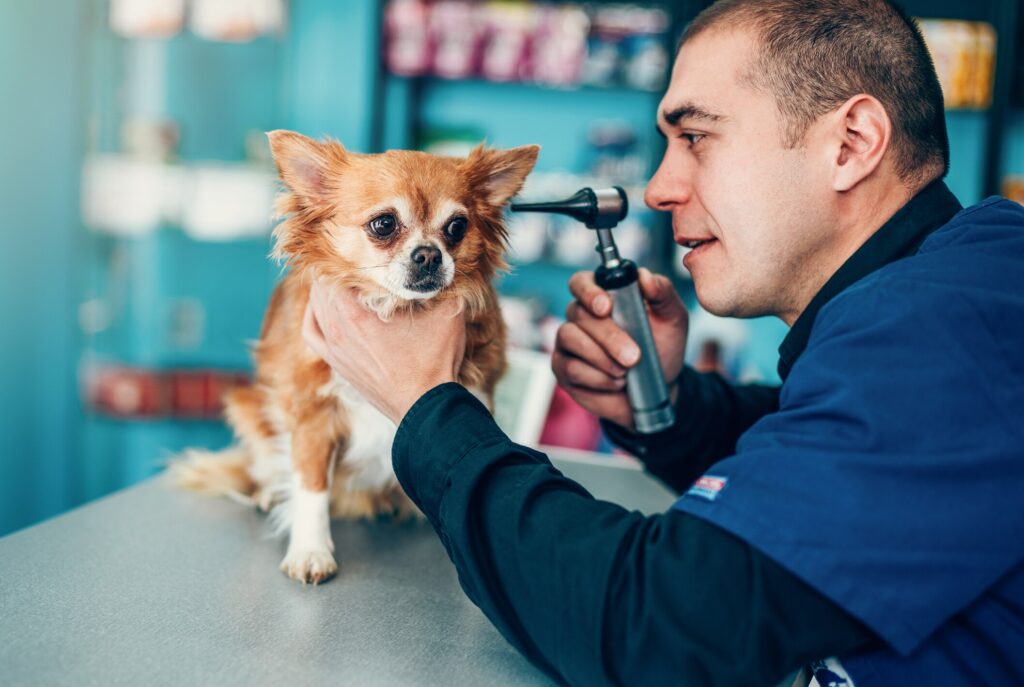
Though physical exam can reveal issues like external ear infections and masses, many causes of deafness are not visible or palpable, even with an otoscope (an ear examination tool). Dogs may have variable responses to sounds in the exam room due to excitement or anxiety. This can make the diagnosis particularly difficult in cases of partial deafness because the unaffected ear may easily compensate for the loss.
A thorough history is important for your vet. Inform them of how long your pet has shown signs of hearing loss, whether it seems sudden onset or slowly progressive, and whether your pet has had any medical conditions or medications that may predispose them to deafness.
This will help your vet determine what further testing or treatment is necessary.
Your vet can directly examine the ear canal during a physical exam to assess the external ear canal and eardrum. However, the entire hearing system can’t be evaluated this way.
Your vet will also examine your dog’s ability to balance and how the other nerves in their head and neck are working. Loss of nerve function or balance coupled with hearing loss may point to an issue in the inner ear or brain as a cause.
Diagnostic Testing
If your dog’s physical examination is normal, baseline blood work and urinalysis can help identify systemic illness like Cushing’s disease or thyroid disease, which can be treated directly.
Imaging can help with diagnosis as well. Radiographs can help rule out cancerous masses in the chest or abdomen, but visualizing changes in the skull can be difficult with these two-dimensional images.
CT is a more effective method for detecting otitis interna or other trauma to the inner ear. MRI may also be considered if a neurologic cause is suspected.
Given the numerous potential causes of deafness, your vet will help choose which diagnostics make sense to understand and identify what might be causing the hearing issue in your dog.
Treatment of Deafness in Dogs
Treatment of deafness in dogs depends on the cause. With few exceptions, issues with the conduction of sound—such as obstruction of the ear canal, minor damage to the eardrum, or infection of the middle ear canal—are treatable. A return to hearing can be expected with appropriate care.
Dogs with damage to the cochlea or nervous system, whether congenital or acquired, are less likely to recover hearing. In these cases, treatment should focus on maintaining a pup’s comfort and quality of life.
Recovery and Management of Deafness in Dogs
For dogs expected to regain their hearing, the timeline for recovery depends on the underlying cause.
Removing masses or debris from the ear canal can result in almost immediate improvement and a return to normal function. However, recovery from otitis media or eardrum damage may take weeks, with progressive improvement as the tissues heal and the body heals inflammation.
Whether temporary or permanent, there are a few things that you can do to help your dog through their hearing loss:
-
Your communication style with your dog may need to change, since auditory commands will no longer be effective.
-
Puppies born deaf can readily learn visual cues and hand signals, but there might be a learning curve for older dogs.
-
It’s important to be able to get and keep your dog’s attention to help them navigate their world. Stomping your feet on the floor may be helpful to get your dog’s attention as you approach them, so they are not startled when they see you.
-
Because your dog does not sense their environment the same way fully hearing dogs do, it is recommended to always keep them indoors, in fenced areas, or on a leash.
-
Deaf dogs cannot hear cars or bicycles approaching on a road. They are also more prone to be startled by strangers or other animals coming up behind them.
-
Patches can be applied to your dog’s harness to alert new people that they should approach with caution. Medical alert tags are also available.
Prevention of Deafness in Dogs
To prevent avoidable causes of deafness in your dog, promptly treat suspected ear infections and work with your vet to manage allergies and other causes of otitis externa.
Use vet-recommended ear cleaners and don’t use cotton swabs in the ear canals.
Do not administer ototoxic medications (those that may damage hearing or the auditory system) at higher doses or longer than is recommended by your veterinarian.
It’s best to avoid topical medications in the ear unless your dog has recently been examined. For working or hunting dogs exposed to gunfire or other highly percussive sounds, use ear protection.
Deafness in Dogs FAQs
Are deaf dogs happy?
Hearing loss is not inherently painful, and deaf dogs can live a very happy life with some lifestyle modifications for safety and stress reduction.
Featured Image: VioletaStoimenova/E+ via Getty Images


