Hip Dysplasia in Cats



What is Hip Dysplasia in Cats?
Hip dysplasia is the medical term describing abnormal development of the hip joint. Cats with hip dysplasia have poorly aligned hips that are too loose, which leads to discomfort.
The hip joint is made of a ball and socket. The ball is the round-shaped head of the femur bone in the hip and the socket is the cup-shaped depression in the cat’s pelvis. In cats with hip dysplasia the ball does not sit firmly in the socket, which results in a loose joint. This abnormal hip joint leads to pain and reduced function.
Over time this poor connection leads to early arthritis as the body tries to stabilize the joint and compensate for the abnormality, laying down new bone and bone spurs. Hip dysplasia is a degenerative disease, meaning that it worsens over time. Bony remodeling (where the body removes and builds bone) and arthritis worsens, resulting in greater discomfort and impaired mobility.
Fortunately, hip dysplasia is rarer in cats than in dogs, and many cats with hip dysplasia may never show clinical signs. Researchers suspect this is because cats are better at compensating for hind limb lameness and hiding their pain. It is still important to be aware of the condition, especially if you have a purebred cat. Some purebreds have a higher risk for dysplasia
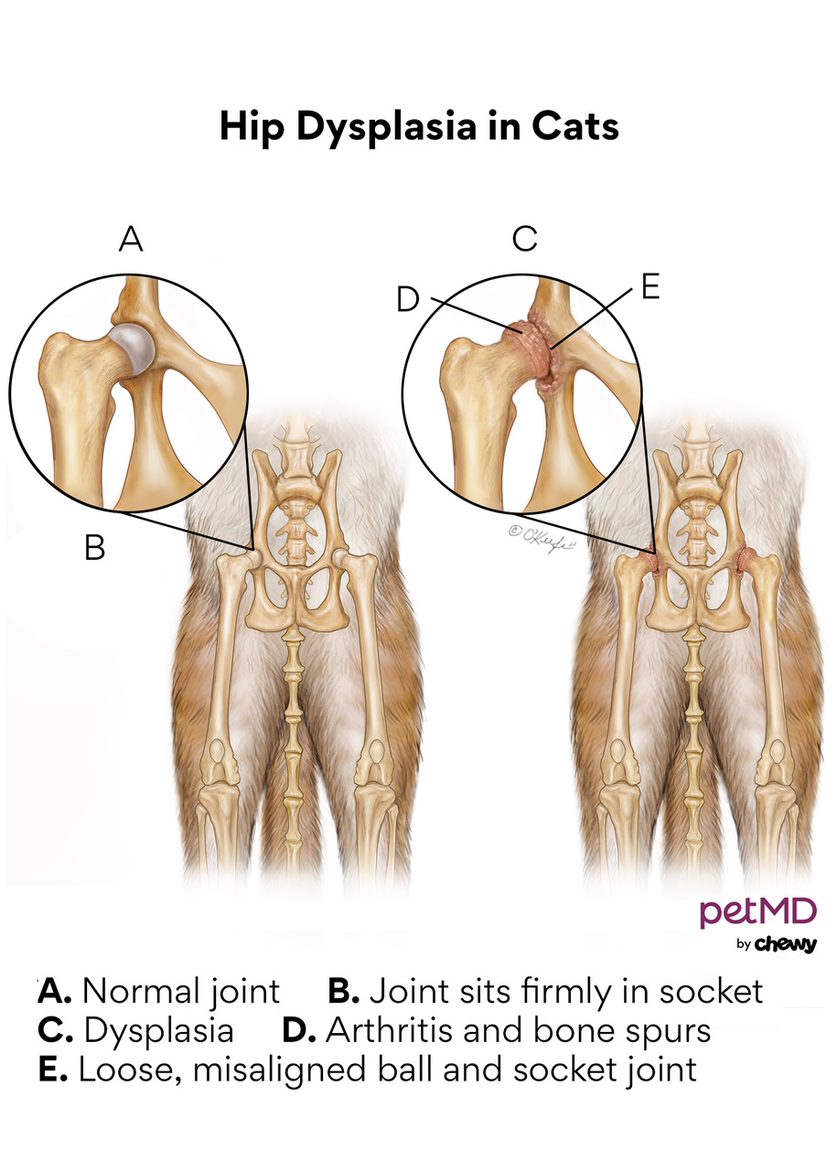
Click here to download this medical illustration.
Symptoms of Hip Dysplasia in Cats
Many cats will never show obvious clinical signs of hip dysplasia and may hide their pain well. Their signs are often more subtle. with the most common clinical signs including:
-
Reluctance to jump to high surfaces
-
Avoiding stairs
-
Hesitance to squat in the litter box
-
Going to the bathroom outside the litter box
-
Excessive chewing/licking at the hip area
-
Avoiding physical activity
-
Changes in temperament, such as becoming agitated, aggressive, or grumpy
-
Rarely, lameness or stiff gait
Causes of Hip Dysplasia in Cats
Hip dysplasia is an inherited condition, and purebred cats have a higher chance of developing it. Hip dysplasia is more common in the following breeds:
-
Maine Coon
-
Persian
-
Himalayan
-
Siberian
While hip dysplasia in cats is generally considered to be caused by genetics, some underlying factors can predispose a cat to develop hip dysplasia.
-
Obesity: Excess weight puts increased force on the hip joint, leading to excessive wear and tear. This can result in degenerative changes accelerating breakdown of the ball and socket.
-
Other orthopedic conditions, like knee problems, can lead to increased stress and breakdown of the hip joint. Injuries can also lead to earlier onset of degenerative changes and accelerate the progression of hip dysplasia.
How Veterinarians Diagnose Hip Dysplasia in Cats
Hip dysplasia is often diagnosed by a combination of a physical exam and X-rays. Your veterinarian will want to palpate, or feel, your cat's hips. They will likely move the hips through a range of motions to see if they move normally.
During this exam, c
Radiographs (X-rays) are very helpful in diagnosing hip dysplasia. With X-rays your veterinarian will be able to see the shape of the femur and the pelvis and be able to assess any degenerative changes.
Treatment of Hip Dysplasia in Cats
Treatment of hip dysplasia can be challenging in cats. Generally, treatment can include one or more of the following:
Pain Medications and/or joint supplements: Pet parents should never give their cat any human pain medication, which can be very dangerous. For example, acetaminophen is toxic to cats, and can result in death. Your veterinarian may prescribe drugs that are appropriate for cats, like opioid medications.
Many veterinarians will recommend supplements to support joint health. Products like Cosequin or Dasuquin contain glucosamine and chondroitin to support cartilage health. While they will not undo damage in your cat’s hips, they have demonstrated some success at slowing down the progression of degenerative arthritis changes. As with prescribed drugs, supplements must only be given under the direction of a veterinarian, as some supplements can be harmful.
Weight Management: Obesity can speed the breakdown of the hip joint and cause subsequent pain. Maintaining a healthy weight is one of the most important things you can do for your cat to improve their quality of life.
Achieving and maintaining a healthy weight is usually accomplished through a combination of dieting and exercise. Exercise can be very challenging to encourage in cats, and may be discouraged if a cat has a debilitating orthopedic disease. Work with your veterinarian to determine the appropriate amount of food that your cat should receive in a day.
Your vet may suggest changing your cat’s diet to encourage weight loss, through over-the-counter or prescription diet food. Given how finicky some cats can be, monitor your cat’s appetite to ensure they
Surgery: While surgery for hip dysplasia treatment in cats is uncommon, surgery may be recommended if the condition seriously impairs a cat’s quality of life. Two of the more common types include femoral head ostectomy (FHO) and a total hip replacement. Both of these surgeries aim to decrease pain by eliminating the grinding and misalignment (called subluxation) in the joint itself.
Recovery and Management of Hip Dysplasia in Cats
While hip dysplasia is uncommon in cats, most cats do well with weight management, joint supplements, and pain control. With medical management, the prognosis is good overall. Hip dysplasia often does not dramatically shorten a patient’s life expectancy unless they are born with genetically severe abnormal conformation in their hips.
Prevention of Hip Dysplasia
Because hip dysplasia is largely inherited, there is not much that a pet parent can do to prevent it in their cat. Avoid breeding cats that have been diagnosed with hip dysplasia. Keep your cat at a healthy weight to minimize excessive force on their joints and earlier onset of arthritic changes in the hip joints.
Hip Dysplasia in Cats FAQs
Can a cat live with hip dysplasia?
Yes, cats can live good-quality lives with hip dysplasia as long as their pain is controlled.
Is hip dysplasia painful in cats?
Yes, it can be painful. Sometimes it is not, however, and is only discovered incidentally on X-rays. Some cats with hip dysplasia never show any clinical signs and are not overtly uncomfortable.
References
Cerna P, Timmermans J, Komenda D, Nyvltova I, Proks P. National Library of Medicine. The Prevalence of Feline Hip Dysplasia, Patellar Luxation and Lumbosacral Transitional Vertebrae in Pedigree Cats in the Czech Republic.
Cornell Feline Health Center, Cornell University College of Veterinary Medicine. Hip Dysplasia.
Wolf, Alice. DVM 360. Degenerative Joint Disease in Cats. August 2009.
Featured Image: iStock.com/shironosov