Corn Snake Care Sheet



iStock/Vagengeym_Elena
Corn Snake Species Overview
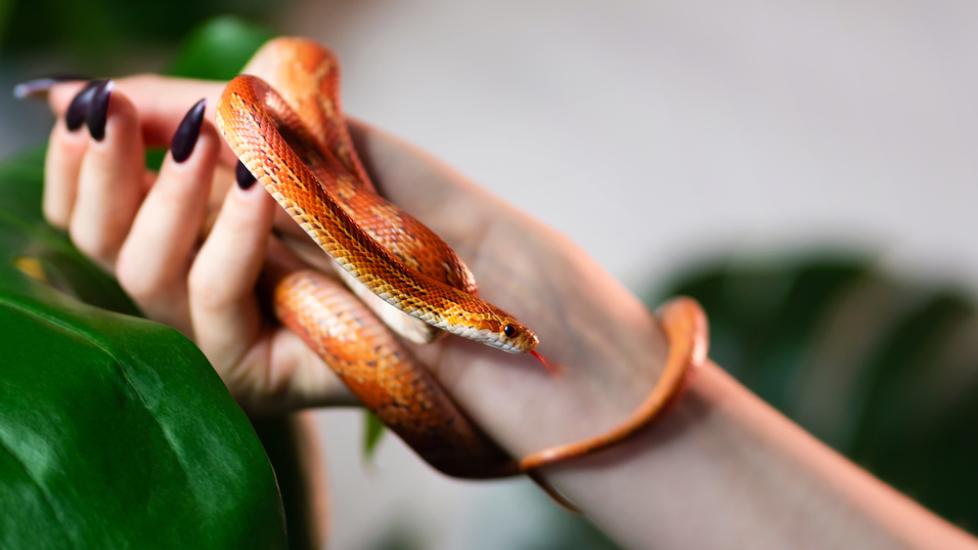
Docile and even-tempered, corn snakes make excellent pets for beginner snake hobbyists.
Corn snakes are named thanks to the spotted pattern of their belly scales, which resembles maize—an ancestor of modern-day corn. Corn snakes come in an assortment of color morphs and patterns, including:
-
Orange
-
Red
-
Brown
-
White
-
Black
-
Yellow
Corn snakes can live for for over 20 years with proper care, so owning a corn snake is a rewarding and long-term commitment.
Corn Snake Handling
Most corn snakes are tolerant of proper handling. But, like all snakes, they may strike if they feel ill, stressed, or threatened.
On occasion, snakes may mistake human hands as a food source. This sometimes happens during shedding periods, when the clear scales that cover the snake’s eyes (eye caps) become loose and impair their vision.
Always approach a snake calmly and quietly, and try to minimize handling when they are shedding. Corn snakes are not venomous.
As solitary creatures, corn snakes prefer to be housed alone.
All reptiles are potential carriers of infectious diseases including Salmonella bacteria, which is zoonotic (transmittable to people) disease. Always wash your hands before and after handling your snake or the habitat’s contents.
Corn Snake Characteristics
|
Difficulty of Care |
Beginner |
|
Average Life Span |
Up to 20+ years with proper care |
|
Average Adult Size |
4–6 feet long |
|
Diet |
Carnivorous |
|
Minimum Habitat Size |
10+ gallons for juveniles; 30–40+ gallons for adults |
Corn Snake Supply Checklist
To keep a corn snake happy and healthy, keep these supplies on hand:
-
Appropriately sized reptile habitat (10+ gallons for juveniles; 30–40+ gallons for adults)
-
Moss
-
Hideaway box
-
Plants
-
Heat fixture
-
UV fixture
-
Under-tank heater
-
Thermostat
-
Feeding tongs
Corn Snake Enclosure
Young corn snakes need a tank that’s at least 10 gallons. As the snake enters adulthood, increase their habitat size to accommodate their growth.
All enclosures should be well-ventilated and have a secure, screened lid to prevent the snake from escaping.
Corn snakes enter adulthood within 2–3 years. An adult corn snake should be housed in a breeder tank that’s 40 gallons or larger.
Corn snakes are active, slender, and curious reptiles and are excellent escape artists. Enclosures must have a secure, locking lid to prevent escapes. Always provide the largest habitat possible.
Corn snakes are solitary animals and should be housed alone. Keeping more than one corn snake in the same habitat can encourage stress, aggression, and competition between tank mates.
Never keep different species of animals in the same habitat.
Corn Snake Temperature Ranges
Check your corn snake’s habitat daily. Two thermometers—one in the warm area and one in the cool area—should be placed in the enclosure so that both zones can be checked at once. A digital point-and-shoot thermometer can also be used to read habitat temperatures instantly.
Corn snakes need a thermal gradient in their enclosure so they can warm up and cool down as needed. The recommended temperature for the warm end of a corn snake’s habitat is 85 F, while the cooler end should be kept in the low 70s F.
Do Corn Snakes Need a Heat Lamp?
Install an under-tank heater and/or over-the-tank basking lamp with a heat bulb to supply radiant heat in the snake’s habitat. The wattage needed for the heat bulb will vary depending on the size of the enclosure, the distance of the bulb from the snake, and the ambient temperature of the room where the enclosure is kept.
Adjust the wattage of the bulb to maintain the recommended temperature gradient within the tank. If an under-tank heating pad is used, it must be connected to a thermostat to prevent the snake from getting burned.
Note: Some light bulbs provide not only light to the tank but also heat and/or ultraviolet (UV) light. Always check light sources before placing them in a snake’s habitat.
Do Corn Snakes Need UVB and UVA Light?
Studies show that daily exposure to UVA/UVB light can improve snakes’ immune system function and promote normal behavior. Be sure to provide your corn snake with eight to 12 hours of UV light daily to imitate natural sunlight. Replace lights every six months since the potency wanes over time.
White lights should not be left on continuously, because they will disrupt the snake’s natural sleep cycle and negatively affect its health. At night, switch to a nocturnal or infrared light, like the Zoo Med Nocturnal Infrared Reptile Terrarium Heat, to ensure the snake can rest.
Corn Snake Humidity
Corn snakes need humidity in their environment to support their respiratory systems, encourage healthy shed cycles, and stay hydrated. The ideal humidity range for a corn snake’s habitat is 40% to 60%.
During shedding cycles, increase the enclosure’s humidity to around 70%. A hygrometer (humidity gauge) should be used to measure the enclosure’s humidity.
Substrate
Paper-based bedding, reptile carpet, cypress much, coconut husk, and Aspen wood shavings are all suitable choices for substrate. Pine and cedar bedding should not be used, because these have oils that can irritate corn snakes’ skin and cause health issues.
If Aspen is used as a substrate, be sure to replace it weekly to prevent the bedding from getting wet or soiled. If wood shavings, mulch, or coconut husk bedding is used, the snake should be fed in a separate enclosure without loose substrate. Otherwise, the snake may accidentally consume bedding particles that are indigestible which can cause gastrointestinal obstruction.
Corn Snake Tank Decorations
Hideout Box
Provide your corn snakes with at least two hideout boxes—one kept on the warmer side of the enclosure and one on the cooler side. Aside from offering privacy, hideout boxes can help corn snakes regulate their body temperature, since these boxes provide space away from their enclosure’s direct basking area.
Monitor your snake's behavior to be sure they are not hiding all the time, as they won’t have a chance to benefit from UV exposure.
Synthetic or natural wood hiding logs are recommended. Hiding logs should always be large enough for the snake to fit inside comfortably, increase the size of their hideout boxes as their corn snake grows.
Climbing Branches
Although they’re primarily terrestrial reptiles, many corn snakes are climbers. Climbing branches can be installed to enrich the snake’s environment and encourage exercise.
Moss, Plants, and Terrarium Background
Moist sphagnum moss can be added to the inside of a hideout box on the warm side of a corn snake’s enclosure to create a humidity hide. Moss holds moisture well and can aid in healthy shedding. Moss should be replaced often to prevent mold from forming.
Adding artificial plants and a terrarium background to a snake’s enclosure can enrich their environment and add some aesthetic flair.
Corn Snake Cleaning and Maintenance
A corn snake's habitat needs to be cleaned and disinfected at least once a week with either a commercially available habitat cleaner or a 3% bleach solution.
Remember to always wash your hands before and after handling your snake or the habitat’s contents, since all reptiles are potential carriers of infectious diseases.
To clean a corn snake’s habitat:
-
Move the snake to a secure environment. Remove any old substrate, décor, and accessories from the habitat.
-
Scrub the empty tank and any furnishings with a reptile habitat cleaner or 3% bleach solution. The bleach solution should stay on the habitat for at least 10 minutes so all surfaces are properly disinfected. If using a commercial habitat cleaner, follow the manufacturer's instructions.
-
Rinse the habitat and accessories thoroughly with water, removing any trace amounts or residual smells left by the cleaning agent or bleach solution.
-
Allow the habitat and its contents to dry completely before placing new substrate and clean accessories into the habitat.
-
Return the snake to the clean habitat.
What Do Corn Snakes Eat?
Pet corn snake diets should include thawed frozen rodents, such as mice and rats. Because corn snakes are primarily diurnal (active during the day), meals should be offered during the day. Use feeding tongs, not fingers, to offer meals. Corn snakes should always have access to fresh, clean water.
A nutritious and well-balanced corn snake diet consists of:
-
Appropriately sized frozen rodents
-
Prey should be around the same size as the snake’s width at mid-body. For example, if the snake’s midsection is 1 inch in diameter, its prey should also be no wider than 1 inch.
-
-
A corn snake’s ideal feeding schedule will depend on its age, size, and activity level. Juvenile corn snakes should be fed once a week, while adults only need to be fed every one to two weeks. Baby snakes can be fed every other day.
-
Begin juvenile snakes on a diet of “pinkies,” or young and nearly hairless mice. As the snake grows into adulthood, it can be transitioned to a diet of larger mice and small rats.
Fresh, clean water should always be available and replaced daily. Reptiles absorb water through their skin to stay hydrated, so water dishes should be large and shallow enough for the snake to soak in if needed. If they aren’t soaking on their own, soak your corn snake for 10–15 minutes, two to three times a week.
Feeding Guidelines
Do not feed your corn snake live prey. If still alive, rodents can become aggressive and injure snakes, including causing life-threatening infections.
Ideally, feeding sessions should take place in a separate enclosure. This is so the snake will not associate their enclosure and their owner's hand with feeding. Instead of your fingers, use long feeding tongs to offer food to your snake.
Due to their slow metabolisms, corn snakes can go weeks or months without eating. However, they often become ill if they don’t eat for extended periods. If a snake misses more than a couple of feeding sessions, consult a veterinarian, especially if the snake isn’t shedding at the time.
How To Thaw Frozen Prey
To thaw frozen prey, take these steps:
-
Remove the needed number of food items from the bag.
-
Put the frozen food in a sealed plastic bag and place it in a thawing container filled with cold water. The thawing container should only be used for thawing your reptile’s frozen meals.
-
Keep the food in the water until it thaws. Discard the cold water.
-
Refill the thawing container with warm water.
-
Place the thawed prey, still in the sealed plastic bag, in the warm water. Allow it to soak for 10-15 minutes before discarding the water.
-
Just before feeding, run nearly hot water over the thawed food to warm it above room temperature.
-
Remove the thawed food from the container and plastic bag.
-
Using feeding tongs, offer the food to the pet right away.
Never use a microwave to thaw or warm frozen rodents, and never offer food that's still frozen to a pet. Frozen food that is not consumed should never be re-frozen for future use, as this encourages bacteria to form in the food.
Avoid preparing frozen rodents in the same area that you use to prepare food. If this is unavoidable, be sure to disinfect the area thoroughly after use.
Corn Snake Grooming and Care
Shedding
Corn snakes shed their skin regularly, and a healthy snake will usually shed their skin in one, complete piece. Humidity levels in your snake’s tank should be kept around 70% to encourage a proper shed.
A snake’s eye caps, also called its spectacles, should come off with the rest of its shed skin. Consult with your veterinarian if you notice the eye caps do not fall off. Do not try to remove them yourself.
Corn snakes may lose interest in eating while shedding. Irritability is also a common behavior during a shed.
Corn snakes can soak themselves in shallow, open dishes of water to help shed their skin. Damp paper towels and moistened sphagnum moss can also be placed in the snake’s enclosure to encourage healthy shedding. Misting your corn snake daily can also support proper hydration.
Due to their slow metabolisms, corn snakes can go weeks and even months without eating. However, they often become ill if they don’t eat for extended periods. If a snake misses more than a couple of feeding sessions, consult a veterinarian, especially if the snake isn’t shedding at the time.
Corn Snake Veterinary Care
Annual Care
Bring your corn snake to the veterinarian for a checkup once a year. They can be transported using a ventilated plastic lidded bin, with or without a snake bag.
Remember to bring pictures of their enclosure, diet, heaters, lights (including exact specifications from the packaging), etc., so your veterinarian can assess your snake’s care as part of the exam.
Signs of a Healthy Corn Snake
-
Clean, clear eyes
-
Intact skin with no ulcerations or stuck shed
-
Clean vent
-
No swellings or bumps
-
Regular flicking of their tongue
-
Relaxed demeanor
When To Call a Vet
-
Cloudy eyes or eyes that appear to have something stuck to the surface
-
Blisters, ulcerations, stuck shed, or other lesions on the skin
-
Discharge around the vent
-
Tumors
-
Lethargy
-
Loss of appetite
-
Sudden inability to move a section of their body
Common Illnesses in Corn Snakes
-
Dysecdysis (stuck shed, retained eye spectacles)
-
Oral infections
-
Cloacal prolapse
-
GI obstruction or constipation
-
Dystocia (stuck eggs)
-
Internal or external parasites
-
Trauma—especially bite wounds if feeding live prey
-
Inclusion body disease
Click here for a downloadable PDF of this corn snake care sheet!
Corn Snake FAQs
How friendly is a corn snake?
Corn snakes are one of the friendliest snakes. They are typically gentle and comfortable with handling and will willingly seek out their humans during active periods.
What snake is mistaken for a corn snake?
Copperheads and corn snakes are often mistaken for each other. Copperheads are venomous and so it is important to not mistake one for the other.
Are corn snakes for beginners?
Yes, corn snakes are about the best beginner snake choice you can make.
How big do corn snakes get?
Corn snakes can reach 4–6 feet long as adults.
Do corn snakes like to be held?
Although they need regular upkeep of the behavior, most corn snakes learn to like being held and will seek you out when you open their enclosure if they’re not sleepy.