Mouth Ulcers in Cats



The following may contain Chewy links. PetMD is operated by Chewy.
What Are Mouth Ulcers in Cats?
An ulcer is defined as a break in the skin or mucous membrane (lining), with eventual loss and death of the tissue. Often, an ulcer appears as a highly inflamed, erosive (loss of tissue), reddish lesion. In cats, oral ulcers—or ulcers that affect any of the lined surfaces of the mouth such as gums, palate, tongue, lips, inner cheeks, or pharynx—are a common medical condition with various causes, some of which are not well understood. These can cause significant pain and debilitation for your cat.
Types of Mouth Ulcers in Cats
Kissing ulcers, or those that arise where the gum contacts the plaque and calculus of the tooth, can lead to stomatitis in cats, an inflammatory condition affecting most of the mucosal surfaces within the mouth. Stomatitis is still not well understood, but it is believed to be an exaggerated immune response toward the teeth and/or the secondary plaque and calculus that adhere to tooth surfaces.
Indolent ulcers are often seen in cases of eosinophilic granuloma complex, and attributed to an underlying allergy. These are typically seen as a brown-red lesion on your cat’s upper lip, but other lesions can be seen inside the mouth and on the skin.
Any type of mouth ulcer indicates greater disease may be present, and your cat needs to be examined by a veterinarian immediately.
Symptoms of Mouth Ulcers in Cats
Pet parents may notice an ulcer around or inside a cat’s mouth. Your cat may also experience multiple signs attributed to oral pain, including:
-
Reluctance to eat or dropping of food
-
Pawing at the mouth or rubbing face on the floor
-
Unkempt hair coat due to lack of grooming
-
Bad breath
-
Swollen gums
-
Excessive drooling or blood-tinged saliva
-
Pain or aggression when pet parent tries to open or close the mouth
-
Weight loss
-
Swelling of the local lymph nodes
Causes of Mouth Ulcers in Cats
By far the most common cause of mouth ulceration in cats is periodontal disease or related conditions, such as tooth root abscesses, cysts, and stomatitis. Other causes, though less frequent, include:
-
Infections such as herpes virus, calicivirus, feline leukemia virus (FeLV), or feline immunodeficiency virus (FIV)
-
Autoimmune diseases
-
Inflammatory and allergic conditions, such as eosinophilic granuloma complex
-
Metabolic diseases, such as kidney disease/uremia
-
Toxins/chemical agents, including certain kinds of plants
-
Burns (electrical and thermal)
-
Radiation therapy
-
Trauma and foreign bodies
-
Cancer
How Veterinarians Diagnose Mouth Ulcers in Cats
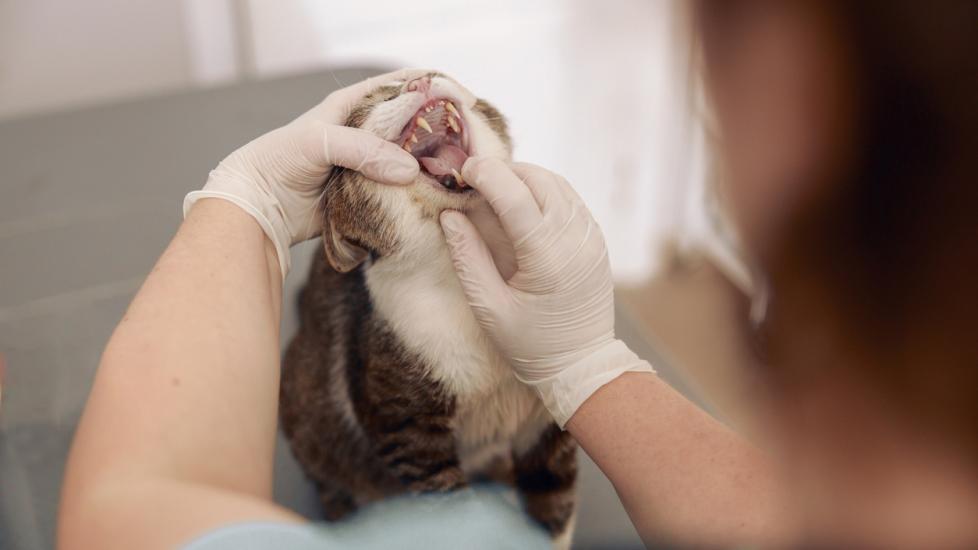
When a pet presents with signs of oral pain, your veterinarian will look for signs of inflammation, infection, swellings, masses, and tooth problems in the mouth. Ulcers are generally uniform in appearance, so diagnosis is straightforward.
However, the underlying cause may not be quite as easy to find, and additional tests may be needed to reach a diagnosis, including:
Treatment of Mouth Ulcers in Cats
Treatment often depends on the underlying cause. Periodontal disease and its associated complications will require a thorough and professional anesthetic dental cleaning and radiographs. Cats suffering from stomatitis will most often require tooth extraction, and in some cases will require extraction of all teeth.
For cats unable to undergo anesthesia or have teeth extracted, medical management can temporarily alleviate symptoms. However, this will not cure the condition and the cat will continue to suffer long-term. Medications may be prescribed:
-
Antibiotics
-
Steroids
-
Immunosuppressive drugs, such as Cyclosporine
-
Immune modulators, such as interferon
Regardless of the treatment pursued, because mouth ulcers are painful, pain medication should be prescribed at the onset of treatment. For severe cases, a feeding tube may need to be surgically placed and maintained until your cat is feeling well enough to eat on its own.
At home, dental care with daily brushing, dental wipes, antiseptic rinses or gels, water additives, and/or dental diets are encouraged for long-term management. Speak with your veterinarian about the best option for you and your cat.
Additionally, for those cats who have allergies, including eosinophilic granuloma complex, your veterinarian will most likely prescribe a change of diet, such as a novel protein diet or a hydrolyzed diet, where the protein is broken down into smaller molecules that are less likely to trigger an immune response. Keeping your cat on strict flea control will also be recommended, as well as allergy testing.
Recovery and Management of Mouth Ulcers in Cats
Many cats can go on to live relatively normal lives once the underlying condition is resolved and/or managed. Most commonly, a few weeks is all cats need to get better, and just because they developed ulcers in the past doesn’t necessarily mean they are prone to getting them again. A small percentage of cats suffering from stomatitis may require long-term intervention with medications, even after full-mouth extraction.
Cats that have or are predisposed to allergies will often be managed long-term with medications and directions to adhere to a prescription diet.
Mouth Ulcers in Cats FAQs
How can pet parents prevent mouth ulcers in cats?
Unfortunately, for most causes, there is little prevention you can do to help your cat. However, pet parents are advised to cat-proof their home as much as possible, and to provide your cat with multiple routes for dental care. At the bare minimum, brushing your cat’s teeth daily is by far the best care you can give going forward. Fortunately, the prognosis is usually excellent once the condition is controlled.
Are mouth ulcers painful for cats?
Mouth ulcers are undoubtedly painful. Your veterinarian will most likely speak to you about the different options for pain control during your cat’s disease.
Featured Image: iStock.com/dima_sidelnikov