Feline Tooth Resorption: Stages and Treatment


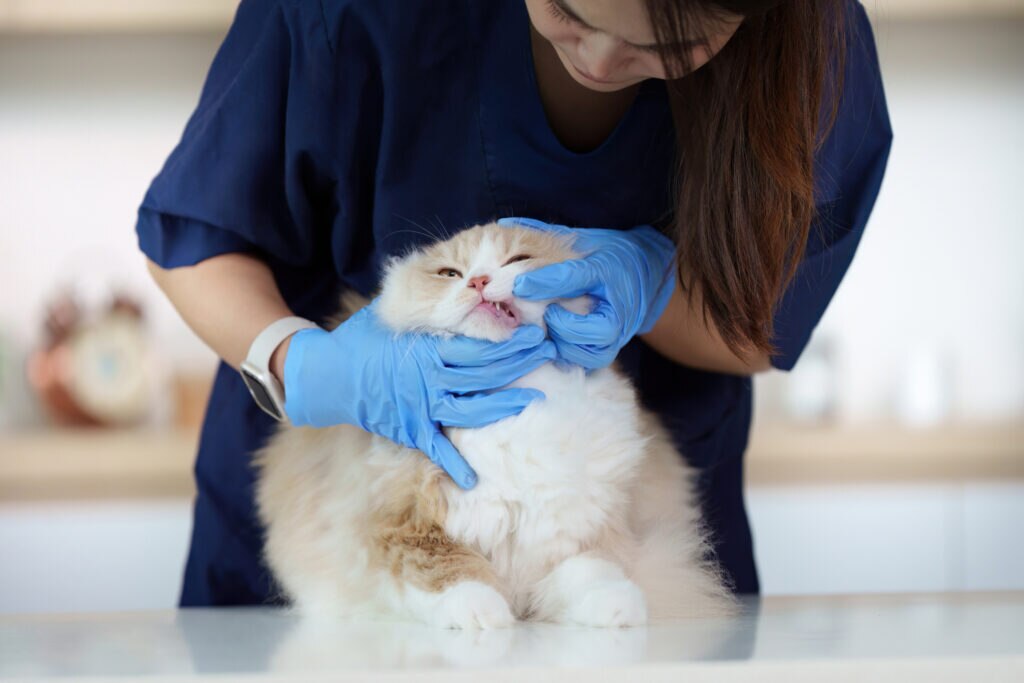
wichayada suwanachun/iStock/Getty Images Plus via Getty Images
Does your cat act like their mouth is bothering them? Are they tilting their head to the side or trying to eat their kibble without chewing?
Your cat may have a common condition called feline tooth resorption.
Feline resorptive lesions are small holes on the teeth where their body has eaten away part of the tooth, leading to discomfort and pain.
Key Takeaways
- Feline tooth resorption is a common, painful condition where the body breaks down a cat’s teeth, often requiring surgical treatment.
- There are two main types and five stages of tooth resorption, with Type 2 being more common and less painful.
- There is no known way to prevent tooth resorption, but regular dental exams and X-rays help with early detection and treatment.
What Is Feline Tooth Resorption?
Feline tooth resorption occurs when a cat’s body starts to break down and absorb the structures of a tooth.
Tooth resorption starts when odontoclast cells begin to attack healthy teeth.
Odontoclast cells usually play a healthy role in your cat's mouth when they are young, aiding in breaking down their baby teeth so that they can readily fall out and be replaced by adult teeth. Problems arise when these cells start to attack healthy, adult teeth.
Any tooth can be affected by resorption, but the mandibular premolars (bottom cheek teeth) are most affected.
Left untreated, cats with tooth resorption may experience chronic pain and potentially weight loss if they’re not eating as much.
Tooth resorption is different from cavities. Cavities are caused by bacteria that create acid. This acid breaks down the enamel and dentin of the tooth, which can kill the tooth.
Feline tooth resorption is common in pet cats, with 28.5–67% of cats diagnosed with one or more tooth resorptive lesion. These lesions usually look like small holes in the tooth. They are very painful and your cat may chatter their teeth when they’re touched or probed with a dental instrument.
There are two main types of tooth resorption: type 1 and type 2. Let’s look at both.
Feline Tooth Resorption Type 1
In Type 1 feline tooth resorption, areas of a diseased tooth are resorbed (broken down and absorbed) and then replaced with inflammatory granulation tissue.
On dental radiographs (X-rays), these areas appear to be less dense than either tooth or bone.
In this form of tooth resorption, the roots of the tooth must be removed with the affected crown to avoid any long-term discomfort. Affected teeth look like they have small holes on the crown, but their roots look intact.
Feline Tooth Resorption Type 2
Cat teeth diseased with Type 2 feline tooth resorption are replaced with a bone-like material. On dental X-rays, these can look like tooth remnants in the bone. As the bone-like material that replaces their root is not painful, the disease crowns of the teeth can be removed without needing to extract the roots as well.
Affected teeth have small holes on the crown again, but the roots have melted away and are replaced with bone.
This is the most common form of tooth resorption as it’s less painful and affected cats can go a much longer time before pet parents notice something is amiss.
Stages of Feline Tooth Resorption
There are five stages of feline tooth resorption that progress from a small amount of tissue loss to severe tissue loss. This extends into the tooth until only remnants of dental tissue remain.
Veterinarians may evaluate each tooth to determine the type and stage of each lesion.
-
Stage 1: Small lesions on the outside of the tooth affecting the enamel or cementum.
-
Stage 2: Lesions extend beyond white outer enamel part of tooth into the yellow dentin beneath.
-
Stage 3: Lesion involves the pulp cavity, the inner chamber of the tooth.
-
Stage 4: Most of the tooth is eaten away
-
Stage 5: The tooth is mostly gone to the naked eye and only appears as bits of remaining tooth on dental X-rays.
What Causes Feline Tooth Resorption?
While the underlying cause of feline tooth resorption is still unknown, researchers continue to investigate both the process and the cause of tooth resorption. Tooth resorption has not been shown to be related to bacteria in the mouth.
Researchers have investigated diets, mineral imbalances, periodontal diseases, vitamin D status, and other factors to identify the cause of feline tooth resorption. Unfortunately, a straightforward answer has not been found.
Studies have shown that cats are more likely to have tooth resorption as they age. They have also found that cats that are diagnosed with tooth resorption are more likely to have other teeth affected in the future.
Cat Tooth Resorption Symptoms
Symptoms of feline tooth resorption can range from:
-
Having difficulty chewing
-
Dropping food while chewing
-
“Chattering” the jaw while eating
-
Running away from the food bowl
Many cats with tooth resorption also show no signs of pain or change in behavior at home.
How Do Vets Diagnose Feline Tooth Resorption?
Several different conditions can cause oral pain in cats.
To diagnose feline tooth resorption, your veterinarian may first rule out conditions like:
-
Pyogenic granulomas
These can be ruled out by doing an oral exam.
Sedation may be needed to facilitate a thorough oral exam.
Your vet will likely recommend taking dental radiographs (X-rays) of your cat’s teeth. Dental x-rays are always done under anesthesia. The sensor used to capture the image cannot be chomped on, or it will break and they are very expensive to replace.
It’s difficult to see all the way in the back of a cat’s mouth when they’re awake. Resorptive lesions may not be found until your cat is under anesthesia for their dental cleaning.
Your cat may need more teeth extracted than what was expected due to resorptive lesions being found while probing their gum line.
Feline Tooth Resorption Treatment
If your pet is diagnosed with feline tooth resorption, your veterinarian will likely use dental X-rays while your cat is under anesthesia to make a treatment recommendation.
Treatment of teeth with resorptive lesions is to remove the affected tooth.
Your vet will treat feline resorption depending on the type:
-
Feline resorption type 1: Type 1 tooth resorptive lesions are treated with extraction of the tooth with the roots (surgical extraction).
-
Feline resorption type 2: Type 2 tooth resorptive lesions can be treated with a crown amputation, which removes the diseased portion of the tooth but leaves the already resorbing roots.
Prior to extracting teeth or doing a crown amputation, your veterinarian will perform a local nerve block to reduce the amount of anesthesia your cat needs and to ensure your cat wakes up numb and comfortable. This entails using a needle to inject a local anesthetic, like lidocaine or bupivacaine, into parts of the mouth where the nerves are so that your cat’s mouth is numb.
Can You Prevent Feline Tooth Resorption?
Unfortunately, there is no way to prevent feline tooth resorption.
Brushing your cat's teeth daily or every other day with a cat-safe toothbrush and toothpaste helps to decrease plaque and bacteria to slow gingivitis and periodontal disease.
If your cat begins to show symptoms of pain or is suddenly resistant to tooth brushing, it may be a sign of a dental issue. Taking your cat for their yearly wellness exams, anesthetic dental exams, cleanings, and dental X-rays is the best way to prevent your cat from quietly suffering from tooth resorption.
Your veterinarian is your best partner for diagnosis and treatment of feline tooth resorption.
Feline Tooth Resorption FAQs
Can cats die from tooth resorption?
While tooth resorption can lead to chronic mouth pain and difficulty eating, it is rarely a cause of death.
What happens if feline tooth resorption is left untreated?
Left untreated, cats with tooth resorption may experience chronic pain and potentially weight loss if they’re not eating as much. Prolonged periods of anorexia can be dangerous, especially for obese cats.
Is there a natural treatment for feline tooth resorption?
Unfortunately, there is no natural treatment for tooth resorption.
Is feline tooth resorption painful?
Tooth resorption is generally painful for affected cats; however individual cats may respond differently to discomfort from tooth resorption. Some types of tooth resorption are more painful than others.
References
1. The Tooth Decay Process: How to Reverse It and Avoid a Cavity | National Institute of Dental and Craniofacial Research. https://www.nidcr.nih.gov/health-info/childrens-oral-health/tooth-decay-process.
2. Berger M, Stich H, Hüster H, Roux P, Schawalder P. Feline Caries in Two Cats from a 13th Century Archeological Excavation. J Vet Dent. 2006;23(1):13-17.
3. van Wessum R, Harvey CE, Hennet P. Feline Dental Resorptive Lesions: Prevalence Patterns. Vet Clin North Am Small Anim Pract. 1992;22(6):1405-1416.
4. Reiter AM, Lyon KF, Nachreiner RF, Shofer FS. Evaluation of calciotropic hormones in cats with odontoclastic resorptive lesions. Am J Vet Res. 2005;66(8):1446-1452.
5. AVDC Nomenclature | AVDC.org. https://avdc.org/avdc-nomenclature/.


