Andalusian

Reviewed for accuracy December 8, 2022.
Officially known as the Purebred Spanish Horse, the Andalusian originated in Spain (specifically Andalusia) centuries ago. The Andalusian, partly as a result of Spanish colonization efforts, has been greatly responsible for improving the stock of several horse breeds worldwide.
Physical Characteristics
The Andalusian is beautiful, elegant, and graceful. Standing at 15.1 to 16.2 hands high, it draws strength from its superb musculature, robust legs, well-formed joints, and dense hooves. That is, however, not to say the Andalusian is sluggish; in fact, it moves easily and with great harmony.
Depending on its bloodlines, the head may be Barb-like or Arab-like, though it is usually slightly convex. Its eyes, meanwhile, are lively and its ears are short and carried high. The Andalusian also has a sloped back, arched neck, broad check, rounded rump, and low-set tail.
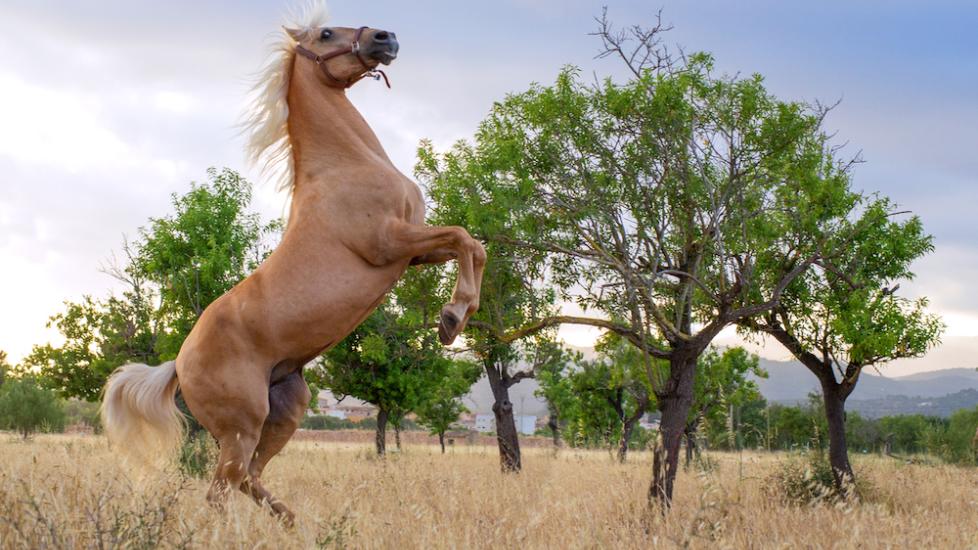
Typically, the Andalusian has a fine coat, but thick hair at the mane and tail. Common coat colors include light gray, black and bay, but can occasionally be chestnut, palomino, or dun.
Personality and Temperament
The Andalusian is keen, quick to learn, and loyal. It is also calm, which was ideal for army officers during battle.
History and Background
The Andalusian may be referred to as the Purebred Spanish Horse but its ancestry is a hodge-podge of various native and foreign horse breeds, including the Sorraia, Galician, Pottok, Garrano, and Asturian.
These foreign breeds were brought to Spain during different periods and on various pretexts; e.g., the many invasions of the Iberian Peninsula. During most of these invasions, the invaders brought their own mounts with them. Among these were the hot-blooded horses of the East and the cold-blooded horses of the North. Other tribes and races that introduced their own horses into the Andulasian gene pool included the Romans (who brought the Camargue), the Arabs (who brought the Oriental horse), and the Goths (who brought the Gotland).
As a result of crossbreeding, the Andalusian has two main types: the classic Andalusian with the convex profile and the Andalusian with the Arab-type head. The classic Andalusian was preserved by the Carthusian Monks, whereas the Andalusian with an Arab-type head is a result of 19th-century efforts to crossbreed the Andalusian with the Arab breed. The use of this horse has been so widespread, in fact, that it is known by various names throughout the world, including the Iberian Saddle horse, the Jennet, and Zapta.
The modern Andalusian still retains its ability to adapt to any environment, one of the reasons it is still one of the most common riding horses in the world today.
Care and Health
The Andalusian is prone to a few health issues, including inguinal hernias in stallions, laminitis, Cushing’s disease, and melanomas (benign, although commonly growing, masses) on gray horses. While some of these conditions cannot be prevented, keeping your horse in adequate body condition with an appropriate diet can help minimize the chances of developing laminitis and other metabolic conditions.
Featured Image: iStock.com/Kerrick