How Fish Sense and ‘Feel’

Sense Organs in Fishes
Much like humans or any other animals, fishes need to know what’s going on around them in order to navigate, feed, communicate, and deal with aggression — either on the attack or in defense.
However, living in water is very different from living on land. Light doesn’t travel far before it is dispersed, especially if the water is particularly cloudy or dirty, while sound travels farther and faster under the surface, as waves of pressure.
Smell and taste are particularly important for water-dwellers since most substances, including food, dissolve in water and tiny particles are dispersed, which trigger appropriate reactions when detected. Some fish also have an extra sense called "electroreception," which works because their environment is an electrolytic solution – in other words, it conducts electricity.
Sight, Sound, and Orientation
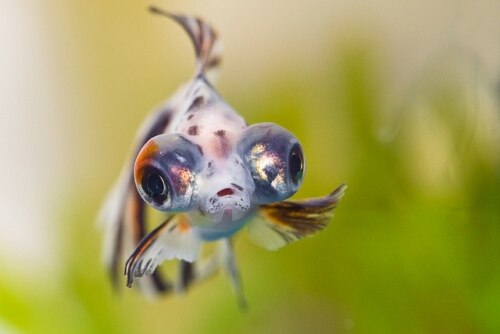
Many people believe that fish don’t see much at all; the reality is quite different. A fish's eyes are very much like those in most other vertebrates — they can focus on objects both near and far, they see in color, and the position of the eyes on the head determines their field of vision. Except in a few species with modified visual equipment, fish do not see well past the top surface of the water, due to the distortion of light rays at the surface.
Much like land-based animals, fish that need good defenses generally have eyes on the sides of the head to provide a wider field of vision, while the predators have their eyes closer together and in front to focus on potential meals.
Fish rely on their hearing very heavily. Sound passing through the water as pressure waves is picked up by a "lateral line" system that runs along the midline of each of the fish’s flanks. The system is a series of canals and pits that filters out all the usual background noise and picks up low-frequency disturbances in the 0.1-200 Hz range.
This ties in with the fish’s inner ear, which detects the high end of their audio spectrum, up to 8 kHz. Some fish have more developed hearing as well, such as carp, which use their swimbladder as an amplification system and receiver.
Fish maintain orientation in their three-dimensional environment using receptors in their inner ear and related structures. These otoliths inform the fish when its head is tilting and detect acceleration, combining this information with receptors that detect fluid moving in the semicircular canals to indicate turning.
Taste and Smell
Just as in humans, taste and smell are closely connected in fish. In fact, they’re so closely related that it’s better to bunch them together under the title "chemoreception." Fish use these senses to locate food and to communicate by means of receptors concentrated in the mouth, nasal openings, and around the head. Some species have receptors spread over their body or concentrated in barbels (whiskers) around the mouth for use in low light, such as catfish and loaches.
Electroreception
Since water conducts electricity, some fishes can use a low-level electric field to detect changes in their vicinity. They generate this field by emitting pulses from an organ near the tail and pick up changes with sensory receptors near the head or by using their lateral line. Using this system, they can detect fish moving nearby, solid obstructions in the water or food in low-light conditions. Electroreception is also used to navigate when light is scarce.
Image: bensonkua / via Flickr


