Dog Intestinal Blockage: Signs and What to Do


vm/E+ via Getty Images
Dog intestinal blockages are serious medical concerns that require immediate veterinary attention.
Intestinal obstructions in dogs can be caused from several conditions, such as inflammation or parasites. Dog intestinal blockage symptoms generally include vomiting and listlessness.
If you think your dog may have an intestinal blockage, contact a veterinarian immediately.
Key Takeaways
- An intestinal blockage (or a bowel obstruction in dogs) is a partial or complete blockage of the intestines that stops solid foods or liquids from passing through.
- A dog intestinal blockage is frequently caused by foreign bodies—items the dog eats that cause an obstruction. Common items include bones, balls, toys, rocks, clothing (such as underwear or socks), fruit pits, tampons, and string.
- Intestinal obstructions in dogs are serious concerns. They require immediate veterinarian attention and surgical removal of the foreign object.
Summary
An intestinal blockage (or a bowel obstruction in dogs) is a partial or complete blockage of the intestines that stops solid foods or liquids from passing through. This can prevent absorption of water and nutrients, which can quickly cause the dog to become dehydrated and have imbalanced electrolytes (minerals that are important for the body to function).
Keep in mind, bowel obstruction and intestinal blockage can be used interchangeably when referring to a dog intestinal blockage.
An intestinal blockage in dogs can damage the intestines by pressing on the intestinal wall and causing the tissue to die (necrosis) or break (bowel rupture or perforation).
If you believe your dog swallowed something they shouldn’t have or is experiencing any signs related to a bowl obstruction, contact your veterinarian immediately.
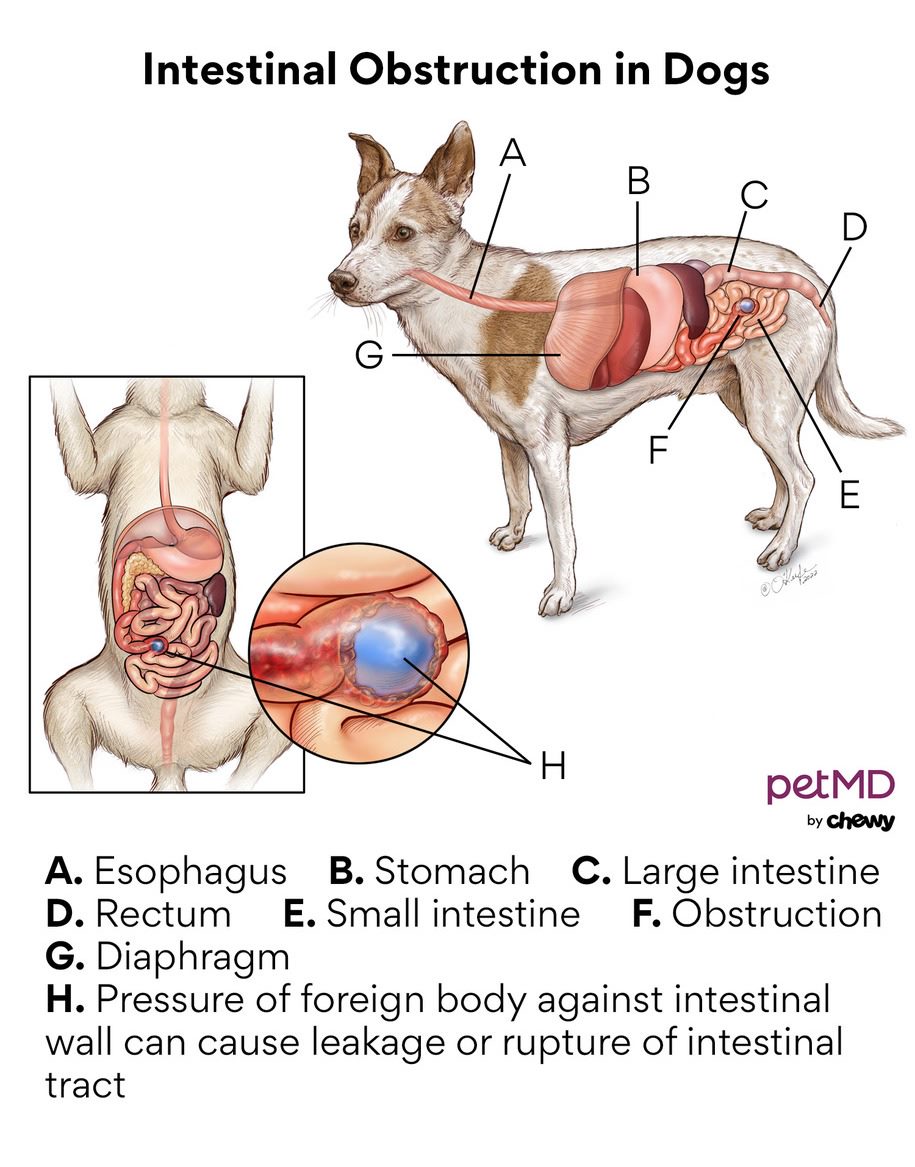
Click here to download this medical illustration.
Symptoms
The following symptoms may be associated with a dog experiencing a bowel obstruction:
-
Vomiting—Persistent vomiting can lead to severe dehydration and electrolyte imbalances.
-
Loss of appetite (anorexia)—Dogs may show no interest in eating. Young dogs with a foreign body obstruction (an object they shouldn’t have eaten) will initially still eat, or try to, but then vomit.
-
Abdominal pain—An obstruction can press on the intestines, which can be very painful and even cause intestinal rupture or inflammation of the abdomen (peritonitis).
-
Weakness/lethargy—This can be caused by dehydration and/or an electrolyte imbalance as well as by pain.
-
Diarrhea/difficulty defecating (pooping)/straining to defecate—A dog with a partial blockage may have diarrhea as liquid squeezes around the obstruction. If there is a complete blockage, the dog may try to defecate but won’t be able to.
If your dog is vomiting but not producing any stool—this is a strong indication of an intestinal blockage. Contact your veterinarian immediately.
Causes
A dog intestinal blockage is frequently caused by foreign bodies—items the dog eats that cause an obstruction. Common items include bones, balls, toys, rocks, clothing (such as underwear or socks), fruit pits, tampons, and linear objects (such as string, yarn, thread, ribbon).
However, dog digestive blockages can also be caused by intestinal tumors or masses (abnormal new growths of tissue), especially in senior dogs.
Other possible causes of gastrointestinal blockages in dogs may include:
-
Strictures (narrowing of intestines often due to scar tissue)
-
Adhesions (bands of scar tissue from previous surgery)
-
Intussusception (telescoping of the intestines where a portion of the intestine slides into an adjacent portion)
-
Torsion (twisting of the intestines)
-
Severe inflammation of the small intestines
Diagnosis
If you see or suspect that your dog has eaten a foreign object, seek immediate veterinary attention.
In some cases, the dog can immediately be made to vomit at a vet office, bringing up the foreign object before it can cause an intestinal blockage. This should be done no more than 30 minutes to two hours after the dog ate the object.
If your dog is showing symptoms of an intestinal blockage, it is likely too late to induce vomiting. In this case, your veterinarian will conduct the following tests:
-
Palpation (touching) the abdomen to check for pain or evidence of masses
-
Physical check for foreign bodies or intussusception (a segment of the intestines telescopes inside another segment)
Treatment
Depending on the size of the dog, location of the problem, how sick they are, and the size of the foreign body, sometimes dogs can pass an object and poop it out in their stool.
However, if it gets stuck and becomes an intestinal blockage, surgery will be needed to identify and remove the blockage.
Bowel Obstruction Surgery in Dogs
Before surgery, your veterinarian may want to admit your dog into hospital, where they can receive IV fluids (to rehydrate them) as well as medication for nausea and pain.
Medications such as Cerenia and famotidine may be recommended.
Once your dog has been stabilized, surgery is performed under anesthesia to identify the blockage.
If a foreign object is the cause of the obstruction, sometimes an incision (cut) can simply be made into the intestines, the object removed, and the intestines sutured (closed) back up (this procedure is called an enterotomy).
However, if the intestines are damaged or there is dead tissue, sections of the intestines may need to be removed along with the cause of the obstruction, such as foreign body or tumor (this is called a resection and anastomosis).
Recovery and Management
Early diagnosis and treatment of intestinal blockage in a dog is important for a good outcome and to prevent complications (such as damage to the intestines, intestine rupture, leakage, splitting, or peritonitis). If surgery is needed. it should be performed as soon as possible.
After surgery, most dogs will need to remain hospitalized for one to two days on IV fluids and pain medications. They can usually go home after they start eating again, and if they are not vomiting. The recovery time is typical for any abdominal surgery and includes 10–14 days of rest and restricted activity.
Your vet will likely recommend a recovery cone or surgical suit to prevent an incisional infection. Some dogs may also need to be placed a bland diet or veterinary diet like Hill’s i/d to help with recovery.
Most dogs make a complete recovery and go back to their normal lives, but this can vary based on the cause of the intestinal blockage.
If a foreign body was the cause of your dog’s blockage, it’s important to make sure they don’t eat any foreign objects in the future, as complications are more likely when there is scar tissue from previous surgeries.
If a tumor caused the blockage, the vet will send a sample to the lab to identify the type of tumor and the likely outcome.
Prevention
Pet parents should ensure they don’t allow their dog to chew on any objects they could potentially ingest that may lead to an intestinal blockage.
Always watch carefully when your dog is chewing on toys, treats, or bones.
If you know your dog is a chewer, refrain from giving him soft plush toys that are easy to chew up. Instead, consider using chew-resistant enrichment toys like the Kong Extreme Dog Toy. Always supervise your dog with toys, even if they're labelled as chew-proof or chew resistant.
If your dog tends to get into trash or other household items they could potentially ingest, keeping them in a dog crate or behind a dog gate in a pup-proofed room will help ensure they don't eat anything undesirable while they're unsupervised.
Intestinal obstructions in dogs are serious concerns. They require immediate veterinarian attention and surgical removal of the foreign object.
Most dogs recover well, but it’s important to prevent your dog from eating objects he may accidentally ingest that could lead to intestinal obstructions.
Dog Intestinal Blockage FAQs
Will a dog still poop if they have a blockage?
Many dogs do still poop when they have a blockage, but it is often diarrhea or very thin in shape.
How long can a dog survive with an intestinal obstruction?
The survival time for dogs with complete intestinal obstructions is only a few days. This is why it is important to seek immediate veterinary attention if you suspect your dog may have an intestinal blockage.
How much does dog intestinal blockage surgery cost?
Intestinal blockage surgery can be costly, ranging from $500 to several thousand dollars depending on the location of the veterinary practice and whether the surgery is done on an emergency basis.
How do you clear an intestinal obstruction in dogs?
Intestinal obstructions generally require surgery for resolution. Small objects may pass through on their own, but these do not generally cause complete intestinal obstructions.
Is walking good for bowel obstruction in dogs?
Dogs who walk can get their intestines moving and potentially clear the blockage depending on the size and type of object ingested.
However, pet parents should consult a veterinarian if they suspect an intestinal obstruction rather than relying on walks.


