Lung Cancer In Dogs


Summary
Lung cancer in dogs is a relatively rare type of cancer. When a dog has lung cancer, it means their lungs have been invaded by malignant tumors. Unlike benign (non-cancerous) tumors, malignant tumors can spread throughout the body, causing serious and potentially fatal health complications.
Lung cancer can affect your dog’s breathing by reducing lung function. When your dog takes a breath, oxygen flows from their mouth into their trachea and then into a series of small tubes called bronchi that travel into the lungs. In the lungs, the bronchi end in tiny sacs called alveoli. This is where gas exchange takes place, as red blood cells give up carbon dioxide, which is exhaled, in exchange for fresh oxygen.
Although lung cancer is a serious condition in dogs, fortunately it’s relatively rare. Only about 1% of cancers diagnosed in dogs are in the lungs. However, because of the high blood supply to the lungs, a lot of cancers from elsewhere in the body tend to spread there. This means that tumors found in the lungs more commonly spread from other parts of the body instead of originating within the lungs (a primary lung tumor).
While dogs could get lung cancer at any age, this mostly affects older dogs. The typical age for diagnosis is 9 to 11 years of age.
Types of Lung Cancer in Dogs
About 97% of primary lung tumors in dogs are carcinomas. Carcinomas are cancers that begin in the tissues that line internal organs or in the skin. The most common type of primary lung cancer is called bronchoalveolar carcinoma.
As in humans, veterinarians “grade” lung cancer in dogs to help make treatment decisions. The grade is based on how fast the tumor is growing, certain characteristics of the cells, and whether there is necrosis (death) of the cells. According to the Veterinary Society of Surgical Oncology, 46% of primary lung carcinomas are grade I (spreading more slowly), 43% are grade II (moderately spreading), and 10% are grade III (spreading more quickly). Low-grade tumors generally have a better prognosis than high-grade tumors.
Other types of cancer that rarely originate in the lungs include histiocytic sarcoma and lymphoma (cancer of the lymphatic system).
Symptoms
Dogs with lung cancer often won’t have symptoms until the tumor has advanced. These tumors may be found during chest X-rays performed for another health reason.
Symptoms of lung cancer in dogs include:
-
Coughing
-
Elevated respiratory rate
-
Coughing up blood
-
Exercise intolerance
-
Respiratory distress
-
Weight loss and muscle wasting
-
Lethargy
-
Decreased appetite
Lung cancers can also cause a secondary condition called hypertrophic osteopathy, which typically affects the long bones of the limbs. The connective tissue on the bones grows rapidly, causing the limbs to become swollen and firm. The pet may limp or be reluctant to move. The underlying cause of hypertrophic osteopathy is not well understood, but it typically resolves if the mass is treated.
Causes
The exact cause of lung cancer in dogs is unknown, though genetics is thought to play a role. Environmental pollutants, such as secondhand smoke, may also contribute to the development of lung cancer in dogs, though research is ongoing.
Breeds thought to have a higher likelihood of developing lung cancer include:
Diagnosis
Lung cancer can’t be diagnosed with a basic physical examination. Instead, your veterinarian will need additional tests, possibly including:
-
Chest X-rays: The first test a veterinarian will run is chest X-rays. For some pets, this will require light sedation. If the veterinarian sees a solitary, well-defined nodule in the lungs, this is more likely to be a primary lung tumor than a metastatic nodule that has spread from elsewhere.
-
Fine needle aspirate: To know what type of cancer your dog has, a veterinarian may perform a test called a fine needle aspirate (FNA) to collect a sample of cells. This test includes placing a needle through the chest wall and into the lesion to remove (aspirate) cells. Your pet will need to be sedated for this procedure.
-
Bronchoscopy and bronchoalveolar lavage: In some cases, the vet may perform a test called a bronchoalveolar lavage. During this test, sterile fluid is placed into the airway and then retrieved and studied. Malignant cells may be seen in the fluid, allowing for definitive diagnosis. This procedure is often done in conjunction with another test called a bronchoscopy, where a camera is inserted down into the larger airways. Your pet would need to be anesthetized for this procedure.
A computed tomography (CT) scan of the chest may be performed to assess the number and size of pulmonary masses. A CT may also be recommended for surgical planning.
Imaging of the abdomen and aspiration of peripheral lymph nodes may be advised to check for cancer spread. With primary lung tumors, the results will often be normal. If the nodules in the lungs are suspected to be metastatic from elsewhere, these tests may help determine where the cancer originated.
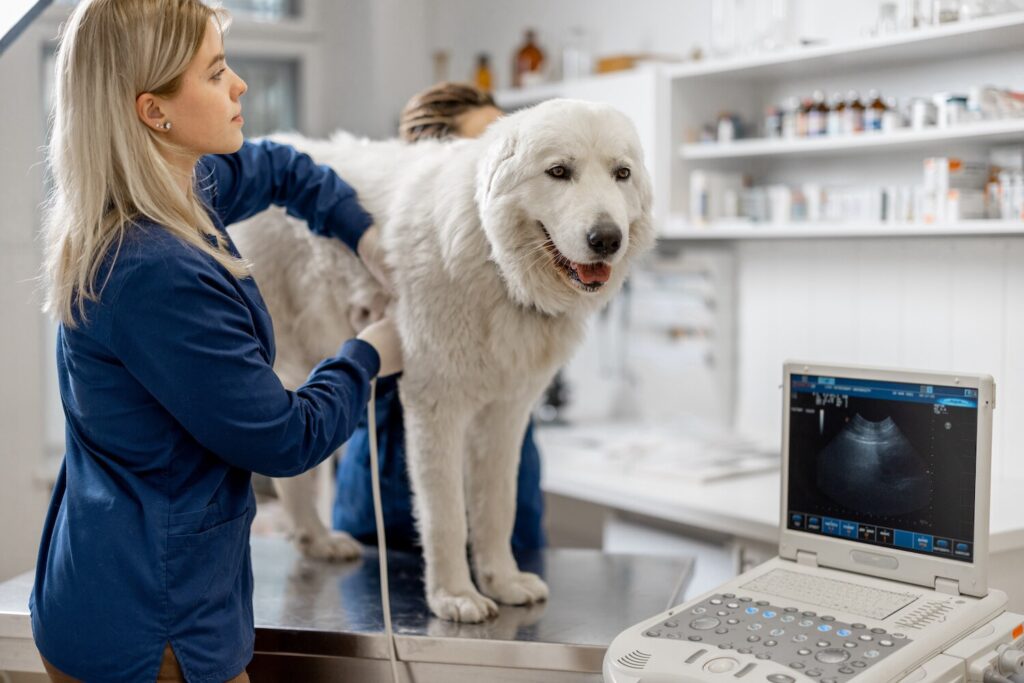
Your family veterinarian can likely perform chest X-rays, abdominal X-rays, aspiration of peripheral lymph nodes, and possibly ultrasound of the abdomen. Aspiration of tumors in the chest, bronchoscopy, bronchoalveolar lavage, and CT scans are often outside of the scope of private practice, so you may be referred to a specialist.
Stages of Lung Cancer in Dogs
When your dog is diagnosed with lung cancer, your veterinarian will stage the cancer. Staging describes how far the cancer has spread within the body. The stage will be used to create a treatment plan. Staging of lung cancer in dogs is based on the size of the primary tumor, if the tumor has spread to nearby lymph nodes, and if the cancer has spread beyond its original site (metastasized).
While lung cancer in humans is often staged using Roman numerals, this system is not routinely used in dogs. However, some veterinarians may use these stages to explain the spread of cancer to pet parents. These stages include:
-
Stage I: The tumor is small and has not spread to lymph nodes.
-
Stage II: The tumor has grown larger and may have spread to nearby lymph nodes.
-
Stage III: The cancer has spread to the lymph nodes between the lung lobes.
-
Stage IV: Cancer has spread from the lung to other parts of the body.
Treatment
The treatment plan depends on the type and severity of the cancer. For a single tumor, surgery is the treatment of choice. During surgery, the surgeon removes part of or the entire lung lobe, depending on the size and location of the mass. The veterinarian will likely biopsy lymph nodes in the chest to determine if the cancer has spread.
Some veterinary oncologists may recommend chemotherapy for high-grade tumors, large tumors, or tumors that show evidence of metastasis. In most cases of primary lung tumors in dogs, chemotherapy alone does not improve survival.
Dogs that have metastatic nodules from cancer elsewhere in the body have a poorer prognosis. This is because these nodules prove the cancer has advanced enough to spread to the lungs. A consultation with a veterinary oncologist is recommended.
Recovery and Management
In dogs that have no metastases and undergo surgery, the procedure may result in a cure. Some dogs can live for over two years post-surgery. Expected survival time ranges from three months to over a year, with dogs who have no clinical signs at time of diagnosis, low-grade tumors, and smaller tumors typically living longer than others.
Many pet parents elect not to have their pet go through open-chest surgery when there is evidence that the tumor is aggressive. Even with surgical treatment, the prognosis is three months in these cases.
If you choose to pursue treatment for your dog’s lung cancer, your veterinarian may recommend frequent chest X-rays for the first year after surgery to monitor for recurrence. If your pet is undergoing chemotherapy, frequent monitoring of their bloodwork is required to ensure they are tolerating chemotherapy.
Other steps you can take to keep your pet comfortable include:
-
Ensuring they have easy access to food and water
-
Providing a comfortable area to rest
-
Ensuring they avoid strenuous exercise
-
Not smoking indoors
-
Using a room air purifier
-
Ensuring you’re consistent with your pet’s medications
-
Speaking with your veterinarian if you’re concerned that your pet may be in pain
In dogs who are declining, your veterinarian will recommend a palliative care plan to keep your pet comfortable. Treatments could include anti-nausea medications, pain medications, cough suppressants, and anti-anxiety medications.
Lung Cancer in Dogs FAQs
What do the end stages of lung cancer look like in dogs?
In the end stages of lung cancer, your dog may have a decreased appetite, weight loss, muscle wasting, lethargy, coughing, wheezing, and labored breathing. In some cases, fluid develops in and around the lungs, which makes breathing very difficult. If you note labored breathing, seek prompt veterinary attention.
How aggressive is lung cancer in dogs?
Whether or not lung cancer is aggressive in dogs depends on the type of tumor and its grade. With surgical removal and no sign of metastases, your pet may be cured. If the tumor has metastasized to elsewhere in the chest or body, these are signs of a more aggressive cancer.
Featured Image: Adobe Stock/rh2010





