Salivary Gland Adenocarcinoma in Dogs


Summary
Dogs have four pairs of salivary glands located within the jaw or neck region. These glands create saliva that is excreted into your dog’s mouth. Similar to other types of glands, cancer can form in the salivary glands. The most common type of salivary gland cancer in dogs is adenocarcinoma. This is an aggressive and malignant type of cancer that needs to be diagnosed and treated by a veterinarian.
Dogs have four pairs of salivary glands that are located below the eye (zygomatic), behind the jawbone where the neck meets the jaw (mandibular), under the tongue (sublingual), and around the base of the ear (parotid). The gland most affected by adenocarcinoma is the parotid gland.
There are also multiple accessory salivary glands located throughout the mouth in the lips, cheeks, and palate. Salivary gland adenocarcinoma occurs when cells that line the salivary glands grow out of control and create a tumor.
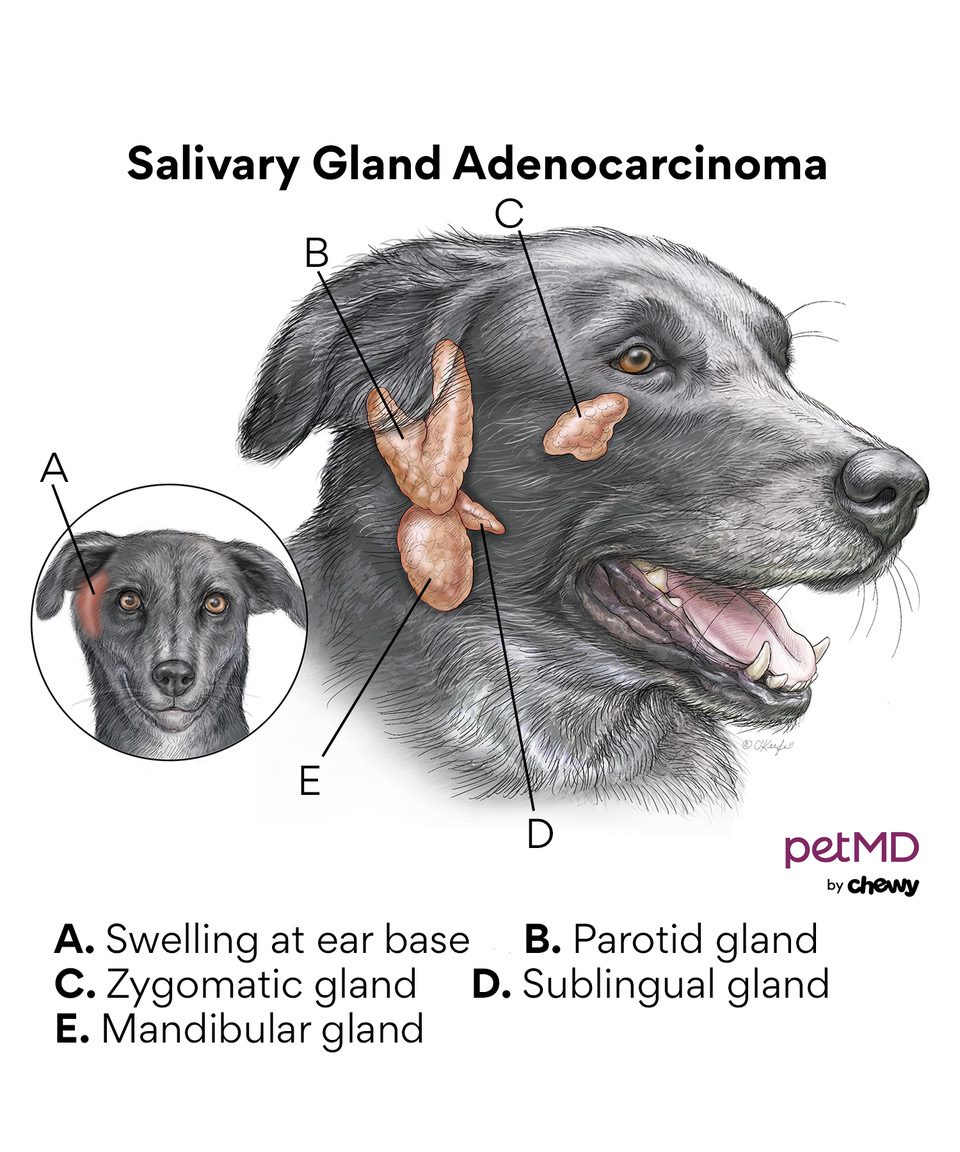
Click here to download this medical illustration.
Symptoms
Dogs with adenocarcinoma can develop symptoms, depending on the size and location of a tumor. Symptoms may include:
-
Bad breath
-
Drooling
-
Difficulty swallowing
-
Changes in your dog’s voice (barking)
-
Firm, painless swelling near a salivary gland
-
One eye bulging out
-
Swelling of the lips, cheeks, near the ear/upper neck, or under the tongue
Causes
We don’t know what causes salivary gland adenocarcinoma. Although many cancers can result from environmental and/or genetic factors, there are no known genetic or environmental causes of salivary gland adenocarcinomas.
Diagnosis
If your vet suspects a salivary gland adenocarcinoma, they will perform an examination. This may include reviewing the dog’s health record and discussing any symptoms you’ve noticed, including difficulty swallowing or eating, bad breath, or other symptoms.
Fine Needle Biopsy
You veterinarian may perform a fine needle biopsy to collect cells from the tumor to examine under a microscope. During this procedure, your vet will use a very fine needle to collect a small sample of cells from the tumor. These cells will be examined under a microscope to determine if they are cancerous versus caused by an infection or inflammation.
X-Ray
If abnormal cells are present, your vet may recommend x-rays of the skull and neck to look for changes in the bone near the affected salivary gland.
Surgical Biopsy
During a surgical biopsy, your veterinarian will remove either all or part of the tumor in a surgical procedure. This removed tissue will be sent to a medical specialist called a pathologist to examine the tissue and make a diagnosis.
Treatment
The primary treatment of salivary gland adenocarcinoma is surgery to remove the tumor. However, before surgery your vet may also perform tests to determine if the cancer has spread to other parts of the dog’s body.
The process of cancer spreading is called metastasizing. Cancers are “staged” depending on how far they have spread. The most common site for adenocarcinomas to spread to are nearby lymph nodes, but they may also spread to your dog’s lungs. Cancers that have metastasized may be treated differently than cancers that are confined to the original gland.
Once your vet has determined the cancer’s stage, they may recommend further testing to help develop a treatment plan. Additional tests can include:
-
Complete blood chemistry
-
X-rays of the lungs, and/or an ultrasound of the abdomen
Because salivary gland adenocarcinoma is often aggressive, your vet may also suggest a CT scan or MRI to examine the area around the gland.
Radiation Therapy
Adenocarcinoma is often very aggressive and can spread to nearby parts of the face, including large blood vessels and nerves, or the lungs. In these instances, your vet may not be able to completely remove the tumor and may recommend radiation therapy. Radiation therapy is also used to treat tumors that cannot be removed with surgery because of their location.
Chemotherapy
If tests indicate the cancer has spread to other areas of the body, your veterinarian may prescribe chemotherapy.
Recovery and Management
Recovery from surgery requires your dog to rest comfortably at home. Your veterinarian may also prescribe medicine to ease pain and reduce inflammation, along with antibiotics to prevent infection. Your dog will also require follow-up visits to your veterinarian and possibly radiation therapy, depending on your vet’s diagnosis.
Salivary Gland Adenocarcinoma in Dogs FAQs
What is the survival rate for salivary gland adenocarcinoma in dogs?
The combination of surgery and radiation therapy typically increases a dog’s life-span. However, if a tumor is not completely removed or radiation therapy is not successful, the tumor will regrow at the original location. Without any treatment, the average survival time in dogs diagnosed with adenocarcinoma is approximately 1.5 years.
How aggressive is salivary gland adenocarcinoma in dogs?
Salivary gland adenocarcinomas can be very aggressive and often spread to surrounding parts of the body. Due to the location of the salivary glands, some major nerves and blood vessels can be affected by a tumor, which makes complete surgical removal difficult.
What do salivary gland adenocarcinomas look like?
Due to the location of the salivary glands, adenocarcinomas are usually not directly visible. However, some owners might see firm, non-painful swelling at one ear base, in the upper neck near the jaw line, or bulging of one eye.
Featured Image: iStock.com/Akchamczuk


