Gum Disease in Cats

Summary
Gum disease, or periodontal disease, is a dental condition in cats. It causes inflammation of some or all the affected tooth’s supporting structures. Gum disease is one of the most common illnesses in cats.
If food particles and bacteria are allowed to accumulate along a cat's gumline, it can form plaque, which—when combined with saliva and minerals—will transform into calculus (tartar). This causes gum irritation, or a reddening of the gums around a cat’s teeth. This inflammatory condition is called gingivitis. This is an early stage of periodontal disease in cats.
After an extended period, tartar builds up under a cat’s gums and separates it from the teeth. Spaces will form under the teeth, fostering bacterial growth.
Once this happens, a cat has irreversible periodontal disease. This usually leads to bone loss, tissue destruction, and infection in the cavities between the gum and teeth.
Types of Gum Disease in Cats
Periodontal disease in cats is classified in four stages based upon how the mouth looks during oral examination and in dental X-rays.
All stages of dental disease in cats can cause the gums to bleed. Your cat’s medical treatment will be chosen based on this staging by your vet.
-
Gingivitis—This stage occurs when there is inflammation of the gingiva, or soft tissues of a cat’s mouth, without attachment loss. Gingivitis does not affect the firm structures (bone).
-
Early periodontitis—Up to 25% attachment loss of the ligament that holds the tooth in a cat’s gums
-
Moderate periodontitis—25% to 50% attachment loss
-
Advanced periodontitis—More than 50% attachment loss
-
Tooth resorption—Destruction of crown and tooth roots, holes in teeth, and intense pain
Symptoms
Symptoms of gingivitis in cats include:
-
Red, swollen gums
-
Bad breath (halitosis)
-
Plaque on the teeth
-
Varying degrees of tarter buildup
-
Painful mouth, which may present as a cat pawing or rubbing their mouth/face
-
Dropping food
-
Bleeding gums
-
Only eating soft food
-
Turning head excessively while eating
Symptoms of periodontitis in cats include all the above, plus:
-
Loose teeth
-
Tooth loss
-
Decreased appetite or anorexia
-
Exposed tooth roots
-
Teeth chattering
-
Tooth resorption
Causes
Cat periodontal disease can be caused by several factors, though it’s most caused by a bacterial infection. Bacteria under the gumline leads to pain and inflammation of the tissue.
This bacteria accumulation below a cat’s gumline is often partly due to lack of oral care, such as routine teeth brushing. Lack of routine dental cleanings with your vet can also cause gum disease in cats.
There may also be a relationship between having a history of calicivirus infection and severe gingivitis.
Other conditions that may contribute to gum disease in cats include:
-
Feline leukemia virus (FeLV)
-
Severe kidney disease
-
Autoimmune disease
Diagnosis
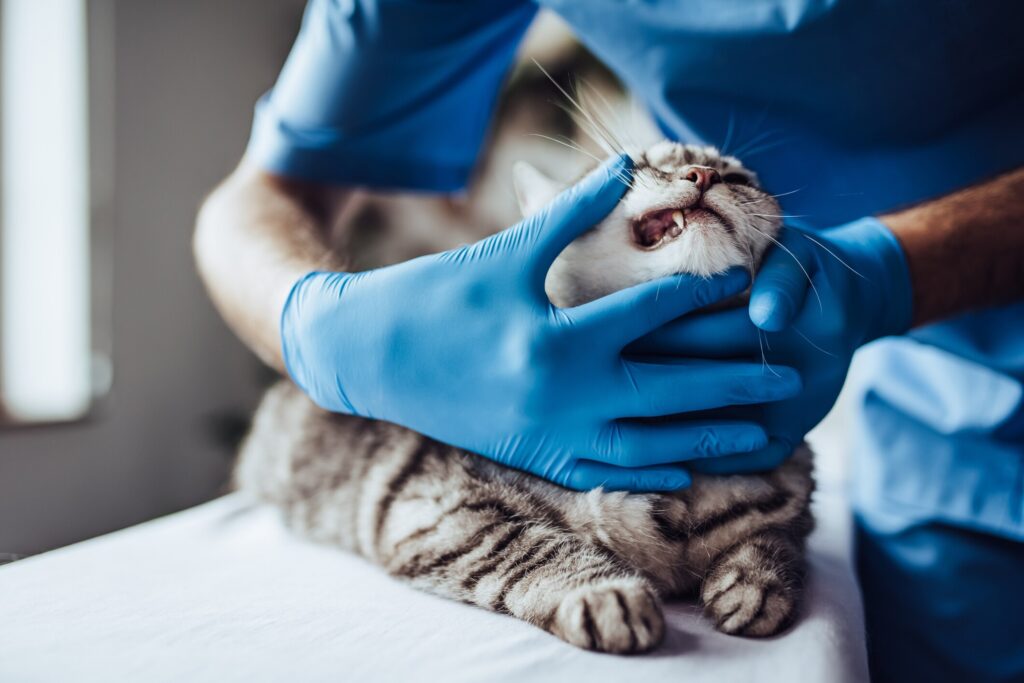
Your veterinarian will look inside your cat’s mouth for red, inflamed gums. Your vet may press gently on your cat’s gums to see if they bleed easily, which is a sign that a deep dental cleaning—or more—is needed.
If your vet notices any of these signs of gingivitis or gum disease, they will likely recommend that your cat have a dental procedure. Your veterinarian will run some blood work. They will also check your cat’s heart and lungs to ensure it’s safe to put them under anesthesia for the procedure.
Once under anesthesia, the diagnosis of cat periodontal disease involves several procedures. If periodontal probing reveals more than one millimeter of distance between the gingivitis-affected gum and tooth, a cat is considered to have some form of periodontal abnormality.
X-rays are important in diagnosing periodontal disease in cats, as up to 60% of symptoms are hidden beneath the gumline. In the disease's early stages, X-rays will reveal loss of density of the tooth which is presented as a dark area instead of bright white. In more advanced stages, it will reveal loss of bone support around the root of the affected tooth.
Treatment
The specific treatment for periodontal disease in cats depends on how advanced a cat’s condition is.
In early stages of gum disease in cats, treatment is focused on controlling plaque and preventing the loss of a cat's tooth. This is achieved through daily brushing with pet-safe toothpaste and vet-prescribed products to minimize the development of plaque.
Your vet may recommend that the affected tooth is removed. To remove the tooth, your cat will have to go under anesthesia. Blood work and chest X-rays are done before anesthesia to ensure your cat’s safety. Before the procedure, your cat will have to be fasted at least 12 hours to ensure an empty stomach for the procedure to reduce changes of complications such as vomiting and aspiration pneumonia.
Once the affected teeth are removed—in conjunction with oral medications like antibiotics—the gum disease should be resolved.
Recovery and Management
Follow-up treatment for periodontal disease in cats consists mostly of maintaining good cat dental care and taking your cat for weekly, quarterly, or biannual checks. Depending on how fast tarter builds up in your cat’s mouth, dental procedures are recommended every six to 12 months.
Ask your vet if they can perform dental cleanings in-clinic. If they can’t, ask where they recommend. Avoid non-aesthetic dental cleanings, as they are not recommended. Ensure that the vet performing the cleaning has the capability to perform dental X-rays.
Dental cleaning procedures for cats often range from $300 to $2,500, depending on the severity of a cat’s gum disease.
Recovery from a dental procedure often requires your cat to wear a recovery collar to prevent them from being able to paw or scratch at the mouth.
Some cats also need to eat canned food or even a special dental diet after the procedure to aide in their recovery. Often antibiotics and/or pain medication are part of the recovery plan.
Your cat’s prognosis will depend on how advanced their gum disease is.
The best way to minimize the adverse effects caused by the disease is to get an early diagnosis, adequate treatment, and proper therapy.
Prevention
The best prevention for gum disease in cats is to maintain your pet’s good oral hygiene. Regularly brush and clean their mouth and gums, at least three times per week, every other day.
If trained slowly over time, cats will allow their teeth to be brushed. Training a cat to enjoy their teeth being brushed starts early in kittenhood and should become routine. You can offer your cat a dental treat before and after teeth brushing to ensure that they enjoy the process.
Prescription cat food dental diets are available for those cats who are unwilling to have their teeth brushed.
Cat dental treats, water additives and other products certified by the Veterinary Oral Health Council (VOHC) are also shown to help reduce plaque and calculus.
Gum disease in cats can be entirely preventable with routine care both at home and with your veterinarian. This can be a very painful condition and can cause further illness if not treated.
If you have questions or concerns about your cats teeth, schedule an appointment with your veterinarian or consider chatting with a veterinary professional at Chewy’s Connect with a Vet.
Gum Disease in Cats FAQs
How long can a cat live with gum disease?
Cats can live a long, healthy life with gum disease if they are monitored frequently by their veterinarian. Ensuring that routine dental cleanings are done as well as preventative care, gum disease is manageable or even curable depending on the underlying cause.
Is dental disease in cats fatal?
Dental disease itself is not fatal—but the consequences of this condition can be.
Dental disease can cause pain which may prompt your cat to stop eating. Cats that don’t get adequate nutrition will start to develop liver failure within about 72 hours of not eating. This occurs from the body using the fat around the liver for energy. Liver failure can be fatal if not treated promptly and aggressively.
Depending on how much liver damage is present, it might not be reversible.
Featured Image: Vasyl Dolmatov/iStock / Getty Images Plus via Getty Images


