Whipworms in Cats


What Are Whipworms in Cats?
Feline whipworms are intestinal parasites that infect the area where the small and large intestine intersect, called the cecum. Untreated, this parasite can damage the tissue, leading to diarrhea and blood loss.
This parasite is transmitted to a cat through food or water contaminated by fecal matter that contains whipworms or their eggs.
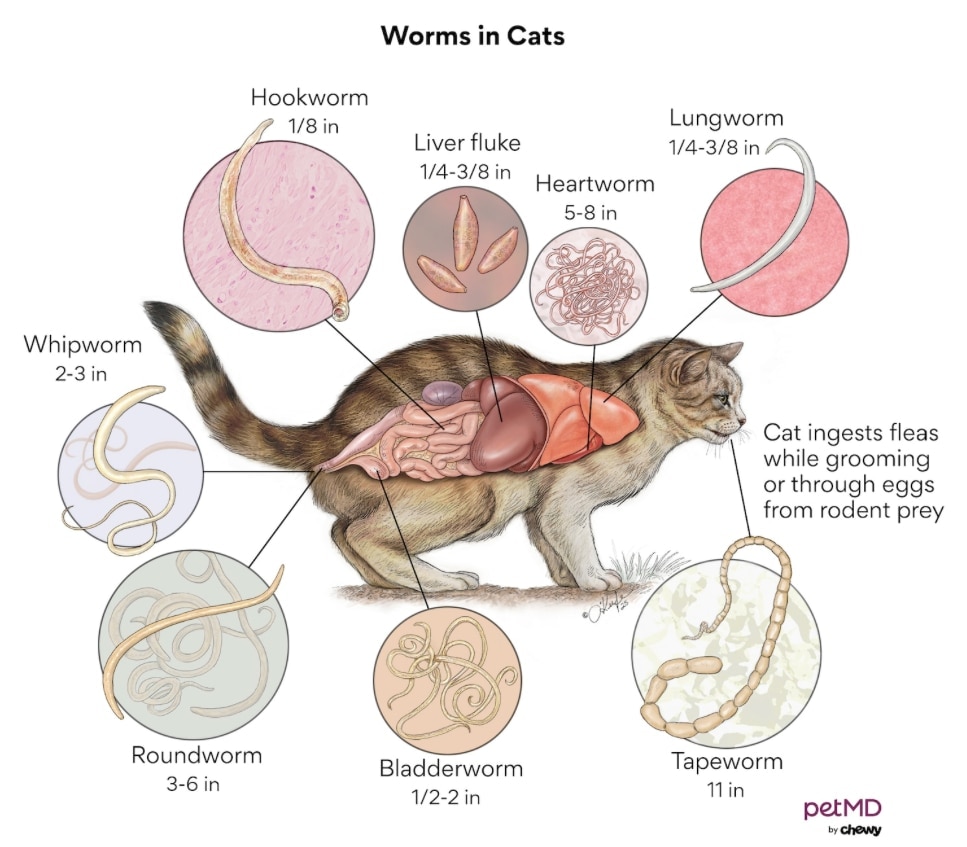
Click here to download this medical illustration.
Infections are comparatively rare in cats and more common in dogs. Cats can become infected from other cats, but they do not pose a risk to human family members.
Symptoms of Whipworm Infection in Cats
Fortunately, most infections are mild in cats, and in many cases a cat will not show any symptoms. A few worms generally don’t cause significant problems. Health concerns arise when a cat is heavily infected. In these rare cases, cats can experience extreme illness or possibly die from the infection.
Symptoms of severe infection include:
- Bloody diarrhea, with or without mucus
- Weight loss
- Dehydration
- General malaise
- Anemia (low red blood cell count)
Whipworms live in the cecum and large intestine, so they are rarely seen by the naked eye. Eggs are microscopic.
Causes of Whipworms in Cats
Whipworms infest fecal matter, which can contaminate food, water, or other surfaces (such as a toy or another cat). A cat often becomes infected in this way. Whipworm eggs can survive in the environment for years and are often ingested through self-grooming behaviors and mutual sharing of a litterbox or outside yard.
Once deposited on the ground, the eggs mature and become infectious after about three weeks. When swallowed, they hatch and mature into adult worms, mate, and reproduce. Eggs are then shed by the female about 12 weeks later and the lifecycle continues.
How Veterinarians Diagnose Whipworm Infection in Cats
Given the lifecycle and that eggs are shed in small numbers at irregular intervals, sometimes it can take multiple examinations and samples before arriving at a diagnosis. Treatment for parasitical infection may be recommended, even if your cat’s tests do not indicate whipworm as the culprit. Tests used to diagnose whipworm include:
- Fecal flotation with centrifugation: This is the most common test performed for parasitical infections. Feces are mixed with a solution, spun, and then analyzed under a microscope looking for the presence of eggs.
- Fecal antigen test (ELISA): In this test, feces are sampled for evidence of whipworm antigen (substances produced by the worm that elicits an immune response), which may often help detect infections in their early stages.
- PCR: A test that uses genetic material to identify a specific organism if whipworms are presumed but not confirmed. This test requires sending fecal samples to an outside laboratory to detect whipworm DNA.
Treatment of Whipworms in Cats
Treatment is fairly cost-effective and simple. Oral dewormer medications such as Panacur® (fenbendazole) are often prescribed for a few days or longer if necessary.
Recovery and Management of Whipworms in Cats
It’s important to have your cat’s stool reexamined after several weeks of treatment to ensure the infection has completely cleared. Another treatment is often recommended after a few months. If your cat goes outside, clean her paws off to minimize the chances of ingesting whipworm eggs.
There are no current monthly whipworm preventatives, so parasite control must begin at home with good hygiene and sanitation practices.
-
Remove feces daily and regularly clean the litterbox with a disinfectant.
-
Keep your cat from roaming outside or contacting other animals that may be at risk of infection.
-
Regular pest control and home hygiene (such as removing shoes upon entering the home).
Prevention of Whipworms in Cats
Preventing whipworm infection requires removing feces daily and cleaning the litterbox frequently with diluted bleach. If your cat enjoys the yard, remove fecal matter. If the yard area is in direct sunlight, that helps in prevention as well.
Whipworms in Cats FAQs
Are whipworms in cats contagious to humans?
A cat with whipworms does not pose a risk to their human family. Whipworms are host-specific, meaning they are only contagious to other cats.
How do indoor cats get whipworms?
Whipworms are present in fecal matter, which a cat can ingest accidentally. Most cats become infected through self-grooming. Additionally, there’s a good chance that eggs are brought inside on a family member’s clothing and shoes. And don’t forget that cats are good hunters and will just about hunt anything inside the home, including rodents, insects, and other pests, which could harbor parasites and cause infection when ingested.
What does a whipworm look like?
Whipworms are named for their characteristic whip or lasso appearance. About five centimeters maximum in length, their posterior is thicker and bigger than their anterior. Eggs are microscopic and football-shaped, thick-shelled with plugs at either end. Their coloring is from yellow to brown.
Featured Image: iStock.com/krblokhin
References
Geng, Jinming, et al. Diagnosis of feline whipworm infection using a coproantigen ELISA and the prevalence in feral cats in southern Florida. Veterinary Parasitology: Regional Studies and Reports. 2018; 14:181-186.
Trichuris felis. American Association of Veterinary Parasitologists. June 2014.


