New Kitten Checklist: Essential Supplies, Home Prep, and Vet Visits


Adobe_stock/Elvira
Bringing home a new kitten is exciting, and preparation is important. A new kitten checklist can help ensure you have all the kitten supplies your new pet needs and a plan to keep them happy and healthy. From kitten essentials like food and litter boxes to scheduling first vet visits and kitten-proofing your home, preparing ahead of time can help set your kitten up for success.
Key Takeaways
- Kitten essentials include high-quality kitten food, food and water bowls, a litter box, litter, toys, scratching surfaces, and a carrier.
- Make your home safe and fun for your kitten by removing hazards and providing a dedicated place to sleep, relax, and play.
- Schedule a visit with a veterinarian to start wellness care, including checkups, vaccines, and parasite prevention.
The Ultimate New Kitten Checklist
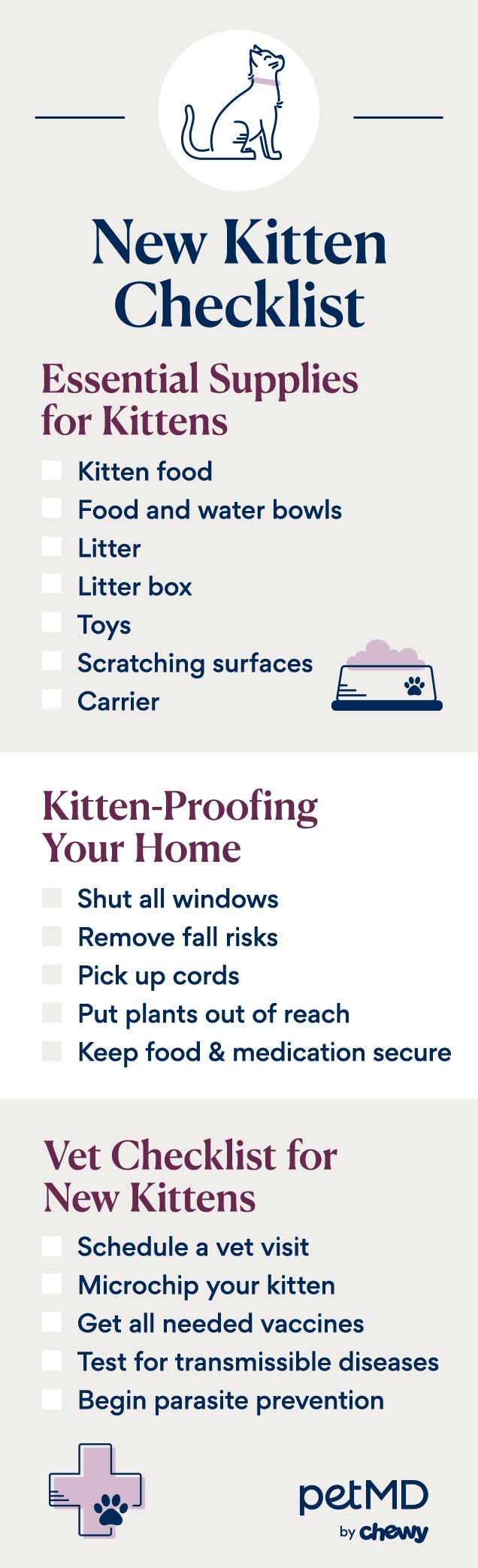
Use our new kitten checklist to make planning and shopping for your recent addition a breeze.
Essential Kitten Supplies
So, what does a kitten need? Essential kitten supplies include kitten food, food and water bowls, a litter box, litter, a carrier, scratching posts, toys, and parasite prevention.
1. Kitten Food
One of the most important items on any kitten checklist is high-quality kitten food.
If your new addition is less than 6 months old, make sure to buy a vet-recommended commercial diet made specifically for growing kittens, such as Purina ONE +Plus Healthy Kitten Formula. These youngsters have higher caloric requirements than older cats and need a different balance of nutrients to support healthy growth and development.
Feeding your new kitten a mix of wet food and dry food can help prevent them from developing picky eating habits as they grow older. This can be particularly important if your kitty ever requires prescription food as an adult.
Feed your kitten four to five small meals daily, rather than free-feeding.
Make sure to measure how much food you are feeding your kitten to track intake and prevent overfeeding. This way, you and your vet can make necessary adjustments to prevent your kitten from becoming overweight after they are spayed or neutered.
2. Cat Food and Water Bowls
The best food and water bowls for a new kitten are easy to clean, durable, and don’t tip over easily. Luckily, choices for kitten accessories are many.
Stainless steel bowls with a wide base, such as the Iconic Pet Stainless Steel Non-Skid Dog & Cat Bowl, will reduce the mess a playful or mischievous kitten can make.
Many cats prefer to drink running water, so investing in a pet water fountain is a great idea. Still, you should also provide your new kitten with a bowl of standing water in case that’s their preference.
3. Cat Litter Box
Without a doubt, kitten necessities include a good litter box. Many cats and kittens prefer open-topped litter boxes.
You might want to buy a smaller litter box at first if your kitten is very tiny, so they can get in and out with ease. But if you do buy a smaller box, replace it as your cat grows—they should always have plenty of room to move around inside the litter box.
The Frisco Senior and Kitten Cat Litter Box offers the best of both worlds: It’s easy for a kitten to climb into but also big enough for an adult cat.
If you are introducing a kitten to a multi-cat household, the kitten needs their own litter box. In general, it’s best to have one litter box for each cat, plus one additional box, set up in different locations. Low-traffic areas that offer privacy work best.
Kittens will snub a dirty box, so clean it daily to keep it inviting. Wash the litter box with soap and water once a month.
4. Cat Litter
Choosing the best cat litter for your kitten can be overwhelming. There are clumping and non-clumping litters, unscented and scented, litter that contains attractants to encourage use, and even litters that help monitor for urine irregularities.
Very young kittens who are just learning to use the litter box should use a non-clumping, unscented litter.
Once kittens are a little older, about 8–10 weeks old, you can switch to an unscented clumping litter, which forms clumps when exposed to moisture, making cleanup easy and helping to control odor.
For kittens who need a little extra encouragement to use the litter box, you can try a litter that contains a natural herbal attractant, like Dr. Elsey’s Kitten Attract Clumping Clay Cat Litter, which can be used with kittens 8 weeks of age and older.
While your kitten is small, fill the box with about 1 inch of litter. Then, as they grow larger, have around 1–3 inches of litter in the box.
Remember to scoop waste daily. Completely change out clumping litter once a month. Non-clumping litter should be changed out more frequently, generally once or twice a week.
5. Cat Toys
Nothing is cuter than a kitten playing with toys, and toys are also important for introducing your kitten to appropriate play so they don’t decide hands and feet are fun to bite. Playful biting might be cute when kittens are small, but not so much in a full-grown cat.
There are a lot of great cat toys on the market designed to engage cats mentally and physically.
Catnip toys, mouse toys, and teaser wands are all popular choices. But teaser wands should be used only in active play with you, as kittens left to their own devices with a wand might chew on the strings and potentially ingest them, resulting in a medical emergency.
Make sure the toys you buy are durable and cannot be ripped up or eaten. Do not let your kitten or cat play with yarn, thread, rubber bands, corks, hair ties, or wire twist ties. These are all easily ingested and can become a hazard.
6. Scratching Surfaces
Scratching surfaces, such as cat scratching posts and pads, and cat trees are essential for reducing stress in cats and kittens.
Different cats will have different preferences for scratching material and orientation. Offer your kitten multiple kinds of scratchers to see which kind they like best. You might find that several suit their scratching needs.
Cardboard scratchers are inexpensive and can be placed horizontally or vertically in multiple locations. Standing sisal scratchers are also very popular; just be sure to get one that’s tall enough for your kitten to fully stretch from the base all the way to the top.
Cat trees provide both scratching surfaces and vertical spaces for your cat to climb and sit. Having high places to rest makes cats and kittens feel safer. Just be sure to start with a shorter cat tree to prevent falls while your kitten is young and learning to climb safely.
7. Cat Carrier
An appropriately sized pet carrier is extremely important for your cat’s long-term health and safety, even if you don’t plan on traveling with them frequently. It is safer for your cat to be restrained in a correctly sized, enclosed carrier in your car to prevent them from being injured if you have to brake suddenly or if you are in a car accident.
Veterinarians most often recommend hard-sided plastic carriers, as they are easy to clean. It’s also helpful to choose a carrier that can be opened from both the side and the top, as this can reduce stress when accessing your kitten.
8. Flea and Tick Prevention
Parasite prevention is important to protect your kitten against fleas and ticks that can cause discomfort and infectious diseases. Most kittens can start flea and tick products at 8 weeks old and at a minimum weight of around 2 pounds.
Starting your kitten on an all-in-one preventive, such as Revolution Plus, can also protect them against heartworm disease and certain intestinal worms.
Always talk with your vet before starting your kitten on flea and tick prevention.
Kitten-Proofing Your Home
A kitten’s natural curiosity will definitely get them into trouble in an unprepared home. Before bringing a new kitten home, create a safe, confined, and kitten-proofed area where they can stay unsupervised. Gradually, over the first few weeks, allow them access to other parts of the home, making sure those areas have been kitten-proofed as well.
Because kittens have no trouble reaching high places and squeezing into small crevices, kitten-proofing your home can be a bit more complicated than child-proofing or puppy-proofing.
1. Shut All Windows
Leaving windows even the slightest bit cracked provides easy escape routes for your new kitten. Even if your windows have screens, you still should keep them closed if your kitten is unattended. Kittens can shred window screens with their sharp claws.
While you’re at the window, make sure any cords from drapes and blinds are tied up and inaccessible. Kittens can get tangled and injured while trying to play with them.
2. Remove Fall Risks
Kittens love to get up high, and shelves are extremely tempting jungle gyms. Evaluate your house for items and furniture that could tip and injure your kitten if they tried climbing them.
Offer your kitten a cat tree or other safe places to perch, like window hammocks or cat shelves. You won’t be able to keep a cat on the floor!
3. Pick Up Cords
Electrical cords make tempting toys for kittens, and chewing on them can lead to electrocution (and damage to your electronics as well!).
Zip-tie and tape loose cords tightly to reduce temptation to your kitten and keep cords out of reach. Hiding cords in protective cord covers is another option.
Keep corded headphones hidden as well—they are a popular chew toy for cats.
4. Make Houseplants and Bouquets Hard To Reach
Though they’re obligate carnivores (meaning they require a diet primarily composed of meat), most cats and kittens can’t resist chewing on houseplants. For the safety of both your kitten and your plants, keep plants in rooms that are inaccessible to your new kitty.
Review the plants you have in case any of them are toxic to cats. Some, such as lilies, are particularly dangerous to cats—even small amounts of the pollen, leaves, and flowers can cause severe kidney damage. Veterinarians recommend simply not having lilies in your house or garden if you have kitties.
5. Keep Food and Medications Locked Away
Keep food in cat-proof storage containers or cabinets. Plastic bags are not a good idea—they are easy for kittens to chew through, and they can also be dangerous to kittens.
Kittens might also eat medications dropped on the floor or left on the counter, which can make them very sick. Make sure to keep these securely put away.
New Kitten Vet Checklist
Even if your kitten is already spayed or neutered with all vaccines up to date, taking them to the vet to establish a relationship is very important.
1. Schedule a Vet Visit
Try to get an appointment for your kitten as soon as you can. You don’t even need to have your kitten’s name picked out to get something scheduled.
If your kitten came from a rescue, shelter, or breeder with any records of treatments, forward these to your vet to make your first visit as streamlined as possible. This way, you and your vet can focus on what your kitten needs next.
2. Microchip Your Kitten
Even indoor cats should be microchipped in case they ever accidentally escape.
And even if your cat wears a collar, they should still be microchipped. Cats typically wear breakaway collars that, as the name implies, can break open easily if caught on a branch or fence, so a microchip might be the only way for your cat to be identified if they get lost.
Ask your vet about the right time to microchip. If your kitten is already microchipped, make sure you have the number recorded somewhere and know how to update your contact information.
3. Get All Needed Vaccines
Vaccines keep kittens protected against serious diseases. Kittens under 16 weeks of age need vaccines, even if some vaccines were administered when the kitten was with the breeder or shelter.
-
FVRCP (feline distemper) should be given every three to four weeks until your kitten is at least 16 weeks old.
-
In most areas, kittens can receive the rabies vaccine at 12 weeks old.
-
The feline leukemia (FeLV) vaccine protects your kitten against the feline leukemia virus. The vaccine series starts at 8 weeks of age and is given in two doses spaced three to four weeks apart.
4. Test for Transmissible Diseases
This is important for all kittens, but especially for kittens entering a multi-cat household. Ask your veterinarian to do blood tests for feline leukemia, FIV (feline immunodeficiency virus), and heartworms.
Bring a stool sample to your appointment to test your kitten for intestinal parasites, as they are extremely common.
5. Begin Parasite Prevention
Even indoor kittens are at risk for fleas, which can hitchhike into your home on rodents, other pets, and even you. And this is especially true for kittens who will be spending time outside, such as on a harness or inside a catio.
Because fleas can be difficult to eliminate once they become established, it's best to start prevention early. There are safe and effective topical, oral, and collar options available for your cat.
Ask your vet about all-in-one prevention that protects your kitten from not only external parasites like fleas and ticks, but also internal parasites like heartworms and intestinal worms.
For example, Revolution Plus is a topical solution for cats and kittens at least 8 weeks old and who weigh at least 2.8 pounds. It protects against fleas, ticks, ear mites, heartworm disease, hookworms, roundworms, and tapeworms.*
Always talk with your vet to find the right option for your kitten.
*Prevents flea tapeworm (Dipylidium caninum) by killing fleas.


